

Machining Services
Request A Quote
NOVA Fabrication carries out all kinds of machine spare parts and contract manufacturing.


Machining Services in Turkey
NOVA Fabrication makes all kinds of machine spare parts and contract manufacturing in Turkey. In line with the demands of its customers, it produces all kinds of machine spare parts in accordance with European standards, adhering to the measurement precision, surface quality and customer production confidentiality.
NOVA Fabrication carries out all kinds of machine spare parts and contract manufacturing. In line with the demands of its customers, it produces all kinds of machine spare parts in accordance with European standards, adhering to the measurement precision, surface quality and customer production confidentiality. With the latest technology CNC Machining Centres, CNC Lathe and CNC Grinding machines we use, we can produce in the desired precision and size range. For all your custom (bespoke) machining projects, it is enough to fill out the quote form. We can provide milling, boring, tapping, drilling, planning, gear hobbing, broaching, stamping, shaping, reaming, turning, deep hole drilling, screwing, heading applications. Machining in Turkey Nova Fabrication; By using advanced equipment, we can save on processing cost and improve product quality. We are committed to providing the best CNC machined products and relative CNC
Nova Fabrication is a Turkish machine shop and foreign trade company in CNC turning and milling of metal and plastic components.
Processes
TURNING
Turning is a circular metal removal process from the rotating workpiece with cutting inserts with certain geometrical cutting edges. In general, a rotational motion is applied to the workpiece. The cutting operations are performed on classical lathe benches or CNC lathes in mass production. Turning processes are applied to cylindrical or cylindrical diameter parts. In our facility, internal and external turning, facing, vertical turning, profile turning, grooving, threading, taper turning, cutting process, curved and angle chamfering process, drilling etc. transactions are made.
Lathes are among the basic lathes used in manufacturing processes. Metal removal potential has increased especially with the use of coated tool inserts in CNC lathe machines. Especially in a short time, parts with precise dimensions and fine surface roughness are successfully processed.
MILLING
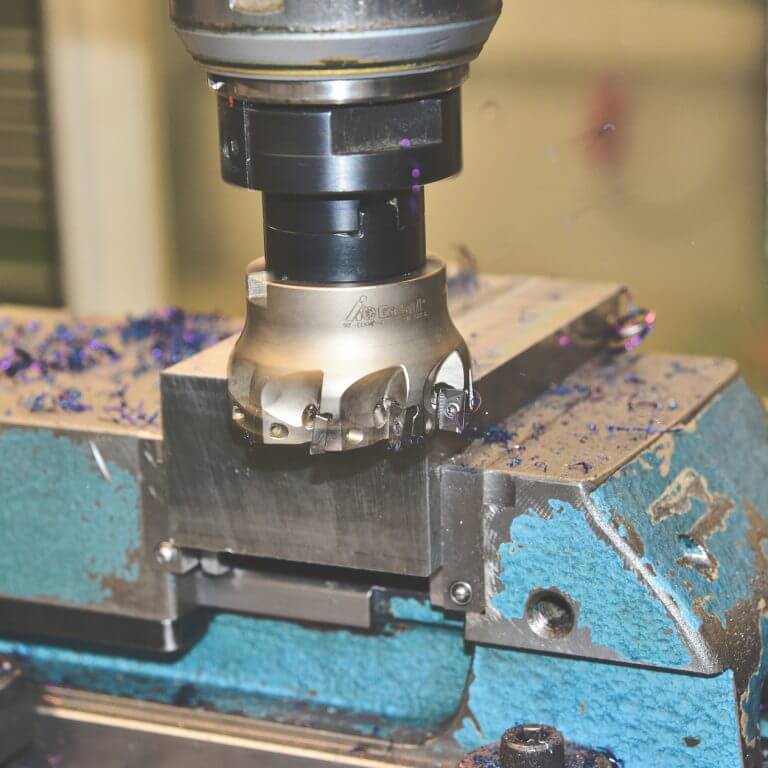
Milling is the process of machining flat or curved surfaces, grooves, helical grooves, gears and screw threads, pocket and step processing, drilling and enlargement processes with single or multi-edged cutting tools with a certain geometric structure.
Cutting tool in milling process both can be movable, depending on the moving or workpiece operation situation. The milling process is done on conventional milling machines or CNC milling machines with detail and precision.
General milling operations are classified as face milling, profile milling, slot milling, form milling, gear hobbing milling. In the milling process, hard HSS single-piece cutting tools are used as well as coated insert inserts in recent years. Milling machines have more processing and cutting power than lathe machines in terms of machining. As NOVA Fabrication, all kinds of slotting, machining from flat surfaces, threading, drilling, obtaining helical and angled surfaces, peck drilling, etc. We can do many processes extremely quickly and precisely. Hole drilling It is the drilling of cylindrical holes or cylindrical holes of certain sizes closed on one side blind hole on the surface of the piece with a cutter drill rotating around its own axis, milling cutter. Drill stands are used for drilling. However, by attaching a drilling apparatus to the machine, it can also be drilled on CNC milling machines. Drilling can be done with drill bits as well as with plain milling cutter. Drilling is one of the most common basic manufacturing processes. In our factory, holes are drilled in desired dimensions and tolerances. High speed steel (HSS) drills are used in these processes. Especially because these cutters have very high metal removal potential, they are widely used in CNC lathe, CNC milling and CNC boring machines.
REAMING
Reaming is a hole improvement process performed with very little chip removal in order to produce high quality and appropriate precision holes. The reaming process is used to provide axial straightness, precise measurement accuracy and fine surface roughness to drilled holes. The reaming process is divided into cylindrical reaming and conical reaming. Cylindrical reaming is applied to cylindrical holes, while conical reaming is used to straighten tapered holes. The Reaming process is similar to drilling. Only a reamer is used instead of a drill for precision machining. Helical or straight grooved reamers are used in these processes. Reaming is performed according to the desired tolerance and usage area in the project.
GRINDING
Grinding is the process of obtaining surface precision in a very fine way by removing a small amount of machining from the surface of machined machine parts with cylindrical stones of various grain sizes, ensuring accuracy, and obtaining a surface with lower roughness. The grinding process is usually done on grinding machines. However, it can also be made on CNC turning and milling machines by attaching additional apparatus. In CNC machining, especially simple hole and outer surface grinding operations can be done easily in order to save time in places that require additional processing and to eliminate a second processing.
In the grinding process, grinding tools combined with natural and artificial particles of various grain sizes and chemicals are used. Particularly, it is possible to remove a small amount of chips from the surface of parts that are difficult to machine very hard by grinding. The grinding process is classified as profile grinding, cylindrical grinding, plane surface grinding as processing methods. Apart from these processes, other basic manufacturing processes are also applied to machine parts. Other basic operations include honing, brushing, and polishing. These processes are mostly applied to sensitive and fine workpieces.
Quality Control
NOVA Fabrication’s infrastructure and service in terms of quality provide customer satisfaction in the best way. Since we work with international companies continuously, we work in accordance with all quality standards. NOVA Fabrication guarantees operation within the specified standard and tolerance range.
All projects submitted to NOVA Fabrication for evaluation enter the quality process after detailed technical evaluation. In addition to our versatile quality procedure that we apply as a standard, we create special ITPs (Inspection Test Plans) that can vary for each project. First of all, we make an evaluation according to the information and technical specifications we receive from our customers. Then we create a comprehensive quality file in which we include all the details.
In our comprehensive quality file, there are documents containing all the processes and technical information from the input quality control of the incoming materials to the shipment stage.
Our quality control documents determined in detail by our engineers in our Quality Control office are transferred to our competent quality control technicians in the field. For each project, a special quality control technician is assigned who constantly checks your project. In this way, we minimize all risks that may occur during the manufacturing phase. Our QC (Quality Control) and QA (Quality Assurance) systems are carried out in accordance with the standards determined by international quality systems.
We request certificates according to EN 10204 for all raw materials we use in our production. All of our welders are certified according to EN ISO 9606-1 for Inox and Steel welding and according to EN ISO 9606-2 for Aluminium welding. Our surface treatment activities such as passivation, polishing, galvanization, powder coating, painting cataphoresis coating, anodic oxidation, hard chromium plating etc. are monitored, measured and controlled by certified inspectors.
In almost all of our projects, we provide our customers with our detailed report, including sample manufacturing, with our CMM (Coordinate Measurement Machines) device for machining. In this way, we prevent all errors that may occur in our manufacturing in advance.
Standards
TS EN ISO 23125 > Machine tools > Safety > Turning machines
This International Standard specifies the requirements and/or measures to eliminate the hazards or reduce the risks on the following groups of turning machines and turning centres which are defined in 3.1 and designed primarily to shape cold metal by cutting: Group 1: Manually controlled turning machines without numerical control; Group 2: Manually controlled turning machines with limited numerically controlled capability; Group 3: Numerically controlled turning machines and turning centres; Group 4: Single- or multi-spindle automatic turning machines. This International Standard covers the significant hazards listed in clause 4 and applies to ancillary devices (e. g. for workpieces, tools and work clamping devices, handling devices and chip handling equipment, etc.) which are integral to the machine. This International Standard also applies to machines which are integrated into an automatic production line or turning cell in as much as the hazards and risks arising are comparable to those of machines working separately.
TS EN ISO 16090-1 > Machine tools safety > Machining centres, Milling machines, Transfer machines – Part 1: Safety requirements (ISO 16090-1:2017)
This International Standard specifies the technical safety requirements and protective measures for the design, construction and supply (including installation and dismantling, with arrangements for transport and maintenance) of stationary milling machines (see 3.1.1), including machines capable of performing boring operations (see 3.1.2), machining centres and transfer machines which are intended to cut cold metal, and other non-combustible cold materials except for wood or materials with physical characteristics similar to those of wood as defined in ISO 19085-1, and for glass, stone and engineered/agglomerated materials as defined in EN 14618.
TS 291-7 ISO 603-4 > Bonded Abrasive Products- Dimensions-Part 4: Grinding Wheels for Surface Grinding/Peripheral Grinding
This International Standard specifies the technical safety requirements and protective measures for the covers grinding wheels and grinding surface treatment.
Products and Materials
With materials such as Stainless Steel, Steel Alloys, Carbon Steel, Aluminium, Plastics, Nickel, Brass, Copper, Titanium, Tungsten, Delrin, Teflon, etc.
We can produce a wide range of products.
Bushings, Sleeves, Washers, Spacers, Pins, Fasteners, Screws, Bolts, Tie Rods, Nuts, Clevises, Fittings, Couplings, Tees, Flanges, Brackets, Plugs, Plates, Rings, Bottle Caps, Stamping Parts, Battery Contacts, Leaf Springs, Special Screws, Shafts, Insert Nuts, Standoff Components, Other Custom Components.