
Tube Laser Cutting vs Sawing and Drilling: Cost, Accuracy and Production Speed
When a metal part begins as tube, pipe or structural profile, the cutting method affects much more than the first operation. It can influence hole position, joint fit-up, welding time, assembly accuracy, labor content and ultimately the delivered cost of the finished component. For simple straight cuts, a saw may be the most economical choice. For isolated holes, conventional drilling can be entirely appropriate. But when a part combines cut-to-length features with holes, slots, notches, miters or complex end geometries, profile and pipe laser cutting can consolidate several separate operations into one CNC-controlled process.
The right choice therefore depends on geometry, tolerances, annual volume and downstream fabrication. This guide compares tube laser cutting with the traditional saw-and-drill route from the perspectives that matter most to industrial buyers: total cost, accuracy, production speed, repeatability and manufacturing risk.
What Is Tube Laser Cutting?
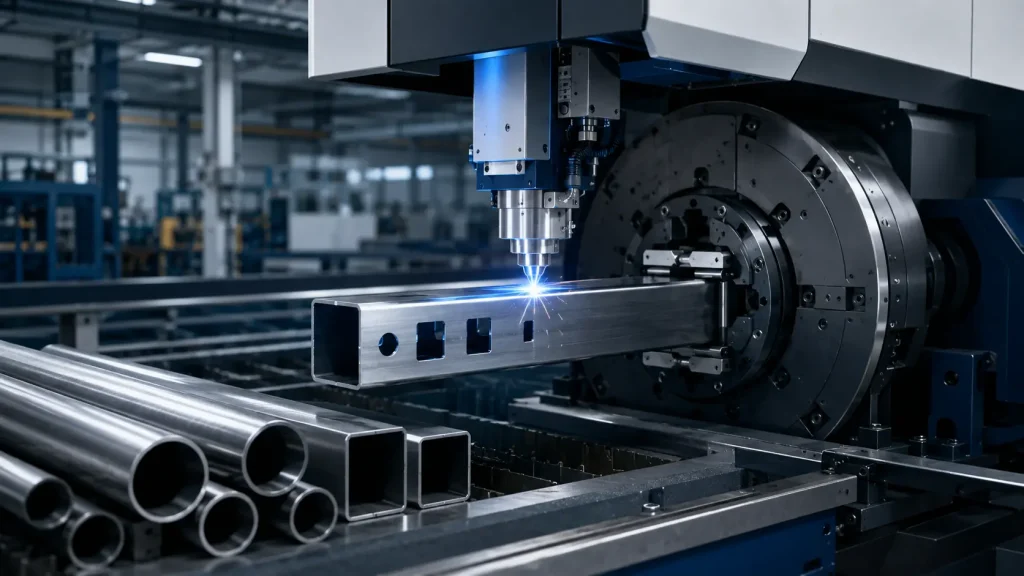
Tube laser cutting uses a focused laser beam and CNC motion control to process round tube, square tube, rectangular hollow section and other supported profiles. The machine can rotate and position the workpiece while cutting around multiple faces. Depending on the machine configuration and part design, the same setup can create end cuts, holes, slots, tabs, notches, cope features, marking details and angled interfaces.
This is the key distinction: the process is not simply a faster replacement for a saw. It can replace a sequence of operations that would otherwise require sawing, measuring, drilling, milling, punching, manual marking and repeated handling. In a broader custom metal fabrication workflow, that consolidation can have a larger impact on cost and lead time than cutting speed alone.
How the Traditional Sawing and Drilling Route Works
A conventional tube fabrication route typically starts with band-saw or circular-saw cutting. The profile is measured, clamped and cut to length. Parts are then transferred to another workstation for drilling, slotting or machining. Features may be located with jigs, stops, templates, manual layout or CNC equipment. If the design includes complex notches or angled interfaces, further machining or manual fitting may be required.
This route remains highly useful. A saw is efficient for repetitive straight cut-to-length work, especially when the part has no additional geometry. Drilling is also effective when the only secondary feature is one or two standard holes. The economics become less favorable when each part requires several setups and each setup introduces handling, fixturing and inspection time.
Tube Laser Cutting vs Sawing and Drilling at a Glance
| Factor | Tube Laser Cutting | Sawing + Drilling | Typical Advantage |
| Straight cut-to-length only | High capability, but machine time may be underused | Simple, fast and economical | Sawing for very simple parts |
| Multiple holes/slots/notches | Features can be completed in one programmed cycle | Requires additional setups and handling | Tube laser |
| Complex end geometry | Excellent for miters, copes and interlocking features | May require machining or manual fitting | Tube laser |
| Repeatability | High CNC repeatability | Depends more on fixtures, stops and setup control | Tube laser |
| Prototype / very low volume | Programming and setup must be justified | Can be attractive for basic geometry | Depends on complexity |
| Medium / high volume complex parts | Strong potential for lower total part cost | Labor and secondary operations accumulate | Tube laser |
| Secondary operation reduction | Often substantial | Usually limited | Tube laser |
1. Cost: Compare Total Part Cost, Not Only Cutting Rate
The first mistake in process comparison is to look only at the hourly rate of the cutting machine. Tube laser equipment is technologically advanced, so its machine-hour cost can be higher than a basic saw. That does not automatically mean the finished part is more expensive. The correct comparison is the total manufacturing route required to produce a conforming part.
With sawing and drilling, cost can accumulate through repeated clamping, operator handling, drill fixtures, layout work, tool changes, deburring, work-in-process movement and inspection between operations. If a profile must be cut on a saw, moved to a drill, transferred again for a slot or notch and then manually fitted before welding, each step adds labor and opportunity for variation.
Tube laser cutting can combine many of those features in a single digital program. For parts with multiple holes, slots or complex interfaces, this often shifts the cost structure from labor-intensive sequential processing toward automated cycle time. The more features a part contains, and the more often it is repeated, the stronger the business case can become.
Sawing and drilling are often more economical when:
- The part is essentially a straight cut-to-length profile.
- Only one or two simple holes are required.
- Volumes are very low and the geometry does not justify laser programming.
- Tolerance requirements are broad and downstream manual fitting is acceptable.
Tube laser cutting often becomes more economical when:
- Several holes, slots, notches or end features are required on each part.
- Parts need accurate interlocking or self-locating geometry for welding and assembly.
- Medium or high quantities make repeated manual setups expensive.
- Reducing downstream labor, fixtures and work-in-process is important.
- A family of similar parts can be produced from digital programs with fast changeovers.

2. Accuracy: Feature-to-Feature Position Matters
A saw can control cut length very effectively, and a properly designed drilling fixture can produce accurate holes. The challenge is the relationship between features created in separate operations. Every time the part is removed and re-clamped, a new datum or positioning step is introduced. Small setup variations can accumulate, particularly on long profiles or assemblies that depend on several holes lining up at once.
Tube laser cutting keeps many features within the same CNC coordinate system. This improves consistency between end geometry, holes, slots and notches because the machine does not rely on separate manual layouts for each operation. That repeatability can be especially valuable for welded frames, racks, machine structures and tubular assemblies where small positional errors can create gaps or force operators to correct alignment during welding.
If a project contains localized surfaces or dimensions that require tighter precision than the tube laser process alone should provide, selected features can still be finished using machining services. A strong manufacturing plan uses each process where it creates the most value rather than forcing one technology to perform every requirement.
3. Production Speed: One Fast Operation vs Several “Simple” Operations
Sawing is fast when the job is only cutting. Drilling is fast when the job is only drilling. The production-speed advantage of tube laser becomes clearer when the part requires both operations plus additional geometry. The relevant metric is not seconds per cut; it is elapsed time from raw tube to a part that is ready for the next manufacturing stage.
A conventional route may involve queue time between machines, batch movement, repeated setup, fixture changes and intermediate inspection. These activities do not always appear as direct machining time, but they influence lead time and work-in-process. A laser cell can reduce those transfers by completing a larger percentage of the part in one cycle.
This is particularly valuable when production includes many part numbers. Digital programs can simplify changeovers compared with maintaining dedicated drill jigs and manual templates for every variant. For buyers sourcing assemblies rather than isolated cut pieces, reduced internal handling can also support more predictable delivery schedules.
4. Downstream Welding and Assembly Can Decide the Winner
Cutting should be evaluated together with the assembly method. Tube laser technology makes it possible to design tabs, slots, locating features and accurately shaped tube intersections. These features can help operators position components consistently and reduce dependence on elaborate welding fixtures.
For example, a saw-cut tube may need manual measurement and tack positioning before welding. A laser-cut version can incorporate self-locating tabs or matching notches that define orientation directly. Even if the laser-cut blank has a higher cutting cost, the completed welded assembly may be cheaper because fit-up is faster and rework is reduced.
This is where early engineering and design-for-manufacturing review becomes important. Minor design changes can sometimes eliminate a fixture, reduce weld length, improve repeatability or turn a difficult multi-step fabrication into a simpler production sequence.
5. Material Utilization and Scrap
Material cost is another part of the equation. Modern tube laser workflows can support nesting strategies that arrange parts along stock lengths to reduce remnants, while accurate programmed cutting can improve consistency from bar to bar. Saw cutting can also be optimized effectively, particularly for repetitive straight lengths, so neither process automatically guarantees lower scrap in every job.
The most useful question is whether the chosen process reduces total waste, including rejected parts and excess allowance left for later fitting. When components are difficult to position or require manual trimming after sawing, the hidden material and labor losses can be more important than the nominal kerf difference between processes.
6. Flexibility for Design Changes and Part Families
Production environments rarely remain static. Hole locations change, product variants are introduced and customers request revisions. In a traditional route, a geometry change may require modifying stops, templates or dedicated fixtures. With tube laser cutting, many revisions are handled primarily through the CNC program, subject to tooling, machine and material constraints.
That flexibility is useful for OEMs and contract manufacturing programs with several related SKUs. It can also make the transition from prototype to repeat production more straightforward because the manufacturing definition is tied closely to the digital part geometry.

When Sawing and Drilling Is Still the Better Choice
Tube laser cutting is powerful, but it is not automatically the best choice for every profile. A good supplier should be willing to recommend a simpler process when it delivers the required result at lower cost.
- Simple cut-to-length components with no complex features.
- Small batches of basic parts where dedicated laser setup offers little benefit.
- Very heavy sections or geometries outside the practical capability of the available laser equipment.
- Projects where hole tolerances, threads or bores require secondary machining regardless of the initial cutting process.
- Repair, maintenance or one-off work where manual flexibility is more important than automated repeatability.
When Tube Laser Cutting Is the Stronger Manufacturing Strategy
Tube laser becomes particularly attractive when a component combines several operations or when downstream assembly cost is significant. Typical candidates include machine frames, welded structures, furniture frames, automotive tubular parts, rack systems, equipment supports, safety structures and fabricated subassemblies.
- Multiple holes on different faces of a tube or rectangular profile.
- Slots and tabs used to locate parts during assembly.
- Mitered or angled end cuts that must repeat consistently.
- Tube-to-tube intersections requiring accurate notches or coping.
- Part families with frequent geometry changes.
- Medium-to-high production volumes where setup and handling time would otherwise accumulate.
A Simple Cost Example: Why the Cheapest Cut May Not Produce the Cheapest Part
Consider a rectangular tube used in a welded machine frame. The part needs two end cuts, four mounting holes, two assembly slots and a notch to fit another tube. A saw-and-drill route may require the saw, a drill fixture, a separate slotting or milling operation and manual notch preparation. The operator must move and re-reference the part several times.
A tube laser can potentially generate all of those features from one program and deliver the component ready for deburring, welding or the next specified operation. The laser cycle may cost more than the initial saw cut, yet the number of setups and labor minutes per finished part can fall substantially. On repeated production, those savings multiply across the batch.
This is why RFQs should describe the complete part and annual volume rather than asking suppliers to quote isolated cutting operations. A supplier that understands the total manufacturing route can evaluate whether laser cutting, sawing, drilling, machining or a hybrid process produces the best commercial outcome.
What Buyers Should Include in an RFQ
To compare manufacturing options accurately, provide enough information for the supplier to evaluate both the part and the production program. Useful RFQ inputs include:
- 3D CAD files such as STEP, plus 2D drawings where dimensions and tolerances are defined.
- Material grade, tube/profile size and wall thickness.
- Critical dimensions, datum requirements and geometric tolerances.
- Required hole sizes, slots, notches, markings and edge conditions.
- Prototype quantity, batch quantity and expected annual volume.
- Welding, bending, machining, coating or assembly requirements after cutting.
- Inspection, documentation and packaging requirements.
- Target delivery schedule and destination.
If the project includes both carbon steel and corrosion-resistant materials, Nova Fabrication can also evaluate the wider fabrication route through its steel fabrication and stainless steel fabrication capabilities.
How to Choose Between Tube Laser Cutting and Sawing + Drilling
Use the part geometry as the starting point. If the job is a simple length cut, a saw can be difficult to beat. If the part requires multiple accurately positioned features, complex end geometry or repeatable interfaces for welding, tube laser cutting deserves serious consideration. Then evaluate volume: the more times a multi-operation part repeats, the more important setup consolidation becomes.
Finally, compare the finished-part route rather than individual machine rates. Include handling, fixtures, secondary operations, inspection, rework risk, welding fit-up and lead time. In many projects, the process that looks more expensive at the first operation produces a lower total cost by making every stage after it easier.
Conclusion: The Best Process Is the One That Simplifies the Whole Manufacturing Route
Tube laser cutting and traditional sawing and drilling are complementary manufacturing methods, not competing technologies that have one universal winner. Sawing is highly efficient for straightforward cut-to-length work. Drilling remains practical for simple, isolated holes. Tube laser cutting adds the most value when a design contains multiple features, complex geometry, tight feature relationships or substantial downstream assembly labor.
For buyers, the decision should be based on total landed manufacturing cost, repeatability and delivery risk—not only the price of the first cut. Nova Fabrication can review drawings and production volumes to determine whether profile and pipe laser cutting, conventional processing or a hybrid route is the most efficient approach for the project. Request a quote with your drawings, material requirements and expected quantities for a manufacturing review.