
In the heart of modern industrial design and manufacturing technologies lies a single question: How can we achieve maximum durability with minimum weight? Especially in sectors like automotive, aerospace, and electronic cabinet manufacturing, reducing material weight is not just about cost savings; it signifies energy efficiency and functional performance. This is precisely where Spot Welding steps in as an engineering marvel that transforms the nature of thin sheet metal.
Spot welding is the process of joining metal parts by applying pressure and electric current at specific points. This method allows for high-strength connections without compromising the structural integrity of thin sheet metals. Unlike traditional arc welding methods, it minimizes heat dissipation throughout the material, thereby eliminating the risk of thermal deformation. In this article, we will deeply explore the critical role of spot welding in thin sheet processing, its technical advantages, and its integration with other manufacturing technologies.
Working Principle of Spot Welding: The Precise Balance of Pressure and Current
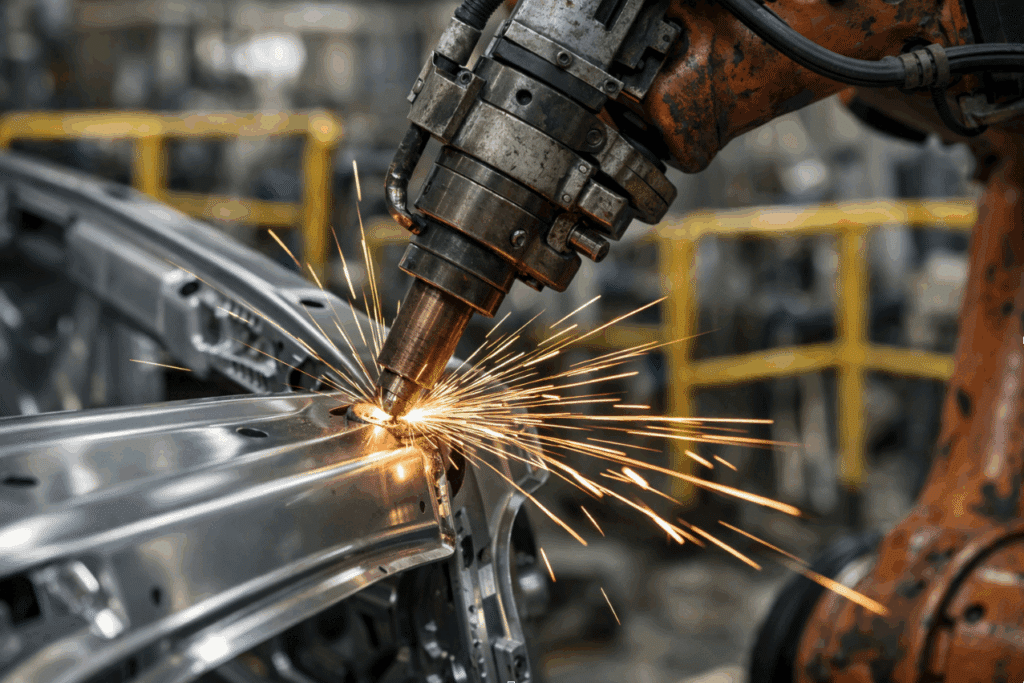
Spot welding primarily falls under the category of resistance welding. The process begins by clamping two or more metal sheets between two electrodes. When a high electrical current is passed through the electrodes, intense heat is generated at the point of contact due to the metal’s internal resistance. This heat melts the metal, creating a “weld nugget.” After the current is cut, the electrodes continue to apply pressure, allowing the metal to cool and form a permanent, high-strength bond.
The biggest difference between spot welding and TIG (Argon) or MIG/MAG welding is that the heat is confined to a localized area measured in millimeters. In TIG welding, because a continuous arc is formed, there is a high risk of burn-through or warping on thin sheets. However, in spot welding, the process time is measured in milliseconds. This speed ensures that the Heat Affected Zone (HAZ) remains narrow, preserving the dimensional stability of the part.
Why Choose Spot Welding for Thin Sheets?
- Low Deformation: Because the heat is localized, the sheet metal does not warp or bend.
- Speed and Efficiency: It is the fastest joining method for mass production.
- Consumable Savings: No additional filler wire or shielding gas is required.
Clean Surface: The need for post-weld slag cleaning or grinding is minimal.
Preparation for a Flawless Joint: The Importance of Laser and Punch Cutting
The quality of a spot welding operation begins long before the electrodes touch the metal—it starts with how the metal is cut. In thin sheet metal manufacturing, the perfect fit-up of parts is critical for the homogeneity of the weld nugget.
To ensure the flawless assembly of parts before spot welding, we perform micron-precision cutting with our Sheet Metal Laser Cutting technology. Laser cutting leaves a smooth edge, allowing parts to fit into assembly jigs without error. If your project involves high volumes and standard forms, we utilize our Punch Cutting Service to complete both cutting and simple forming operations simultaneously, increasing operational efficiency.
Precision cutting is indispensable in areas where aesthetics and sealing are paramount, such as Cabinet Manufacturing. If gaps remain between parts, expulsion (sparks) may occur during spot welding, leading to weak joints. Therefore, our technological infrastructure in the preparation stage directly dictates the final strength of the weld.

Forming and Structural Integrity: Synergy with Press Brake Bending
Sheet metal shaping is like a chain of events. Cut parts are usually subjected to bending before reaching the welding stage. The success of spot welding depends directly on the accuracy of the bending angles.
Forms given to the sheets via our Press Brake Bending Service must facilitate easy access for the spot welding gun. Thanks to our advanced CNC bending machines, we prepare even the most complex geometries with millimetric accuracy. The corners and joint lines formed after bending create ideal “overlap” areas for spot welding. This harmony provides maximum rigidity, especially in parts exposed to dynamic loads, such as automotive body components.
Technical Comparison: Spot Welding vs. Other Welding Methods
The following table demonstrates why spot welding stands out in thin sheet joining projects based on specific criteria:
Feature | Spot Welding | TIG (Argon) Welding | MIG/MAG Welding |
Thin Sheet Suitability | Excellent (< 3mm) | Very Good (Precise) | Moderate (Thick focus) |
Thermal Deformation | Very Low | Moderate | High |
Process Speed | Very High | Low | High |
Automation Compatibility | Fully Compatible | Moderate | Fully Compatible |
Consumables | None | Electrode + Gas | Wire + Gas |
For thicker parts or joints requiring absolute sealing (e.g., pressure vessels), you may also explore our Argon Welding (TIG) solutions. However, if lightness and mass production speed are the priorities, spot welding is the undisputed leader.
The Future in Mass Production: Robotic Welding and Spot Welding Integration
In the era of Industry 4.0, robotic systems replacing manual labor have taken the speed and quality of spot welding to the next level. Robotic Welding systems guarantee the same pressure and current duration for every single weld spot. This completely eliminates errors caused by human factors, such as missing welds or overheating.
Robotic arms exhibit high maneuverability, especially in hard-to-reach areas and complex body structures. In a server cabinet production line, completing hundreds of spot welds in seconds and without error is only possible with this technology. Robotic spot welding not only increases production speed but also ensures consistent quality standards across all products.

Sectoral Solutions: Cabinet Manufacturing and Automotive Spare Parts
The “lightweight yet durable” body structure provided by spot welding is vital for specific industries.
1. Cabinet Manufacturing
In the production of electrical panels, server racks, and UPS enclosures, spot welding is essential for achieving smooth exterior surfaces. Since the weld points remain on the interior, the exterior of the cabinet offers aesthetic integrity. This technology ensures structural stability in durable Server and UPS Cabinets, protecting sensitive components from external factors.
2. Automotive Spare Parts
In the automotive sector, safety is everything. A vehicle’s chassis or body parts must be flexible enough to absorb energy during a collision but strong enough to protect the passenger cabin. Spot welding ensures the molecular fusion of sheets, offering high tensile and shear strength. Our adherence to international standards in Automotive Spare Parts production is rooted in the precision spot welding technology we utilize.
Finishing and Aesthetics: The Perfect Surface Before Painting
The stage that determines the lifespan and aesthetics of the product after welding is surface protection. One of the greatest advantages of spot welding is the absence of the “weld bead” found in arc welding. This allows the surface to be ready for painting with very little sanding.
Parts completed in our manufacturing line are transferred to Electrostatic Powder Coating for corrosion resistance and aesthetic appeal, or Wet Painting for more specific needs. The smooth substrate provided by spot welding ensures better paint adhesion and prevents defects like orange peel effect. The result is an engineering product that is both technically durable and visually flawless.
Why Work With Us?
Spot welding in thin sheet processing is more than just joining two metals; it is the art of optimizing a product’s lifespan, weight, and cost. With our modern machinery and expert engineering staff, we manage the entire process from cutting and bending to welding and painting under one roof in an integrated manner.
If you are looking for professional solutions that offer both lightness and durability in your projects, we are here as your B2B partner.