
PVD Coating vs Electroplating: Appearance, Durability and Environmental Impact
PVD coating and electroplating can both create decorative or functional metallic surfaces, but the processes are not interchangeable. Physical vapor deposition forms an extremely thin film in a vacuum chamber by vaporizing a solid source and condensing it on the component. Electroplating deposits metal from a liquid electrolyte using electrical current. The different routes lead to different layer structures, colors, thicknesses, design limits and environmental controls.
Buyers comparing industrial coating services should begin with the base material, desired appearance, wear mechanism, corrosion system, critical dimensions, production quantity and compliance requirements. A supplier cannot select a reliable finish from the words “gold,” “black” or “chrome” alone.
Key takeaway: PVD is often preferred for thin, hard, premium-colored surfaces on suitably prepared components. Electroplating remains valuable when the specification requires a deposited metal such as zinc, nickel, copper or chromium, thicker buildup, sacrificial protection or dimensional restoration. Environmental impact must be evaluated process by process, not by slogan.
How PVD and Electroplating Work
PVD coating takes place in a controlled vacuum chamber. After cleaning, the parts are loaded on fixtures and often heated, ion-cleaned or biased. A target material is vaporized by arc, sputtering or another physical method. Reactive gases can combine with the vapor to form compounds such as titanium nitride, chromium nitride or zirconium nitride. Rotation helps distribute the line-of-sight film.
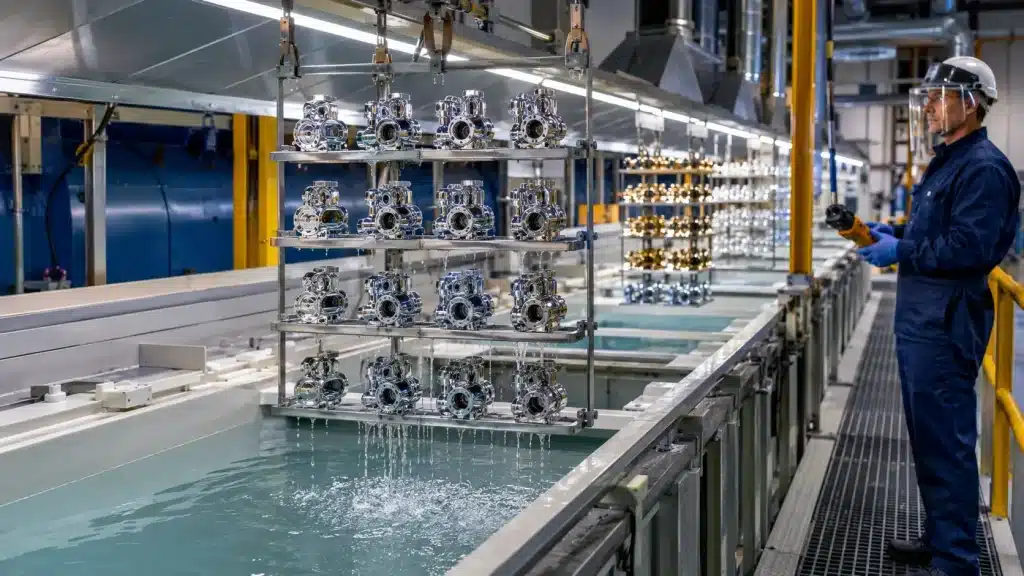
Electroplating immerses a conductive part in a chemical bath. Direct current drives dissolved metal ions onto the component. Cleaning, activation, strike layers, undercoats, rinsing, passivation and baking may all be part of the route. Zinc plating protects steel sacrificially; nickel can provide a decorative or functional barrier; decorative chromium is usually a thin top layer over nickel; hard chrome is a thicker engineering deposit.
PVD vs Electroplating: At-a-Glance
Decision factor | PVD coating | Electroplating | Commercial implication |
|---|---|---|---|
Deposition route | Vacuum-phase physical deposition | Aqueous electrochemical deposition | Equipment and controls differ |
Typical build | Very thin hard film | Thin decorative to thick engineering deposit | Tolerance and leveling behavior differ |
Appearance | Premium metallic colors; substrate texture remains | Metal-dependent bright, satin or functional finish | Approved samples are essential |
Wear potential | Often high hardness and low friction | Ranges from soft zinc to hard chrome | Specify the actual coating system |
Corrosion role | Usually barrier/top layer; often needs sound substrate | Can be barrier, sacrificial or multilayer | Base system determines protection |
Geometry | Line-of-sight; rotation and fixtures matter | Current density creates edge buildup and recess thinning | Complex shapes require process review |
Temperature | Vacuum cycle may heat the component | Usually lower bath temperature; baking may follow | Assemblies and heat treatment must be checked |
Color flexibility | Gold, bronze, black, gray and other compounds | Limited by deposited metals and post-treatments | Do not select from screen colors |
Economic fit | Premium repeat parts that fit chamber and fixtures | Broad volume range; metal and thickness dependent | Compare tooling, preparation and reject risk |

1. Appearance: Thin Color Film vs Deposited Metal
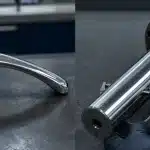
PVD can create saturated metallic colors while preserving fine brushing, polishing and machining detail. Champagne, gold, bronze, rose, gray and black finishes are common in architectural and consumer applications. Because the layer is very thin, it does not level scratches, pits, weld marks or inconsistent polishing. The substrate preparation becomes the visual foundation of the final part.
For premium decorative metal fabrication, finish direction, gloss, color range, viewing angle and visible faces should be agreed on a production-representative sample. A polished substrate creates a mirror-like PVD finish; a brushed substrate remains directional and satin.
Electroplating appearance depends on the deposited metal and layer stack. Nickel can be bright or satin, copper may provide warmth and leveling, and decorative chrome adds a cool bluish top surface. A “chrome finish” may actually be a copper-nickel-chromium system. Electroplating can offer more leveling when suitable underlayers are used, but it still cannot rescue poor fabrication or deep defects.
2. Durability Must Be Defined by Failure Mode
PVD compounds are often exceptionally hard and resist fine scratching, abrasion and tarnish. Hardness alone does not make a coating indestructible. A very hard, thin film can fail if the substrate dents, flexes, contains contamination or lacks adequate support. Adhesion, substrate hardness, film architecture, edge geometry and service load must be qualified together.
Electroplating spans a much wider property range. Zinc is selected primarily for sacrificial corrosion protection, not premium scratch resistance. Nickel may provide barrier protection, wear or an underlayer. Hard chrome can support wear and dimensional restoration, while thin decorative chrome relies heavily on nickel beneath it. Comparing “PVD durability” with “plating durability” without naming the electroplate is technically meaningless.
3. Corrosion Resistance Belongs to the Complete System
Many PVD films are chemically stable, but their extreme thinness means pores, scratches and edges can expose the substrate. Stainless steel or a nickel-plated base may provide the underlying corrosion resistance, while the PVD contributes color, hardness and surface performance. On carbon steel, PVD alone should not automatically be treated as a substitute for a qualified corrosion-protection system.
On stainless steel fabrications, surface preparation, grade, weld cleanup and passivation condition can affect both appearance and corrosion behavior before PVD is applied. Mixed-metal assemblies also require galvanic and cleaning compatibility review.
Electroplating can provide sacrificial or barrier protection depending on the metal. Zinc protects steel at small exposed areas because it is anodic to the substrate. Nickel and chromium are barrier systems; pores or damage can concentrate attack at exposed steel. Thickness, continuity, underlayers, conversion coatings, seals and service environment determine the result.
4. Thickness, Tolerances and Surface Preparation
PVD adds very little thickness compared with most decorative or engineering electroplates. This is valuable on fine details and close fits, yet masking may still be needed on electrical contacts, bonding points or surfaces where even a thin film changes friction. Because PVD follows the substrate, polishing and brushing must be completed before coating.
Functional plating on machined components can materially change dimensions. External diameters grow, holes shrink and thread fits change. Drawings should define significant surfaces, thickness ranges, masking and pre-plate dimensions. Hard chrome or engineering nickel may require final grinding or polishing after deposition.
Design issue | PVD consideration | Electroplating consideration |
|---|---|---|
Surface texture | Transferred directly through thin film | Underlayers may provide limited leveling |
Threads and fits | Usually low buildup; verify friction/contact | Mask or allow for deposit thickness |
Deep recesses | Line-of-sight coverage can be limited | Low current density can reduce thickness |
Edges | Fixture orientation affects coverage | Current concentration can create edge buildup |
Hanging contacts | Fixture marks must be located | Rack contacts leave unplated witness areas |
Final finishing | Normally completed before PVD | Thick engineering deposits may be ground after |

5. Geometry, Chamber Size and Production Fixtures
PVD is directional. Parts often rotate on planetary fixtures so visible faces receive consistent exposure to the vapor source. Shadowed recesses, overlapping components and deep internal passages can receive less coating. The component must also fit the chamber, tolerate vacuum and process temperature, and be clean enough to avoid outgassing.
Electroplating can reach complex shapes through the liquid bath, but deposition is still nonuniform. Current density rises at edges and exposed projections and falls in recesses. Shields, auxiliary anodes and conforming tooling can improve distribution. Blind holes, crevices and trapped solution create rinsing and contamination risks. Neither process is geometry-neutral.
6. Environmental Impact: Compare the Whole Process
PVD is often described as environmentally preferable because it can avoid large aqueous metal-bearing baths and produces a very thin film with high material efficiency. It may reduce water use and some hazardous effluent streams. However, vacuum pumps, plasma sources, heating, cooling and compressed gases consume energy. Targets, chamber cleaning residues, rejected parts and upstream production of coating materials also carry impacts.
Electroplating commonly uses substantial water for cleaning and rinsing and may generate metal-bearing wastewater, sludge and hazardous chemicals. The impact varies greatly by deposited metal, bath chemistry, drag-out control, closed-loop rinsing, recovery, wastewater treatment and regulatory management. Modern, well-controlled lines can reduce releases and reuse resources; poorly controlled lines create serious risks.
Impact area | PVD questions | Electroplating questions | Buyer evidence |
|---|---|---|---|
Energy | Chamber heating, pumps and cycle utilization | Rectifiers, heating, ventilation and drying | Energy monitoring and batch utilization |
Water | Cooling and cleaning demand | Cleaning, bath makeup and rinsing demand | Water balance and reuse program |
Chemical hazard | Process gases and cleaning chemistry | Metal salts, acids, alkalis and additives | Chemical inventory and controls |
Waste | Targets, shields and cleaning residue | Sludge, spent baths and rinse treatment | Licensed treatment and recovery records |
Air emissions | Vacuum exhaust and cleaning operations | Mist, fumes and ventilation discharge | Permits, capture and monitoring |
Worker exposure | Loading, cleaning and chamber maintenance | Bath handling, dosing and maintenance | Risk assessment and PPE systems |
Product life | Hard film may extend service life | Corrosion or wear system may extend service life | Qualified durability and repair plan |
Environmental claim rule: request process-specific evidence. A low-impact coating can become a poor choice if it causes high rejection, short service life or difficult recycling. Conversely, a controlled electroplating line may deliver long component life with documented water and metal recovery.
7. Cost and Production Volume
PVD equipment, vacuum time, target materials and custom fixtures create meaningful setup costs. The route often becomes attractive for repeat batches of premium parts that fit the chamber efficiently. Substrate polishing can be a major cost driver because the thin film preserves every surface defect. Frequent color or chemistry changes may add chamber cleaning and qualification time.
Electroplating cost depends on metal value, thickness, bath route, masking, rack versus barrel processing, hydrogen-embrittlement controls, polishing, wastewater treatment and inspection. Zinc-plated fasteners and multilayer decorative trim belong to very different cost categories. Compare price per conforming finished part, including preparation, rejects, test coupons, packaging and transport.
Finish Selection Checklist
Question | PVD may fit when | Electroplating may fit when |
|---|---|---|
Visual intent | Premium metallic color should preserve texture | A deposited metal appearance or layer stack is required |
Wear | Thin hard low-friction film is valuable | Selected engineering metal provides required behavior |
Corrosion | Substrate/underlayer already provides protection | Sacrificial or thicker barrier protection is needed |
Dimensions | Very low buildup is important | Thickness can be designed into the part |
Geometry | Visible surfaces are accessible to deposition | Bath and tooling can reach controlled surfaces |
Heat sensitivity | Part tolerates qualified vacuum cycle | Lower bath temperatures are preferable |
Volume | Repeat premium batches fill chamber efficiently | Barrel/rack production matches quantities |
Repair | Replacement or recoating is acceptable | Strip/replate or engineering restoration is planned |
Environmental priority | Vacuum route has verified energy/material controls | Aqueous line has verified water/chemical recovery |
What to Include in a Finishing RFQ
- Part data: drawing revision, substrate, heat treatment, dimensions, weight and annual volume.
- Finish system: PVD composition/color/film target or electroplated metal, layer stack, thickness and post-treatment.
- Service requirements: wear, friction, corrosion, UV, chemicals, temperature, cleaning and expected life.
- Appearance: visible faces, polish or brush direction, color range, gloss, approved sample and allowable defects.
- Masking and fixtures: threads, contacts, datums, rack marks, coating-free zones and acceptable hanging points.
- Validation: adhesion, thickness, hardness, color, corrosion test, first article and sampling plan.
- Compliance: restricted substances, wastewater/air controls, declarations, traceability and certificates.
Frequently Asked Questions
Is PVD more durable than electroplating?
Not universally. PVD can be extremely hard, while zinc, nickel, decorative chrome and hard chrome serve different functions. Compare the actual systems and failure modes.
Is PVD always more environmentally friendly?
Not automatically. PVD may reduce water and aqueous waste but consumes energy and materials. Plant controls, utilization, rejects and product life determine the result.
Can PVD replace chrome plating?
Sometimes for decorative color and wear. It does not automatically replace sacrificial protection, thick hard chrome or dimensional restoration.
Which finish offers more color options?
PVD provides distinctive metallic compound colors; electroplating provides deposited-metal appearances. Powder coating usually offers the broadest opaque palette.
Can either finish hide scratches and weld marks?
PVD is too thin to hide them, and plating offers limited leveling. Cosmetic substrate preparation must be controlled.
Validate the Complete Coating System
Approve a production-representative first article using the intended substrate, preparation, underlayers, fixtures and coating cycle. Inspect color, texture, thickness, adhesion, coverage, rack marks and assembly fit. Agree on wear or corrosion test criteria before testing, and support environmental claims with current supplier records.
A coordinated custom metal manufacturing route can align substrate preparation, tolerances, finishing and packaging. Nova’s engineering support and quality and project approach can help define first-article and documentation requirements appropriate to project risk.
Specify the Performance, Not Just the Process Name
PVD is a strong choice for premium colors, very thin hard films and applications where surface detail should remain visible. Electroplating is the better route when a particular deposited metal, sacrificial protection, multilayer decorative system or thicker engineering buildup is required. The most responsible specification connects appearance and durability to measurable requirements while asking the supplier for credible environmental controls.
To compare both routes for a real component, request a project quotation with drawings, substrate, annual quantities, visual target, service conditions, masking, validation and compliance expectations. A meaningful quotation should price the full conforming route—not merely the coating operation.