

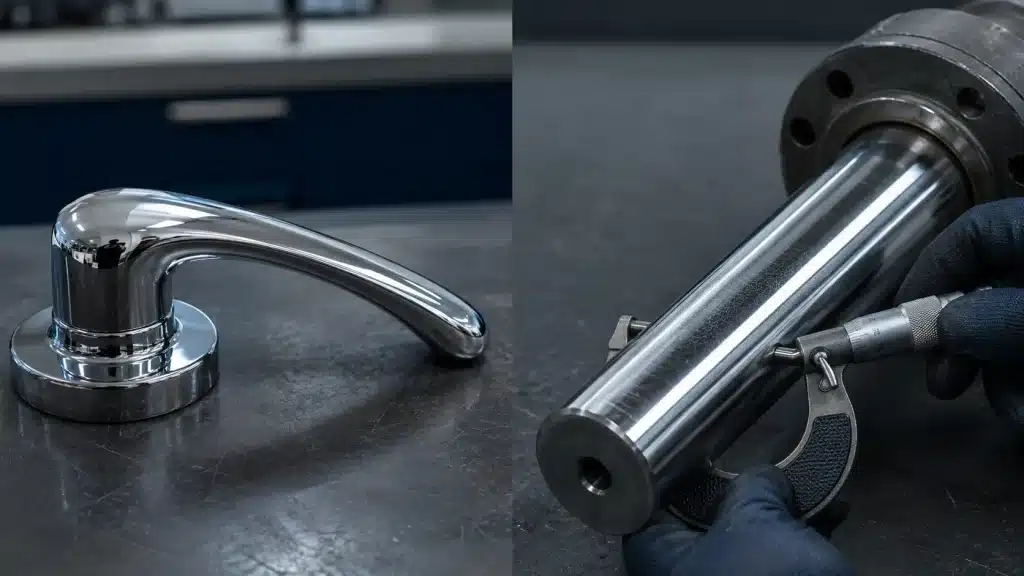
Zinc, Nickel and Chrome Electroplating: Which Finish Should You Specify?
Zinc, nickel and chromium can all create a bright metallic surface, but they solve different engineering problems. Zinc is commonly chosen to protect steel through sacrificial action. Nickel is generally a barrier coating and can provide appearance, hardness, wear resistance or an underlayer. Chromium may be a very thin decorative top layer over nickel or a much thicker engineering deposit used on functional surfaces.
A useful specification therefore starts with service conditions and component function—not a color name. Buyers working with industrial coating services should define the substrate, required thickness, corrosion or wear target, visible surfaces, masking, post-treatment and inspection method. The same nominal metal can behave very differently when preparation, undercoats, geometry and deposit thickness change.
Key takeaway: choose zinc for economical sacrificial protection of steel; nickel when a controlled barrier, decorative base or functional deposit is needed; and chromium only after distinguishing decorative nickel–chrome from hard/engineering chrome. There is no universally “best” electroplate.
Electroplating Is a Coating System, Not a Color
Electroplating uses electric current to deposit metal from an electrolyte onto a conductive component. Cleaning, activation and rinsing are integral to the result. Some specifications also require an undercoat, conversion coating, seal, topcoat, baking step or final mechanical finishing. A plated surface can fail even when its average thickness looks correct if adhesion is poor, pores expose the substrate or recesses receive too little deposit.
Upstream engineering and DFM support should consider current distribution, drainage, racking contacts, blind holes and sharp edges. Electroplating tends to build faster at edges and exposed areas than in deep recesses. Drawings must identify critical surfaces and measurement locations instead of assuming uniform thickness everywhere.
Zinc vs Nickel vs Chrome: At-a-Glance
Decision factor | Zinc | Nickel | Chrome |
|---|---|---|---|
Primary role | Sacrificial corrosion protection for steel | Barrier, appearance, wear or underlayer | Decorative top layer or functional hard deposit |
Typical substrate | Carbon and alloy steel | Steel, copper alloys and other qualified substrates | Usually nickel-coated decorative parts; steel substrates for hard chrome |
Appearance | Clear, blue, yellow, black or other passivated tones | Bright, satin or engineered appearance | Bright bluish decorative finish; hard chrome is functional |
Corrosion behavior | Protects exposed steel sacrificially | Barrier performance depends on continuity and porosity | Decorative system depends heavily on nickel underlayer |
Wear potential | Moderate; usually not selected for severe wear | Can be tailored for hardness and wear | Hard chrome suits selected wear and sliding surfaces |
Thickness sensitivity | Threads and fits still require control | Functional deposits can materially change dimensions | Decorative is thin; hard chrome may require finish grinding |
Cost tendency | Often lowest for common steel hardware | Higher and process-dependent | Decorative multilayer or hard chrome can be costly |
Typical use | Fasteners, brackets, stampings and hardware | Trim, tooling, molds, components and undercoats | Decorative fittings, rods, shafts and repair surfaces |
1. Zinc Plating: Economical Sacrificial Protection
Zinc is anodic to steel, so it can corrode preferentially when a scratch or small discontinuity exposes the base metal. This sacrificial behavior is why zinc electroplating is widely used on fasteners, clips, brackets and formed steel components. It is generally economical for volume production and can be applied in barrel or rack processes depending on part geometry, cosmetic needs and damage risk.
The final performance is not determined by zinc thickness alone. Passivation or conversion coating influences color and corrosion behavior, while a sealer or topcoat can further change performance, friction and appearance. A specification such as “zinc plated, silver” is incomplete because it does not identify the standard, service condition, thickness class, passivation chemistry, seal, torque-tension requirement or acceptance test.
Parts created through sheet metal laser cutting and forming should arrive free of scale, oil and heavy oxide. Welded crevices and trapped solution can create staining or delayed corrosion, so fabrication details and drainage need review before plating.

2. Nickel Plating: Barrier, Appearance and Functional Performance
Nickel acts mainly as a barrier. If a pore, crack or damaged area reaches steel, the nickel does not protect the exposed substrate sacrificially in the way zinc does. Corrosion resistance therefore depends on preparation, deposit continuity, thickness, underlayers and the actual environment. Decorative nickel can create brightness and leveling beneath a thin chromium topcoat, while engineering nickel deposits may be selected for dimensional restoration, hardness or wear.
Electrolytic nickel and electroless nickel are different processes. Electroless nickel deposits chemically without external current and is often valued for relatively uniform coverage on complex geometry; its phosphorus content and heat treatment influence properties. It should not be substituted for electrolytic nickel without engineering review, even if both are called “nickel plating” in casual conversation.
Functional nickel on machined components needs allowance in the dimensional stack. Masking, pre-plate size, deposit distribution and any final machining or precision grinding should be agreed before manufacture.
3. Chrome Plating: Decorative and Hard Chrome Are Different
Decorative chrome is normally a thin chromium layer over one or more nickel layers, sometimes with copper beneath them. Chromium supplies the familiar bright, slightly bluish appearance and helps resist tarnish and surface wear; most leveling and corrosion performance comes from the underlying system. Specifying “chrome” without the full layer system and service class leaves the supplier to guess.
Hard chrome—also called engineering chromium—is a different functional process. It is deposited much thicker on selected working surfaces to provide hardness, wear resistance, low friction or dimensional restoration. Shafts, rods, rolls, hydraulic components and tooling may use it. Thick deposits can require grinding to final size, and cracks, edge buildup or poor coverage in recesses must be managed through tooling and process control.
Characteristic | Decorative nickel–chrome | Hard / engineering chrome |
|---|---|---|
Main objective | Appearance, tarnish resistance and light wear | Hardness, wear, friction control or dimensional restoration |
Layer system | Usually thin chromium over nickel; may include copper | Thicker chromium on prepared functional surfaces |
Typical components | Handles, fittings, trim and visible hardware | Rods, shafts, rolls, tooling and repair surfaces |
Dimensional effect | Small but relevant on tight fits | Major design input; finish grinding may be required |
Inspection focus | Appearance, thickness, adhesion and corrosion class | Thickness, hardness, cracks, adhesion, geometry and finish |
Drawing language | State complete multilayer system and service condition | State engineering chrome thickness and final-size route |
4. Corrosion Performance Depends on Exposure and Design
Indoor handling, outdoor weathering, road salt, condensation, cleaning chemicals and marine exposure are not equivalent conditions. Zinc is often practical for general steel corrosion protection, but severe service may call for a different zinc system, a thicker metallic coating or another finish entirely. Nickel and decorative nickel–chrome can perform well when the layer system is appropriate, yet pores, damaged edges and corrosive chemicals can attack the substrate.
Accelerated salt-spray results are useful only when the specimen preparation, coating system, test method and failure criteria are defined. A quoted number of hours is not a direct prediction of field life. Drainage, crevices, bimetallic contact, assembly damage and maintenance can matter more than a laboratory ranking.

5. Thickness, Fits and Current Distribution
Plating adds material. External diameters grow, holes shrink, thread fit changes and bearing or sealing surfaces may become unusable if the drawing does not define masking and pre-plate dimensions. The problem is greatest with thick engineering deposits, but even thin decorative systems can affect precision interfaces. Coating thickness should be stated at significant surfaces with an agreed measurement method.
Electric current concentrates at corners and exposed projections, producing thicker deposits there and thinner deposits in recesses. Auxiliary anodes, shields, conforming fixtures and part orientation can improve distribution, but they add process development. Deep bores, internal passages and close overlaps should never be assumed to receive the same thickness as an open face.
6. Hydrogen Embrittlement Must Be Managed
Acid cleaning and electroplating can introduce hydrogen into susceptible high-strength steels. The component may crack after plating under sustained stress, even if it passed visual inspection. Risk depends on material strength, hardness, residual stress, geometry, cleaning route and service load. High-strength fasteners, springs and hardened components require particular attention.
Specification rule: identify material grade, hardness and tensile strength, then state any required stress relief, hydrogen-embrittlement relief bake, timing, test and lot traceability. Baking reduces risk but does not make every susceptible part automatically safe; the entire process route must follow the applicable drawing and standard.
7. Process Chemistry, Compliance and Appearance
Zinc passivation and chromium plating chemistry may be trivalent or hexavalent depending on the process and requirement. The words “chrome plated” describe the deposited finish, not necessarily the oxidation state or environmental profile of every bath used to produce it. Regulatory, customer and end-market restrictions should be stated explicitly, including substance declarations when required.
Appearance criteria also need discipline. Define visible faces, color range, gloss, acceptable rack marks and limits for pits, stains, burns, roughness or unplated zones. A master sample should use the actual substrate and preparation route. Decorative plating cannot reliably hide deep tool marks, weld distortion or substrate porosity.
Finish Selection Matrix
Requirement | Zinc | Nickel | Chrome |
|---|---|---|---|
Economical protection for steel | Strong candidate | Usually not first choice | Usually not first choice |
Sacrificial protection at small scratches | Yes | No | No |
Bright decorative finish | Possible, utilitarian tones | Strong base/standalone option | Specify decorative nickel–chrome system |
Functional wear surface | Limited | Possible with engineered deposit | Hard chrome may be suitable |
Complex geometry | Distribution must be reviewed | Electrolytic distribution must be reviewed | Recesses and edge buildup are critical |
Tight dimensional control | Mask or allow for thickness | Plan pre-plate size and distribution | Hard chrome often needs finish grinding |
High-strength steel | Embrittlement controls required | Embrittlement controls required | Embrittlement controls required |
Field repair priority | Often replace/replate | Application-specific | Hard chrome may be stripped and replated |

What to Include in an Electroplating RFQ
- Part definition: drawing revision, 3D model, substrate grade, heat treatment, hardness, dimensions, weight and quantities.
- Finish system: plated metal, applicable standard, class/type/grade, underlayers, passivation, seal or topcoat.
- Functional targets: corrosion, wear, hardness, friction, conductivity, solderability or appearance requirement.
- Thickness control: range, significant surfaces, measurement method, pre-plate sizes and final-machining responsibility.
- Masking and contacts: threads, bores, bearing seats, electrical contacts, rack marks and coating-free areas.
- Risk controls: hydrogen-embrittlement relief, stress relief, adhesion checks, sampling plan and lot traceability.
- Acceptance: approved sample, visible faces, allowable defects, corrosion test method, certificates and packaging.
Frequently Asked Questions
Is zinc plating always the best option for outdoor steel parts?
No. Zinc is useful and economical, but the exposure, coating thickness, passivation, sealer, geometry and maintenance determine suitability. Severe outdoor service may require another system.
Is nickel plating more corrosion resistant than zinc?
Not as a universal rule. Nickel is a barrier coating; zinc protects steel sacrificially. The better option depends on coating continuity, thickness, environment and the required failure mode.
Is decorative chrome the same as hard chrome?
No. Decorative chrome is typically a thin top layer over nickel. Hard chrome is a thicker engineering deposit used for wear, friction or dimensional restoration.
Can plating hide machining marks or weld defects?
Only to a limited extent, and it should not be used as a defect-concealment strategy. Substrate texture, pits, porosity and weld quality can remain visible or reduce adhesion.
Do all high-strength steel parts need baking after plating?
Requirements depend on material strength, hardness, process and governing specification. When baking is required, timing and temperature must be controlled; engineering review remains essential.
Validate the Complete Route Before Production
Approve a first article made from production-representative material and processed through the intended cleaning, activation, plating and post-treatment sequence. Inspect thickness at agreed locations, appearance, adhesion, masking, thread or gauge fit and critical dimensions. For functional deposits, verify hardness, surface finish and any final grinding. For corrosion-critical systems, agree on the test method and failure definition before testing begins.
A coordinated custom metal manufacturing route can align machining, fabrication, pretreatment, plating allowance and packaging. Nova’s quality and project approach can support first-article planning and supplier documentation appropriate to the component risk.
Specify the Performance, Then Select the Finish
Zinc, nickel and chromium are not interchangeable silver-colored finishes. Zinc is often the practical choice for sacrificial steel protection. Nickel can serve decorative, barrier, undercoat and functional roles. Chromium must be split into decorative nickel–chrome and hard engineering chrome before cost or performance can be compared. The correct specification connects the deposit to the substrate, geometry, service environment and inspection plan.
For plated parts incorporated into stainless steel or mixed-metal fabrications, galvanic contact and finish compatibility should also be reviewed. To compare a real production route, request a project quotation with drawings, material condition, annual volume, finish standard, thickness, masking, test requirements and visible-surface criteria.