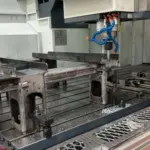


In modern manufacturing, quickly, strongly, and efficiently joining parts is critically important. This is precisely where Spot Welding comes into play. Offering a revolutionary solution particularly in sheet metal joining processes, this method is indispensable across many sectors, from automotive to home appliances, electronics to furniture. At Nova Fabrication, we add value to your projects with high-precision spot welding solutions.
So, what is spot welding, how does it work, and why is it so widely used? Let’s delve into the details of this effective and efficient welding method.
1. What is Spot Welding and How Does It Work?
Spot welding is one of the most common and well-known members of the resistance welding family. Its fundamental principle is to heat and join two or more metal pieces at specific points by utilizing electrical resistance.
1.1. Basic Working Principle
- Workpiece Clamping: Two or more sheet metal parts to be welded are placed between two electrodes, usually made of copper alloy, and firmly clamped. This clamping ensures good electrical contact between the parts and provides the necessary pressure for the metal to melt and fuse during welding.
- Current Application: A very high electric current (typically at low voltage) is passed through the clamped parts for a short duration via the electrodes.
- Resistance Heating: The current encounters the highest resistance at the contact points of the electrodes and at the interface where the two sheets meet. According to the principle of Joule heating (Heat = Current² x Resistance x Time), intense heat generation occurs at these points when electric current encounters resistance.
- Melting and Fusion (Nugget Formation): The generated high heat causes the metal at the point of electrode contact to melt, forming a small “molten pool” or “nugget” (core).
- Solidification and Weld Joint: When the current is cut off, the molten pool rapidly cools and solidifies under the pressure applied by the electrodes. This solidification creates a permanent weld spot that strongly joins the two parts. When the electrodes are removed, a small indentation usually remains on the surface.
1.2. Advantages and Key Features
- Speed: It is an extremely fast welding method. A single spot weld typically takes fractions of a second.
- Efficiency: Offers low energy consumption and high automation potential.
- Cleanliness: No filler material or shielding gas is required, making the welding process very clean. Fumes, slag, or spatter are minimal.
- Low Distortion: Since heat is concentrated in a small area, the risk of part deformation and warping is low.
- Ease of Automation: Easily integrated into robotic systems, providing high repeatability and efficiency in mass production.
- Economical: No material cost (filler wire, gas).

2. Applications and Industries of Spot Welding
Spot welding plays a critical role in many industries due to its speed, efficiency, and suitability for automation.
2.1. Automotive Industry
Spot welding is the backbone of automotive production lines. It is widely used in joining vehicle chassis, body panels, doors, and hoods. A single car contains thousands of spot welds, and the quality of these welds is vital for the vehicle’s safety and durability.
2.2. Home Appliance Manufacturing
Spot welding is extensively used in the production of home appliances such as refrigerators, washing machines, ovens, and dishwashers for joining external and internal panels. This ensures both rapid production and the robustness of the products.
2.3. Electronics and Electrical Industry
The precision and cleanliness of spot welding are utilized in joining battery packs, circuit board components, electric motor parts, and connectors. It is ideal for assembling small and delicate parts.
2.4. Aerospace Industry
Used for joining certain lightweight alloys and thin materials to meet high strength and low weight requirements.
2.5. Metal Furniture and Household Goods
Spot welding is preferred for quickly and securely joining parts in the production of metal chairs, tables, shelves, and various small household items.
3. Spot Welding Equipment and Parameters
For efficient and high-quality spot welding, the right equipment and parameter settings are essential.
3.1. Basic Equipment
- Spot Welding Machine: The main unit that provides and controls the electric current. Various types exist (resistance spot welders, capacitor discharge welders, etc.).
- Electrodes: Typically made of copper alloys with high conductivity and wear resistance. Electrode tips can have different shapes and sizes (dome, pointed, flat, etc.) and directly affect weld quality.
- Clamping Mechanism: The mechanism that allows the electrodes to press the parts together with specific pressure (can be manual, pneumatic, or hydraulic).
- Control Unit: An electronic unit that precisely adjusts current duration, current intensity, and clamping pressure.
3.2. Critical Welding Parameters
- Welding Current (Amps): Directly affects the amount of heat generated at the weld spot. Too low a current can lead to weak welds, while too high a current can cause spatter and overheating.
- Welding Time (Cycles/Seconds): The duration for which the current is applied. The correct time is critical for sufficient nugget formation.
- Electrode Force (Pressure): The force applied by the electrodes on the parts. Sufficient pressure ensures good contact and helps the metal fuse correctly.
- Hold Time: The time the electrodes continue to apply pressure after the current is cut off. This period allows the nugget to cool and solidify, gaining strength.
- Squeeze Time: The time between electrode contact and the start of current flow. It ensures the parts are fully clamped and air gaps are expelled.

4. Advantages and Disadvantages of Spot Welding
Like any welding method, spot welding has its own strengths and weaknesses.
4.1. Advantages
- Fast and Automatable: Excellent for mass production.
- Economical: Low consumable material (filler wire, gas) cost.
- Environmentally Friendly: Low fume and gas emissions.
- Low Distortion: Minimal risk of warping due to concentrated heat.
- High Strength: Provides very strong joints when applied correctly.
- Clean Process: Virtually no slag or spatter.
4.2. Disadvantages
- Overlap Joint Only: Generally suitable only for joining two overlapping sheets. Cannot be used for corner or butt welds.
- Surface Preparation Critical: Surface contamination, rust, or paint negatively affects weld quality.
- Visual Aesthetics: Weld spots can leave marks on the surface, which might be an issue where aesthetics are very important.
- Limited Access: Electrodes must be able to reach the weld spot, which can limit use in complex geometries.
- Material Thickness Limitation: Most suitable for sheet metals between 0.5 mm and 3 mm. Not efficient for very thick materials.
5. Nova Fabrication: Your Reliable Spot Welding Solutions
At Nova Fabrication, we provide high-capacity and precise spot welding services to meet your modern manufacturing needs. We develop customized solutions for our clients in various sectors, from automotive to home appliances, furniture to electronics.
With our state-of-the-art spot welding machines and expert team, we guarantee the speed, quality, and repeatability you need in your projects. Whether you have a large-scale production project or a specialized prototyping task, Nova Fabrication is by your side every step of the way.
Why Choose Nova Fabrication?
- Experience and Expertise: Years of industry experience and accumulated knowledge.
- Technology-Oriented: Working with the latest and most efficient spot welding equipment.
- Quality Assurance: Consistent quality standards at every weld spot.
- Customer-Centric: Flexible and optimized solutions tailored to your needs.
- Fast Delivery: Your projects are completed on time thanks to our efficient production processes.
If you are looking for a reliable partner for your spot welding needs, do not hesitate to contact Nova Fabrication. We are happy to offer you the most suitable, cost-effective, and high-quality solutions.