

Reducing Welding and Assembly Time with Laser-Cut Tube Connections
In welded tube fabrication, the welding operation itself is only one part of the total production time. Operators may also need to measure profiles, mark hole positions, prepare tube ends, align components, adjust fixtures, tack the assembly and correct distortion before completing the final welds.
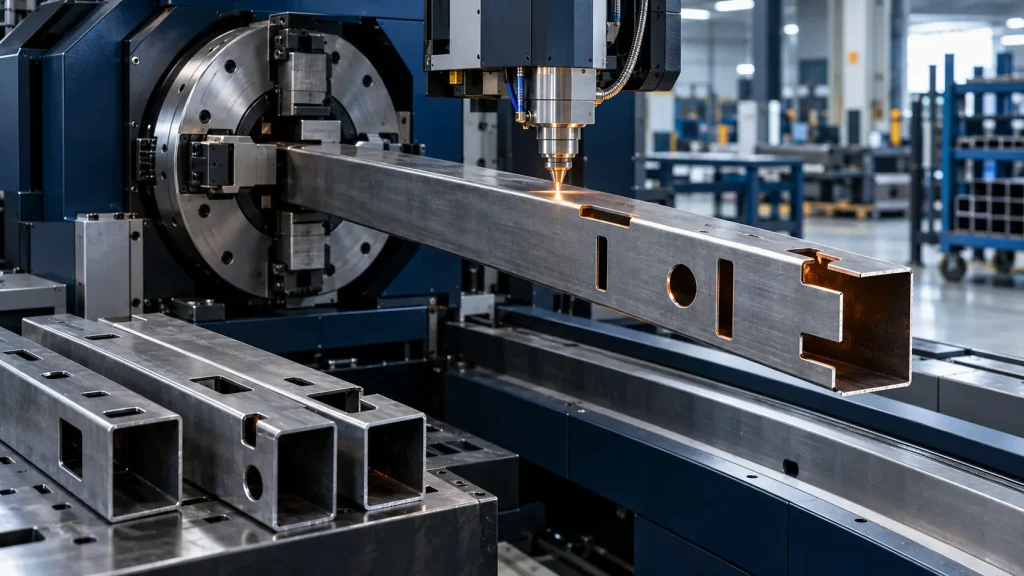
Laser-cut tube connections can reduce many of these manual operations. Tabs, slots, notches, mitres, saddle cuts and locating features can be produced directly on round, square or rectangular profiles. When these features are designed correctly, the parts locate each other during assembly and reach the welding station with fewer preparation steps.
The result is not simply faster cutting. It is a more controlled manufacturing process from raw tube to completed assembly.
Where Do the Time Savings Come From?
A conventional tube assembly may require several separate operations. Profiles are cut to length on a saw, holes are drilled, tube ends are ground or notched, and reference positions are marked manually. Each operation adds handling time and creates another opportunity for dimensional variation.
Modern profile and pipe laser cutting combines many of these features in a single programmed process. A tube can be cut to length while its connection profiles, mounting holes, slots and access openings are produced in the same setup.
This reduces the need to move parts between machines. It also improves the relationship between individual features because they are created from the same digital manufacturing data.
The largest saving, however, often appears during fit-up. When two plain tube ends must be welded together, the operator must position and measure them before tacking. A self-locating connection provides physical reference points, helping the assembler establish orientation, angle and position more quickly.
Self-Locating Features for Tube Assemblies
Laser-cut connection geometry can be adapted to the function of the assembly. Common features include:
- Tabs and matching slots for locating one profile relative to another
- Keyed or asymmetrical joints that prevent reversed assembly
- Fishmouth and saddle cuts for round-tube connections
- Interlocking corners for rectangular frames
- Locating holes for pins, fasteners or inspection points
These features can provide a mechanical poka-yoke function. For example, two similar braces may be given different tab positions so that each one fits only in its correct location. This reduces the risk of mirrored or reversed parts being welded into an assembly.
The features should remain simple enough for reliable cutting and assembly. Very small tabs can be damaged during handling, while excessively tight slots may make fit-up difficult when actual tube dimensions vary.
Nova Fabrication’s laser cutting services can be combined with welding and forming operations to create a coordinated production route rather than treating each process as an isolated step.
Reducing Fixture Dependence
A welding fixture holds components in their intended position while they are tacked and welded. Fixtures remain important for controlling critical dimensions, production repeatability and heat distortion. However, complex fixtures can be expensive to manufacture, difficult to modify and time-consuming to load.
Self-locating tube connections can simplify the fixture’s job. Instead of positioning every component independently, the fixture may only need to establish the main datums and hold the assembly securely during welding.
This is especially valuable for product families that share a common frame design but have different lengths or accessory locations. Laser-cut locating features can change with the CAD model, while the basic fixture remains relatively simple.
Laser-cut connections do not automatically eliminate the need for fixtures. Large frames, tight geometric tolerances and distortion-sensitive assemblies may still require substantial support. The objective is to use part geometry to reduce unnecessary fixture complexity.

Can Laser-Cut Connections Reduce Weld Length?
Improved fit-up can produce more consistent joint gaps and make welding easier to control. In some applications, interlocking geometry may also allow the designer to use shorter or more strategically positioned welds.
However, weld length should never be reduced solely to save production time. The required weld type, size, length and location must be determined by the expected loads, material thickness, fatigue conditions and applicable design requirements.
The main advantage is consistency. When every connection reaches the welding process with a predictable gap and position, operators can use more stable parameters and spend less time correcting poor fit-up. This can reduce excess filler metal, grinding and rework without compromising the intended structural performance.
Clearance and Tolerance Must Be Designed Together
A laser-cut tab and slot may appear perfect in CAD but still be difficult to assemble if manufacturing variation has not been considered. Tube outside dimensions, wall thickness, corner radii, twist, straightness and weld-seam position can all affect the connection.
Laser kerf and cutting angle must also be considered. A slot designed at exactly the nominal tab width may be too tight once actual material and process variations are included. Conversely, excessive clearance prevents the joint from locating the parts accurately.
Designers should evaluate the complete tolerance chain rather than applying very tight tolerances to every feature. The required clearance depends on the tube size, material, wall thickness, joint geometry and assembly method.
If the parts will be powder coated or otherwise finished before assembly, coating thickness may also need to be included in the clearance calculation. Nova’s DFM guidelines for metal parts provide a useful starting point for designing features around real manufacturing conditions.
Supporting Robotic Welding
Repeatable, self-locating connections are particularly useful when assemblies are intended for robotic welding. A robot follows programmed paths and cannot compensate for inconsistent fit-up as flexibly as an experienced manual welder.
Laser-cut reference features can help keep joint positions within a more predictable working window. They can also make loading the welding fixture faster and reduce the possibility of placing a component in the wrong orientation.
Reliable robotic production still depends on stable datums, controlled gaps, suitable torch access and an effective welding sequence. Thermal distortion must be considered even when the initial part positioning is highly accurate.
For industrial frames and welded structures, these considerations should be addressed during the design stage. Nova’s industrial metal frames and structures guide explains how geometry, loads and fabrication requirements interact.
When Does the Approach Make Economic Sense?
Laser-cut tube connections create the most value when assemblies contain repeated profiles, numerous holes or notches, complex end preparations or significant manual fit-up. The benefit generally increases with production volume because programming and design effort are distributed across more parts.
For a simple, low-volume frame with straight cuts, conventional sawing and manual welding may still be economical. For recurring batches, modular products or assemblies with high labor content, tube laser cutting can reduce total production cost even if the cutting rate itself is higher.
The comparison should therefore consider total manufacturing time, including:
- Cutting, drilling and end preparation
- Part identification and handling
- Fixture loading and measurement
- Tacking and final welding
- Grinding, correction and rework
- Inspection and assembly
This total-cost approach provides a more realistic decision than comparing only the hourly cost of a saw and a tube laser.

Information to Include in an RFQ
To evaluate a laser-cut tube assembly accurately, the RFQ package should define:
- Tube shape, dimensions, wall thickness and material grade
- A 3D model and a dimensioned manufacturing drawing
- Joint locations and required connection features
- Weld type, size and inspection expectations
- Critical assembly datums and tolerances
- Order quantity and expected repeat volumes
- Required bending, machining, coating or final assembly operations
Providing complete manufacturing data allows the supplier to review whether locating tabs, slots or other design changes could reduce production time.
Conclusion
Laser-cut tube connections can shorten welding and assembly time by transferring part of the positioning work from the operator and fixture into the component geometry. Accurate tabs, slots, notches and keyed joints reduce manual preparation, improve fit-up and make repeated assemblies easier to control.
The greatest benefit comes from treating tube cutting, connection design, welding and inspection as one manufacturing system. Joint clearances must reflect real tube tolerances, weld requirements must remain based on structural needs, and fixtures must still control critical dimensions and distortion.
Nova Fabrication combines tube laser cutting, welding and other metal manufacturing services for tube frames and fabricated assemblies. To review a new or existing design, upload your drawings through the request a quote page.