
How to Select a PVD Color and Finish for Architectural Metalwork
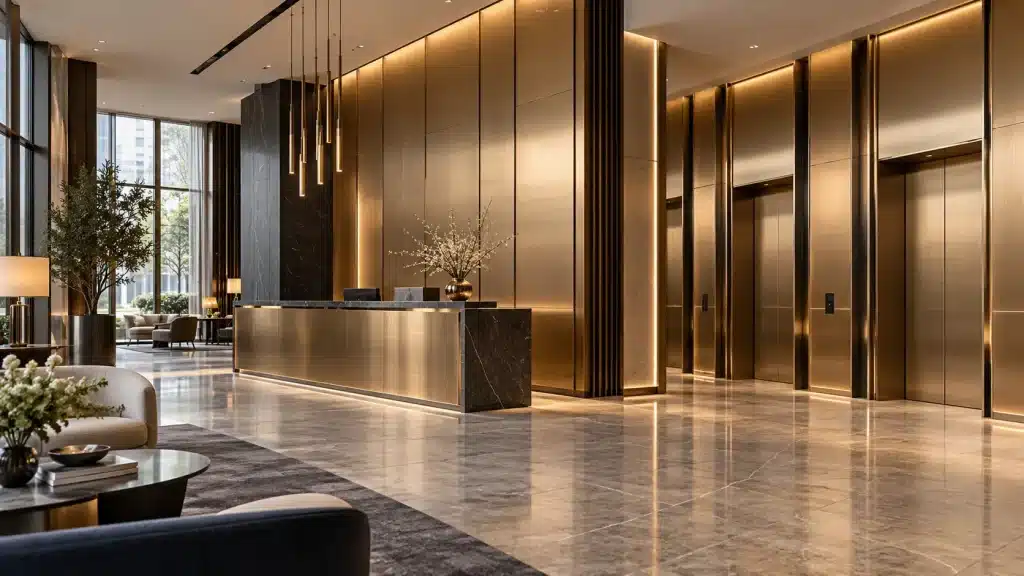
PVD coating is widely used to give architectural metalwork a premium metallic color while preserving the character of the base material. It can be applied to elevator interiors, wall panels, decorative screens, handrails, shopfitting components, door hardware and reception areas.
However, choosing a PVD finish is not as simple as selecting “gold,” “bronze” or “black” from a color chart. The final appearance is influenced by the substrate, surface texture, coating chemistry, lighting and viewing direction.
A successful specification must define both the color and the underlying mechanical finish.
What Is PVD Coating?
Physical Vapor Deposition, or PVD, applies a very thin metallic compound to a prepared surface inside a vacuum chamber. The process can improve surface hardness, wear resistance and decorative appearance without hiding the texture of the underlying metal.
Because the layer is thin, PVD follows the existing surface closely. A brushed stainless steel panel remains visibly brushed after coating, while a mirror-polished panel keeps its reflective character.
Nova Fabrication’s PVD coating service can be integrated with fabrication, polishing, surface preparation and final inspection for architectural metal components.
Start with the Base Material
Decorative architectural PVD is frequently applied to stainless steel because it provides:
- A smooth and stable substrate
- Good corrosion resistance
- High-quality brushed or polished finishes
- Clean fabrication possibilities
- A premium metallic appearance
The stainless steel grade should be selected according to the service environment. Indoor decorative components may use a different grade from external or coastal applications.
The comparison between 304 and 316 stainless steel can help project teams evaluate corrosion exposure before selecting the decorative coating.
PVD should not be treated as a replacement for correct material selection. A colored coating may improve appearance and surface performance, but it cannot compensate for an unsuitable substrate in an aggressive environment.
PVD Color Names Are Not Universal Standards
Terms such as champagne gold, rose gold, bronze, coffee, anthracite and black are useful descriptions, but they are not always universal color standards.
Two suppliers may use the same color name for visibly different finishes. Differences can result from:
- Coating chemistry
- Process parameters
- Coating thickness
- Base-metal finish
- Stainless steel grade
- Batch conditions
- Viewing angle
- Light source
For appearance-critical projects, a written color name should always be supported by an approved physical sample.
Digital renderings, photographs and monitor displays are useful for early design decisions, but they should not be treated as final color approval tools.
Common PVD Colors for Architectural Metalwork
PVD color family | Typical visual character | Common architectural uses |
Champagne gold | Warm, light and understated | Lobbies, elevators and luxury retail |
Yellow gold | Rich and highly decorative | Feature walls and premium interiors |
Rose gold | Soft copper-pink tone | Hospitality and boutique interiors |
Bronze | Warm, mature and architectural | Screens, trims and reception areas |
Copper tone | Strong, warm metallic effect | Feature panels and branded spaces |
Coffee brown | Dark and restrained | Furniture, wall details and shopfitting |
Anthracite | Dark gray metallic appearance | Modern façades and industrial interiors |
Black | Strong contrast and premium minimalism | Frames, trims, doors and signage details |
Blue or specialty colors | Distinctive and project-specific | Art installations and statement elements |
Availability and repeatability must be confirmed with the coating supplier. Not every color is equally suitable for every substrate, finish or project quantity.

The Underlying Finish Changes the Color
The same PVD color can appear dramatically different depending on the mechanical finish beneath it.
Brushed Finish
A brushed finish contains consistent directional lines. After PVD coating, these lines remain visible and create a controlled architectural texture.
Brushed PVD is commonly used for:
- Elevator panels
- Wall cladding
- Door trims
- Reception desks
- Handrails
- Retail fixtures
The brushing direction should be shown on the drawing. If adjacent panels are installed with different grain directions, they may appear to have different colors even when they were coated in the same batch.
Satin Finish
Satin surfaces produce softer reflections and can reduce the visual impact of fingerprints and minor handling marks.
They are suitable for large wall panels, public areas and components viewed under strong lighting.
Mirror-Polished Finish
Mirror polishing creates a highly reflective and luxurious appearance. PVD adds color while preserving the strong reflection.
Mirror PVD is visually striking, but it can reveal:
- Surface waviness
- Grinding defects
- Distortion from welding
- Fingerprints
- Installation misalignment
- Inconsistent reflections between panels
It is best suited to components where the fabrication and polishing standards can support the required visual quality.
Textured or Patterned Finish
Etched, embossed, bead-blasted or patterned stainless steel can also be combined with PVD coating. These finishes create greater visual depth and may reduce the visibility of handling marks.
Before selecting a pattern, confirm that it can be produced consistently across the required sheet size and project quantity.
Nova Fabrication’s guide to decorative metal finishes compares PVD with anodizing, powder coating and mechanical polishing.
Consider the Lighting Environment
PVD finishes interact strongly with light. A sample viewed beside a window may look different under warm hotel lighting or cool commercial LEDs.
Project teams should evaluate samples under:
- Daylight
- Installed artificial lighting
- Warm and cool light temperatures
- Direct and indirect illumination
- Multiple viewing angles
- Nearby surface colors
Mirror surfaces reflect their surroundings, while brushed finishes create directional highlights. This means the same panel can look lighter, darker or warmer as the viewer moves.
For important interiors, review a full-size mock-up in the intended lighting environment rather than approving only a small sample in an office.
Define the Direction of the Finish
Directional finishes require careful coordination from fabrication through installation.
The project drawings should identify:
- Brushing or polishing direction
- Panel orientation
- Visible faces
- Fold direction
- Adjacent panel alignment
- Required pattern continuation
- Installation sequence
Protective film should also include orientation identification where necessary, but marks should not be applied directly to visible finished surfaces.
Finish direction is particularly important on long corridors, elevator interiors and multi-panel feature walls. One rotated panel can remain visibly different even if its PVD color is technically correct.

Fabrication Quality Must Come Before PVD
PVD is a thin surface treatment. It does not fill weld marks, deep scratches, dents or uneven grinding.
Before coating, components may require:
- Controlled grinding
- Weld blending
- Brushing
- Polishing
- Edge finishing
- Cleaning
- Degreasing
- Protection from carbon-steel contamination
Visible surfaces should reach the approved mechanical finish before they enter the PVD process.
Nova Fabrication’s stainless steel fabrication service combines cutting, forming, welding and surface finishing for custom metal components.
Design Parts for Consistent Finishing
Complex geometry may create challenges during polishing, cleaning, coating and handling.
Designers should review:
- Deep recesses
- Tight internal corners
- Overlapping joints
- Hidden welds
- Sharp edges
- Complex perforations
- Contact and hanging points
- Areas requiring masking
- Surfaces that cannot be polished mechanically
Where possible, visible decorative faces should be separated from structural connections and welding zones.
The production route should also avoid performing unnecessary welding or grinding after the final finish. Local repair of a decorative PVD surface may remain visible.
Early DFM review for sheet metal parts can reduce finishing risk and improve repeatability.
Interior vs Exterior Applications
PVD can be used in a wide range of architectural settings, but exterior suitability should be verified for the complete system.
Important factors include:
- Stainless steel grade
- PVD coating chemistry
- UV exposure
- Coastal salt
- Industrial pollution
- Cleaning chemicals
- Water retention
- Contact with dissimilar metals
- Installation method
Do not assume that every decorative indoor PVD finish is suitable for a façade, external handrail or coastal installation.
For outdoor applications, request documented confirmation for the specific color, substrate, exposure and maintenance conditions.

Fingerprints, Cleaning and Maintenance
Dark mirror finishes often show fingerprints more clearly than light brushed surfaces. High-touch locations should therefore be evaluated for both appearance and maintenance.
The cleaning plan should avoid:
- Aggressive abrasive pads
- Steel wool
- Chloride-rich cleaners
- Harsh acidic or alkaline chemicals
- Contaminated cleaning tools
Use cleaning products and methods approved for the specific PVD system.
If the component will be touched frequently, consider:
- Satin or brushed texture
- Lighter color
- Anti-fingerprint treatment
- Replaceable design
- Accessible cleaning geometry
The finish decision should consider how the product will look after months of real use—not only on installation day.
Approve a Physical Sample and Mock-Up
A reliable approval process can include three stages:
- Small finish sample: confirms the initial color and texture direction.
- Production-intent sample: uses the correct substrate, polishing route and PVD process.
- Full-size mock-up: confirms reflections, panel joints, lighting and installation quality.
The approved sample should be stored carefully and referenced in the purchase order.
When possible, production panels for the same visible area should be processed in the same batch. Large projects may also require an agreed tolerance for acceptable color variation.
PVD Finish Specification Checklist
Include the following information in drawings and RFQs:
- Base material and grade
- Sheet or component thickness
- PVD color name or approved reference
- Mechanical finish
- Brushing direction
- Visible faces
- Interior or exterior use
- Environmental exposure
- Gloss or reflectivity expectations
- Anti-fingerprint requirement
- Masked or uncoated areas
- Racking and contact-point restrictions
- Cosmetic acceptance criteria
- Approved sample requirement
- Batch consistency requirement
- Protective film
- Packaging method
- Cleaning instructions
- Replacement-part color expectations
- Required inspection records
Sample Specification
A practical architectural specification might state:
Fabricate visible panels from 304 stainless steel with a uniform directional brushed finish. Apply champagne-bronze PVD coating to all identified visible faces. Brushing direction shall run vertically after installation. Color and surface texture shall match the approved physical sample under the project lighting conditions. Visible surfaces shall be free from dents, deep scratches, coating voids, stains and inconsistent polishing lines. Panels within the same elevation should be produced using a coordinated finishing and coating batch. Apply removable protective film and package panels to prevent metal-to-metal contact during transport.
This example should be adjusted to match the project environment and design intent.
Conclusion
Selecting a PVD finish requires coordination between color, substrate, mechanical texture, lighting, fabrication and maintenance.
The most important decisions are:
- Choose a suitable base material
- Select both the PVD color and underlying finish
- Define grain direction and visible faces
- Review the finish under realistic lighting
- Approve a physical sample or full-size mock-up
- Establish cosmetic acceptance and packaging requirements
The right PVD specification creates more than an attractive surface. It helps the finished architectural metalwork remain consistent across panels, production batches and future replacement components.
For a project-specific review, submit drawings, quantities, material details and finish references through Nova Fabrication’s request a quote page.