

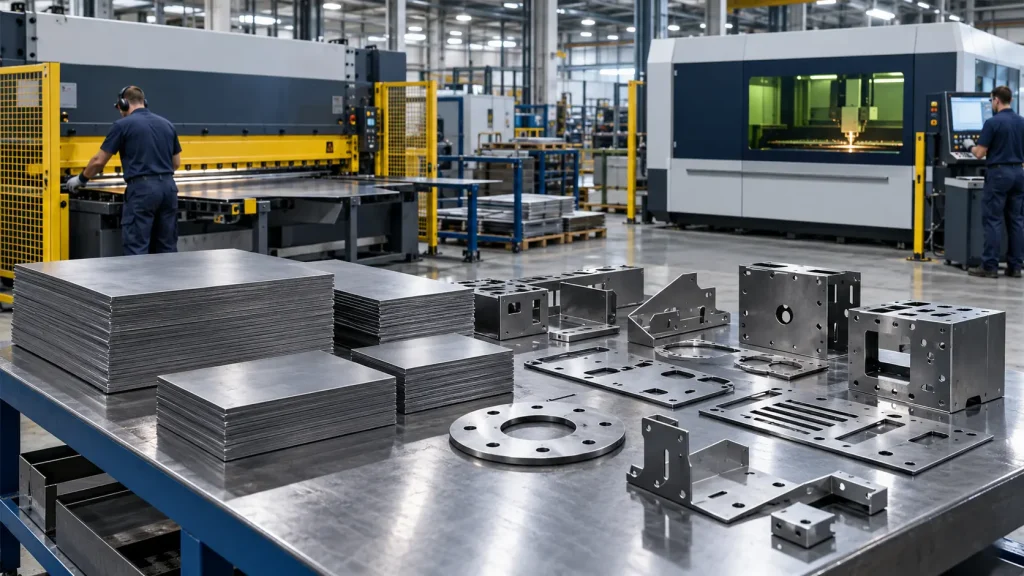
Guillotine Cutting vs Laser Cutting: Choosing the Right Sheet Metal Cutting Process
Guillotine cutting and laser cutting are both efficient methods for processing sheet metal, but they solve different manufacturing problems.
Guillotine cutting is fast and economical for straight cuts, rectangular blanks and basic sheet sizing. Laser cutting is more flexible and can produce complex contours, holes, slots and detailed internal features.
The right choice depends on part geometry, material thickness, order volume, tolerance requirements and the operations that follow cutting.
What Is Guillotine Cutting?
Guillotine cutting—also called shearing—uses an upper blade and a fixed lower blade to separate sheet metal along a straight line.
The sheet is positioned against a back gauge, clamped and cut as the upper blade moves through the material. Because the process does not follow a programmed contour, it is particularly fast for producing square or rectangular blanks.
Nova Fabrication’s guillotine cutting service can be used for operations such as:
- Cutting sheets to production size
- Producing rectangular blanks
- Preparing material for bending
- Trimming sheet edges
- Dividing large sheets into smaller sections
- Preparing simple panels and strips
The process does not normally require assist gas or a programmed cutting path. For suitable components, this can make guillotine cutting one of the most economical sheet metal cutting methods.
What Is Laser Cutting?
Laser cutting uses a focused beam to melt or vaporize material along a CNC-programmed path. Assist gas removes the molten material and influences cutting speed and edge condition.
Nova Fabrication’s sheet metal laser cutting service is suitable for parts requiring:
- Complex external contours
- Holes and slots
- Curved edges
- Internal cut-outs
- Multiple part geometries on one sheet
- Detailed mounting features
- Prototype and low-volume components
Because the cutting path is controlled digitally, laser cutting can move from one part design to another without dedicated cutting dies.
Guillotine Cutting vs Laser Cutting
Factor | Guillotine Cutting | Laser Cutting |
Cut geometry | Straight cuts only | Straight, curved and complex contours |
Internal holes | Not possible | Easily produced |
Cutting speed | Very fast for simple blanks | Depends on contour length and piercing count |
Programming | Minimal | CNC programming required |
Tooling | Blades and back gauge | No profile-specific hard tooling |
Material utilization | Efficient for strips and rectangles | Efficient nesting for complex parts |
Edge condition | Possible rollover, burr and deformation | Possible dross, taper and heat-affected edge |
Best application | Basic sheet sizing | Finished complex components |
Typical cost advantage | Simple rectangular parts | Detailed or frequently changing designs |

When Is Guillotine Cutting More Cost-Effective?
Guillotine cutting is usually the more economical option when the required part can be produced entirely with straight cuts.
Examples include:
- Rectangular cabinet blanks
- Flat strips
- Simple cover panels
- Shelves without internal features
- Material prepared for press brake bending
- Oversized sheets divided before another process
A guillotine can complete a straight cut across a sheet very quickly. If hundreds of identical rectangular blanks are required, using a laser to trace the complete perimeter may add unnecessary machine time and assist-gas consumption.
Guillotine cutting may provide the best value when:
- All edges are straight
- Parts are rectangular or square
- No internal holes or slots are required
- Production quantities are moderate or high
- Tolerances are compatible with shearing
- Minor edge rollover or burr is acceptable
- The blanks will receive further processing
However, the cutting sequence must be planned carefully. Each guillotine cut normally continues across the sheet, so it cannot create enclosed internal shapes or stop in the middle of the material.
When Is Laser Cutting More Cost-Effective?
Laser cutting becomes more economical when part complexity would require several secondary operations after guillotine cutting.
For example, a rectangular panel may initially appear suitable for shearing. However, if it also requires mounting holes, ventilation slots and cable openings, laser cutting may produce the complete flat part in one setup.
Laser cutting is generally preferred when:
- The outer profile is not rectangular
- Curves or angled features are required
- The part includes holes and slots
- Several different components share one sheet
- Design changes are expected
- Prototypes are required
- Feature position is critical
- Manual drilling or notching must be reduced
Laser cutting can also improve material utilization by nesting irregular parts closely together. The actual saving depends on part geometry, sheet size, grain direction and required spacing.
Edge Quality and Distortion
Neither process creates a perfect edge under every condition.
Guillotine-Cut Edges
A sheared edge may show:
- Rollover at the top
- A smooth burnished zone
- A fractured zone
- Burr at the bottom
- Slight deformation near the cut
- Bow, twist or camber in narrow strips
Blade condition, blade clearance, sheet thickness and material strength affect the result. Incorrect clearance can increase burr, deformation and cutting force.
Laser-Cut Edges
A laser-cut edge may show:
- Fine vertical striations
- Dross or burr
- Slight taper
- Heat discoloration
- Oxidation depending on assist gas
- A narrow heat-affected zone
Critical requirements should be defined on the drawing instead of using a general phrase such as “perfect edge.” Nova’s guide to laser cutting tolerances and edge quality explains how kerf, burr, assist gas and heat input affect the finished part.
Material Thickness and Type
Both methods can process materials such as carbon steel, stainless steel and aluminium, but machine capacity and edge expectations must be considered.
Guillotine cutting requires sufficient machine force and suitable blade clearance. High-strength or thick materials may require greater capacity and can create more visible deformation at the cut.
Laser cutting capability depends on:
- Laser power
- Material reflectivity
- Sheet thickness
- Assist gas
- Required cutting speed
- Desired edge condition
The most economical method should therefore be selected using the actual material grade and thickness—not only the basic part shape.
How Downstream Bending Affects the Decision
Many cut blanks are later formed using a press brake. In these cases, cutting accuracy affects bend position, flange length and final assembly dimensions.
Guillotine cutting can be highly efficient for producing rectangular blanks that will receive straightforward bends. However, laser cutting may be more practical if the flat pattern includes:
- Bend-relief features
- Corner notches
- Alignment slots
- Mounting holes
- Tabs
- Complex flange outlines
Coordinating cutting with Nova’s press brake bending service can help prevent tolerance accumulation between blank size, feature position and bend location.
Designers can also use Nova’s DFM guide for sheet metal parts to review hole placement, bend reliefs and manufacturing allowances before releasing production data.

Can Both Processes Be Used on the Same Project?
Yes. Guillotine and laser cutting can complement each other.
A guillotine may divide large sheets into manageable blanks or prepare simple rectangular components. The laser can then produce complex parts, holes or special contours where necessary.
In some projects, using the guillotine for simple components and the laser for detailed components provides a lower total cost than assigning every part to the same machine.
Nova Fabrication’s wider precision metal cutting services allow the cutting route to be selected according to each component rather than forcing one process across the entire assembly.
RFQ Checklist
To receive an accurate process recommendation, include:
- 2D drawing or DXF file
- 3D model where applicable
- Material grade
- Sheet thickness
- Part dimensions
- Required quantity
- Annual production volume
- Dimensional tolerances
- Edge and burr requirements
- Grain or surface direction
- Cosmetic requirements
- Downstream bending or welding
- Coating and finishing requirements
- Delivery expectations
Nova’s engineering services can evaluate whether guillotine cutting, laser cutting or a combined route is most appropriate for the complete part.
Conclusion
Choose guillotine cutting when the component consists of straight cuts, rectangular blanks or simple strips and high processing speed is the main priority. For these geometries, shearing can provide a very low cutting cost.
Choose laser cutting when the part includes curved edges, holes, slots, notches or complex contours. It may have a higher machine cost, but it can eliminate drilling, notching and additional setups.
The correct comparison should consider the finished component—not just the initial cut. To review the most economical production route for your project, submit the drawing, material and quantity information through Nova Fabrication’s request a quote page.