
Tube Laser Cutting for Round, Square and Rectangular Profiles: A Buyer’s Guide
Tube laser cutting makes it possible to turn standard metal profiles into production-ready components with holes, slots, mitres, notches and locating features completed in a single programmed process.
However, cutting a round tube is not the same as cutting a square or rectangular hollow section. The profile shape affects how the material is clamped, rotated, measured and supported. It also influences achievable feature geometry, tolerance strategy, cycle time and the risk of distortion.
For buyers, the key question is therefore not simply whether a supplier has a tube laser machine. It is whether the machine, tooling, programming approach and inspection plan are suitable for the profile, material and assembly requirements of the project.
This guide explains what changes between round, square and rectangular profiles and what information should be included in a tube laser cutting RFQ.
What Is Tube Laser Cutting?
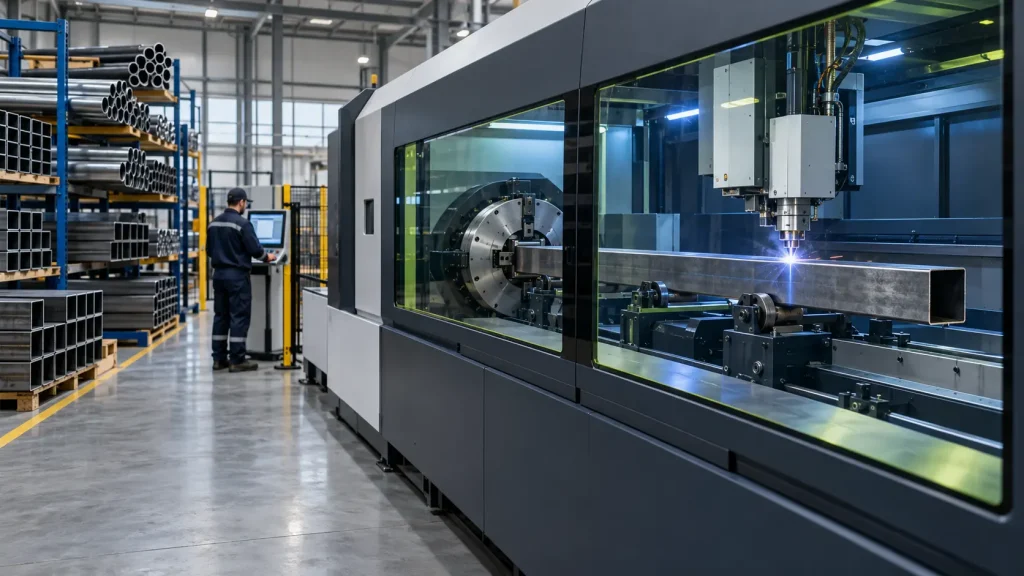
Tube laser cutting is a CNC-controlled process in which a focused laser beam cuts features into pipes, tubes and structural profiles. The workpiece is normally held in a rotating chuck while the cutting head and material move according to the programmed geometry.
Unlike conventional sawing and drilling, tube laser cutting can combine several operations:
- Straight and angled end cuts
- Holes and slots
- Mitres and fish-mouth joints
- Tabs and locating features
- Connection notches
- Weld-preparation features
- Part identification features where appropriate
- Cut-outs on multiple faces of a profile
Nova Fabrication’s profile and pipe laser cutting service supports the production of complex profile components without requiring a separate machine setup for every hole, slot or end condition.
Consolidating operations can reduce manual handling, eliminate drilling fixtures and improve repeatability between parts. The commercial benefit becomes particularly significant when the laser-cut features simplify welding and final assembly.
Round vs Square vs Rectangular Profiles
Each profile family behaves differently during cutting.
Consideration | Round Tube | Square Profile | Rectangular Profile |
Machine positioning | Continuous rotary positioning | Four primary faces and rounded corners | Four faces with different widths |
Datum strategy | Centreline and rotational position | Flat faces, centreline and corners | Face orientation and long/short axis |
Typical applications | Frames, handrails, fluid systems, furniture | Machine frames, structures, racks | Chassis, frames, supports and architectural assemblies |
Feature placement | Defined by angle around circumference | Usually related to a specific face | Must distinguish wide and narrow faces |
Main design challenge | Maintaining angular orientation | Managing corner radii and face transitions | Controlling orientation, stiffness and asymmetric behaviour |
Common joining feature | Fish-mouth or saddle cut | Mitre, tab-and-slot or face notch | Mitre, slot, notch or stepped connection |
Inspection focus | Diameter, roundness and angular position | Face-to-face size, twist and squareness | Face dimensions, orientation, twist and straightness |
The profile category alone does not determine cut quality. Material grade, wall thickness, incoming straightness, weld seam condition and the relationship between feature size and tube geometry are equally important.

Round Tube Laser Cutting
Round tube is naturally suited to rotary laser cutting because its external surface remains at a consistent radial distance from the profile centreline. This allows the machine to rotate the workpiece while maintaining the programmed cutting path.
Typical round-tube applications include:
- Handrails and guardrails
- Automotive components
- Furniture frames
- Exhaust and fluid-handling systems
- Agricultural equipment
- Structural trusses
- Tubular machine assemblies
Fish-Mouth and Saddle Cuts
One of the main benefits of round tube laser cutting is the ability to create fish-mouth or saddle profiles that fit against another tube.
A correctly designed joint can:
- Improve component location
- Reduce the weld gap
- Shorten fixture loading time
- Make tack welding more repeatable
- Improve assembly consistency
- Reduce manual grinding and fitting
The joint should still include an appropriate clearance. Designing a theoretically perfect zero-clearance intersection can cause assembly problems because real tubes have dimensional variation, ovality and weld seams.
Clearance should be selected according to the welding process, tube size, material thickness and required joint quality. If the assembly is welded after cutting, Nova’s professional welding services can be considered as part of the complete manufacturing route.
Angular Feature Position
Features on a round tube are normally defined by their angular position around the circumference. A hole may be placed at 0°, 90° or another specified angle relative to an assembly datum.
The drawing should clearly identify:
- The rotational datum
- Which end controls orientation
- The position of the longitudinal weld seam
- Whether mirrored parts are required
- The allowable angular deviation between features
Without a clear datum, two parts can be dimensionally correct but still fail during assembly because their holes are rotationally misaligned.
Square Tube Laser Cutting
Square hollow sections provide flat surfaces that are convenient for mounting brackets, panels and accessories. They are widely used in machine frames, furniture, material-handling equipment, storage systems and welded structures.
Tube laser cutting can create:
- Holes on one or multiple faces
- Corner notches
- Mitred ends
- Tabs and slots
- Access openings
- Drainage holes
- Interlocking frame joints
- Mounting patterns
Corners Are Not Perfectly Sharp
A square profile has external and internal corner radii. It is not a mathematically perfect box.
This matters when a cut feature approaches or crosses a corner. The laser head must follow a changing surface, and the material thickness around the formed corner may differ slightly from the flat wall.
Buyers should avoid locating critical holes directly on a profile corner unless the feature has been reviewed for manufacturability.
Where possible:
- Keep precision holes on flat faces
- Provide adequate distance from tangent points
- Avoid extremely narrow corner notches
- Specify whether a feature is allowed to wrap around a corner
- Dimension critical features from stable faces or datums
Early fabrication and engineering input can help convert assembly requirements into production-ready tube geometry before drawings are released.
Tabs and Slots for Self-Fixturing Assemblies
Tabs and slots can help locate square-tube components during welding. Used correctly, they can reduce measurement time and prevent parts from being assembled in the wrong orientation.
However, tab-and-slot joints require realistic clearances. The designer should account for:
- Laser kerf
- Material thickness variation
- Coating allowance
- Weld access
- Heat distortion
- Required assembly fit
- Whether the joint must be removable before welding
A tight tab may appear accurate in CAD but become difficult to assemble on the shop floor. A small, controlled clearance is usually more useful than a nominal zero-clearance fit.

Rectangular Tube Laser Cutting
Rectangular hollow sections share many characteristics with square profiles, but their unequal face dimensions introduce additional orientation and stiffness considerations.
They are frequently used for:
- Machine bases
- Vehicle frames
- Conveyor structures
- Architectural elements
- Equipment supports
- Industrial shelving
- Welded chassis
- Protective frames
Wide Face vs Narrow Face
A feature located on the wide face cannot be treated as interchangeable with the same feature on the narrow face. The drawing and 3D model should clearly establish profile orientation.
The supplier needs to know:
- Which surface is the primary face
- Which direction is considered “up”
- Whether the profile can be rotated during assembly
- Where the seam should be positioned
- Whether left-hand and right-hand versions exist
- Which axis carries the primary structural load
Orientation errors can produce parts that are individually within dimensional limits but unusable in the final assembly.
Asymmetric Behaviour
Rectangular profiles have different stiffness around their major and minor axes. Long, thin-walled profiles may respond differently depending on how they are supported and clamped.
This can affect:
- Straightness during loading
- Vibration during processing
- Part movement after cut-off
- Distortion around large openings
- Handling of long components
- Measurement repeatability
Support strategy becomes especially important when a large percentage of one face is removed. Large windows or closely spaced slots can reduce local stiffness and cause the profile to relax after cutting.
What Materials Can Be Tube Laser Cut?
Common tube laser materials include:
- Carbon steel
- Stainless steel
- Aluminium
- Galvanized steel
- Selected copper alloys, subject to machine capability
- Various structural and mechanical tubing grades
Material selection affects laser power, assist gas, cutting speed, edge condition and downstream processing.
For example, nitrogen is often selected when a clean, low-oxide edge is important, while oxygen may improve productivity on some carbon-steel applications. The practical differences are explained in Nova Fabrication’s guide to nitrogen, oxygen and compressed air in fiber laser cutting.
Buyers should specify the exact material standard and grade rather than using descriptions such as “mild steel,” “stainless” or “aluminium tube.”
A complete material specification may include:
- Material grade and standard
- Profile dimensions
- Wall thickness
- Surface condition
- Welded or seamless construction
- Required certification
- Heat or batch traceability
- Grain or finish direction where relevant
How the Weld Seam Affects Tube Laser Cutting
Many commercial profiles are manufactured from strip material that is formed and longitudinally welded. The resulting seam may create a local geometric or surface variation.
The seam can influence:
- Chucking and rotation
- Internal fit-up
- Hole position
- Fish-mouth joints
- Weld penetration
- Cosmetic appearance
- Bending behaviour
- Final assembly orientation
If seam position is functionally important, it must be stated in the RFQ and drawing. Examples include:
- Seam must face inward
- Seam must be hidden after assembly
- Holes must avoid the seam
- Seam must remain outside the bend zone
- Seam orientation must be consistent between parts
Do not assume that the seam will automatically remain at a fixed clock position unless seam detection and orientation control are included in the agreed production process.

Tolerances: What Buyers Should Expect
Tube laser cutting can be highly repeatable, but tolerance capability depends on the complete system rather than the laser beam alone.
Influencing factors include:
- Incoming profile dimensional tolerance
- Bow, twist and straightness
- Wall-thickness variation
- Profile corner radii
- Tube ovality
- Weld seam geometry
- Part length
- Feature size
- Feature position around the profile
- Machine and chuck configuration
- Support arrangement
- Thermal behaviour
- Measurement method
A tight tolerance on a hole may not solve an assembly problem if the incoming profile itself has significant bow or twist.
The drawing should therefore separate:
- General dimensions that can follow standard manufacturing tolerances
- Critical dimensions that directly affect fit, function or inspection
- Reference dimensions provided only for information
Nova’s guide to laser cutting tolerances, kerf, heat-affected zones, burr and edge quality provides additional guidance on defining realistic acceptance criteria.
Hole and Slot Design Considerations
Small holes and narrow slots become more difficult as wall thickness increases. The relationship between feature size and material thickness should be evaluated rather than applying one universal minimum size.
Potential issues include:
- Excessive taper
- Dross formation
- Local heat accumulation
- Reduced dimensional stability
- Distortion of narrow bridges
- Poor edge condition
- Difficulty inspecting internal features
For critical holes, the buyer should specify whether the laser-cut condition is final or whether drilling, reaming, tapping or machining is required afterward.
Threaded holes, bearing locations and high-precision dowel holes may need a secondary machining operation. Tube laser cutting can still create pilot holes or locating features to reduce subsequent setup time.
End Cuts, Mitres and Joint Preparation
Tube laser machines can produce straight ends, angled ends and complex intersections. This can eliminate manual sawing and reduce the number of fixture-dependent operations.
Common end conditions include:
- 90-degree cut-offs
- Single-angle mitres
- Compound mitres
- Fish-mouth cuts
- Stepped ends
- Partial notches
- End slots
- Weld preparation
Some machines also support bevel cutting, but bevel capability should be confirmed for the specific profile geometry, wall thickness and angle.
A complex 3D end condition may increase programming and cutting time. It can still reduce total manufacturing cost if it eliminates manual fitting, grinding or machining.
Designing Parts for Faster Welding and Assembly
The greatest value of tube laser cutting often appears after the cutting operation.
Well-designed laser-cut features can:
- Locate mating components
- Control joint orientation
- Reduce assembly measurement
- Prevent incorrect part placement
- Provide weld access
- Reduce the number of fixtures
- Support robotic welding
- Improve repeatability between assemblies
For welded structures, cutting and joining should be planned together. Nova Fabrication’s wider manufacturing services can combine profile cutting with bending, machining, welding and coating under a coordinated production route.
If the profile also requires forming, the cutting sequence must be coordinated with the profile and pipe bending service. Features positioned too close to a bend may distort, while the weld seam and hole pattern may affect how the tube behaves during forming.

Common Design Mistakes
1. Sending Only a 2D Drawing
A 2D drawing may describe lengths and hole positions but fail to communicate complex intersections or features distributed around several faces.
Provide a clean 3D CAD model together with a controlled 2D drawing.
2. Ignoring the Profile’s Corner Radius
Placing holes or slots too close to the corner can create unexpected geometry and inspection problems.
3. Applying Tight Tolerances Everywhere
Unnecessary precision increases programming, inspection and production costs without necessarily improving function.
4. Forgetting the Weld Seam
The seam may interfere with holes, bending, joining or cosmetic requirements.
5. Designing Zero-Clearance Joints
Real profiles have dimensional variation. Assembly features need practical clearance.
6. Ignoring Internal Dross
Molten material can remain inside a closed profile. If internal cleanliness is critical, specify the required acceptance condition and cleaning expectations.
7. Not Identifying Mirrored Parts
Left-hand and right-hand components should have distinct part numbers and controlled models.
8. Defining Features Without Datums
Every angular or face-specific feature requires a clear orientation reference.
What Determines Tube Laser Cutting Cost?
Tube laser cutting cost is influenced by more than total cut length.
The main cost drivers include:
- Material grade and profile size
- Wall thickness
- Profile length and weight
- Number of features
- Number of machine rotations
- Piercing count
- Cut complexity
- Assist gas selection
- Part unloading requirements
- Scrap and remnant strategy
- Required tolerance
- Inspection scope
- Batch quantity
- Secondary operations
- Packaging and traceability requirements
A more complex laser-cut component may still deliver a lower total assembly cost if it replaces drilled holes, manual notching, separate brackets or time-consuming welding fixtures.
Buyers should compare the total manufactured and assembled cost—not only the price per laser-cut part.
Tube Laser Cutting RFQ Checklist
Include the following information when requesting a quotation:
- Latest 3D CAD model
- Controlled 2D drawing
- Part number and revision
- Profile type: round, square or rectangular
- Outside dimensions and wall thickness
- Material grade and standard
- Welded or seamless construction
- Required quantities and annual volume
- Critical dimensions and tolerances
- Datum and orientation scheme
- Weld seam position requirements
- Surface and cosmetic requirements
- Internal dross or cleanliness criteria
- Required inspection reports
- Material certification requirements
- Downstream bending, machining or welding
- Coating or finishing requirements
- Packaging and marking instructions
- Prototype and production delivery expectations
Nova’s engineering services can support the review of profile geometry, joints, tolerances and production data before manufacturing begins.
For a technical and commercial assessment, submit the files through the request a quote page.
Frequently Asked Questions
Is tube laser cutting suitable for low-volume production?
Yes. It can be suitable for prototypes and low-volume batches because complex features are created through CNC programming rather than dedicated cutting dies. Setup, programming and material requirements still affect economic feasibility.
Can the same machine cut round, square and rectangular profiles?
Many modern tube laser systems can process all three, but available dimensions, wall thicknesses, lengths and clamping conditions depend on the specific machine configuration.
Can tube laser cutting replace drilling?
It can replace many drilled holes where the required size, tolerance and edge condition are compatible with laser cutting. Precision dowel, bearing, tapped or reamed holes may still require machining.
Can holes be cut on every face of a square tube?
Generally yes, provided the machine can rotate and support the profile correctly. Feature access, chuck position, profile size and part length must still be reviewed.
Can a laser cut through both walls of a tube at once?
Although the beam may physically reach the opposite wall in some conditions, cutting both walls in a single pass is generally undesirable when independent control of the rear feature is required. It can cause damage, taper, dross and positional uncertainty. Controlled rotation and separate cutting are normally preferred.
Does tube laser cutting eliminate deburring?
Not always. Edge quality depends on the material, wall thickness, assist gas, cutting parameters and feature geometry. Some parts may require light deburring or internal cleaning.
Is a STEP file enough for quotation?
A STEP file communicates geometry effectively, but it does not fully define tolerances, material standards, surface requirements, inspection criteria or revision control. A controlled 2D drawing should accompany the model.
Conclusion
Tube laser cutting can transform round, square and rectangular profiles into accurate, assembly-ready components while reducing sawing, drilling, notching and manual fitting.
The best results come from coordinating profile selection, feature geometry, weld seam position, tolerances, joining and downstream forming before production begins.
Round tubes require clear rotational datums and realistic joint clearances. Square profiles require attention to corner radii and face transitions. Rectangular profiles require especially careful orientation and support because their wide and narrow faces behave differently.
A complete RFQ, controlled CAD data and early manufacturing review allow the supplier to select an efficient cutting strategy while protecting the dimensions that matter to final fit and performance.