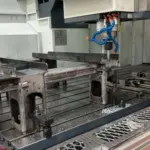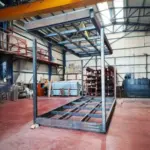


Hello! Welcome to the heart of modern industrial manufacturing. Imagine the transformation of a metal sheet into a complex machine casing or an aesthetically pleasing piece of furniture. This transformation is made possible not just with powerful machines but also with precise intelligence and meticulous planning. This is where CNC Press Brakes come in, elevating the sheet metal bending process from a simple production stage to an art form powered by automation. At Nova Fabrication, thanks to this technology—one of the most crucial components of our machine park—we bring your designs to life, ensuring the highest quality and repeatability in every single piece.
So, what exactly does “CNC Press Brake” mean, and what changes does the power of automation bring compared to manual bending methods in today’s competitive world? Let’s find the answer to this question together.
1. From Traditional to Modern: The Evolution of the Press Brake
In its simplest definition, a press brake is a machine that applies pressure to a metal sheet between two basic dies (an upper die – punch and a lower die – die) to bend it to the desired angle. While older, manual press brakes performed this process with limited control, CNC (Computer Numerical Control) technology changes everything fundamentally.
A CNC press brake, just like a computer, operates through a pre-loaded program. Our engineers input all the bending angles, lengths, bending sequences, and even the bending force into this program. The machine follows these digital commands with millimeter-level precision, offering a level of repeatability and perfection that is unattainable by human hands. This means that there is not even the slightest difference between the first part and the hundredth part. This elevates the bending process from a mere craft to an integral part of the engineering discipline, powered by automation.

2. The Powerful Advantages of Automation in Sheet Metal Bending
We believe that a CNC press brake is not just a machine but a strategic investment that adds value to your production processes. Here are the biggest advantages that automation brings:
2.1. Unmatched Precision and Repeatability
CNC systems control the bending angle and position with incredible precision. This is vital, especially for parts with complex geometries and high-volume mass production. The fact that every single one of hundreds, or even thousands, of parts maintains the same standard simplifies your assembly processes, minimizes production errors, and elevates the final product quality to its peak.
2.2. Speed and Efficiency
The automatic backgauge system speeds up the bending process by ensuring the part is held in the correct position. Thanks to pre-programmed bending sequences, all the operator has to do is place the part in the right position. This dramatically reduces both setup time and bending cycle time, increasing production speed and shortening your delivery times.
2.3. Material and Design Flexibility
CNC press brakes can work with various material types (steel, stainless steel, aluminum) and thicknesses. Advanced control systems calculate issues like springback (the metal’s tendency to return to its original form after bending) in advance, allowing you to achieve the correct final angle for every material. This also gives designers the freedom to imagine and realize geometries that were previously impossible.
2.4. Optimized Material Use and Safety
Advanced CAD/CAM software allows for pre-bending simulations, ensuring the most efficient material usage. This reduces scrap rates and maximizes the yield from every sheet of metal. At the same time, automation is designed to keep the operator’s hands or body away from dangerous areas during the bending process. Modern machines feature safety light curtains, sensors, and emergency stop systems to minimize the risk of accidents.
3. The CNC Bending Process at Nova Fabrication: Expertise and Technology
At Nova Fabrication, we see our CNC press brakes not just as tools, but as an extension of our engineering team. Our process proceeds with these steps:
3.1. Digital Design and Programming
The 2D or 3D drawings provided by our clients are reviewed by our experienced engineers. When necessary, bending simulations are performed using professional software like SOLIDWORKS. The bending sequence, angle, and dies to be used are meticulously calculated to create a custom program for the CNC machine.
3.2. An Integrated Process from Cutting to Bending
The sheet metal parts, which usually come directly from our laser cutting machine, are prepared for the bending process. Having the cutting and bending stages in a single location prevents time loss and improves part quality.
3.3. Automated Bending and Quality Control
The program is loaded into the CNC press brake, and the bending process begins under the supervision of our operator. The machine performs each bend with the optimal speed and force. Automatic backgauges ensure the part is in the correct position for every bend. After the process, the parts undergo calibration and dimensional checks with precise measuring tools like digital calipers and protractors before being prepared for delivery to the client.

In Which Fields Are CNC Press Brakes Used?
Thanks to the high precision and flexibility they offer, CNC press brakes play a critical role in many different branches of modern industry. Here are some of the main application areas for this technology:
- Electronics and Telecommunications: Used in the production of sensitive structures such as server cabinets, computer chassis, electronic device enclosures, and control panels.
- Automotive Industry: Indispensable in bending many different metal components like vehicle chassis, body panels, exhaust systems, and interior panel brackets.
- Defense and Aerospace: Used for manufacturing lightweight, durable, and complex-geometry metal parts for aircraft and defense systems.
- Medical Equipment: Preferred for bending stainless steel products where hygiene is important, such as hospital equipment, X-ray machine casings, and laboratory cabinets.
- Heating, Ventilation, and Air Conditioning (HVAC): Used in the production of air ducts, external casings for air conditioning units, and filter enclosures.
- Architecture and Construction: Widely used in bending aesthetic and structural elements like building facade panels, decorative metal panels, railings, and roofing systems.
- Furniture and Decoration: Used to create aesthetic forms in many products, from office furniture and custom-designed shelves to lighting fixtures and metal frames.