

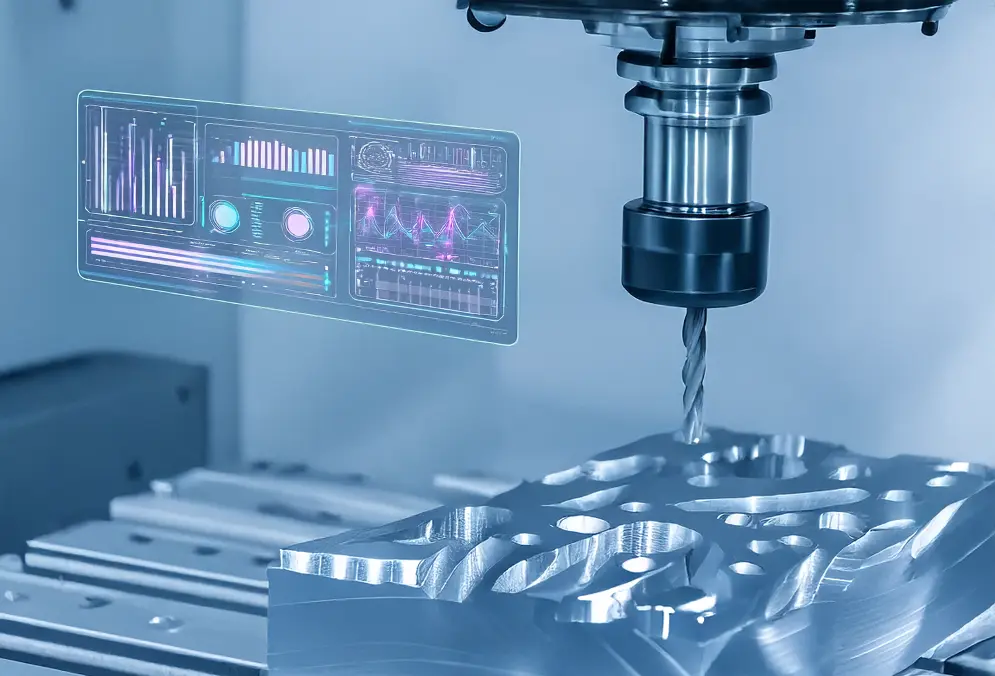
Introduction: Beyond Precision – The Dawn of the Intelligent Machine
For decades, the story of CNC machining has been a linear progression of precision and speed. From manually-guided mills to multi-axis machining centers, the goal was to achieve tighter tolerances, faster cycle times, and more complex geometries. Today, that paradigm is shifting. The new frontier isn’t just about precision; it’s about intelligence. The manufacturing landscape is in the midst of a profound transformation, moving from automated processes to truly autonomous ones.
This evolution is driven by two interconnected forces: Artificial Intelligence (AI) and Predictive Maintenance (PdM).
For manufacturers and their clients, this isn’t just a technological upgrade—it’s a fundamental change in the business model. The traditional manufacturing floor is plagued by costly, unpredictable problems: catastrophic machine failures, unplanned downtime, high scrap rates from quality drift, and inefficient use of resources. AI and PdM are not far-future buzzwords; they are practical, data-driven solutions that directly attack these core cost centers.
They promise a future where a machine not only knows it’s making a part but understands how it’s making it. A future where a critical spindle bearing “announces” it will fail in 72 hours, not by failing, but by sending a maintenance alert.
At Nova Fabrication, we see this as the most critical evolution in modern Machining Services. This article will explore exactly how these technologies work, moving beyond the hype to show how AI-driven insights are a direct tool for delivering higher quality, greater reliability, and, most importantly, lower operational costs.
De-Mystifying the "Smart Machine": What Are AI and PdM in a CNC Context?
Before we analyze the cost savings, it’s essential to understand what these terms mean on the factory floor, far from the abstract world of data science.
What is AI in CNC Machining?
In the context of CNC machining, “AI” almost always refers to Machine Learning (ML). This is a process where complex algorithms are fed massive amounts of data from the manufacturing process. The AI model “learns” to identify patterns in this data—patterns that are far too subtle for a human operator to detect.
This data comes from a network of sensors (the “Industrial Internet of Things,” or IIoT):
- Vibration Sensors: Monitor the resonant frequency of spindles, tool holders, and bearings.
- Acoustic Sensors: “Listen” to the sound of the cutting tool engaging with the material.
- Thermal Sensors: Track the temperature of the spindle, motors, and coolant.
- Power/Load Monitors: Analyze the exact amount of energy the machine’s motors are drawing.
- Vision Systems: Visually inspect the part or the tool for micro-fractures.
The AI model’s job is to analyze all this data simultaneously and establish a “Digital Fingerprint” of a perfect operation. Any deviation from this fingerprint, no matter how small, is an anomaly.
From “Broken” to “About to Break”: The Predictive Maintenance (PdM) Leap
Predictive Maintenance is the primary application of this AI-driven anomaly detection. It represents a total evolution in how we manage machine health.
- Reactive Maintenance (The Past): The machine stops working. A spindle seizes, a ball screw fails. The production line halts, panic ensues, and technicians scramble to diagnose the problem. This is the most expensive and disruptive form of maintenance.
- Preventive Maintenance (The Present): We change the spindle bearings every 2,000 hours, whether they need it or not. This is far better than reactive maintenance, but it’s incredibly wasteful. It leads to unnecessary downtime (changing a perfectly good part) and high MRO (Maintenance, Repair, and Operations) costs.
- Predictive Maintenance (The Future): An AI model, having monitored the spindle’s vibration signature for months, detects a new, microscopic harmonic frequency. It cross-references this with its data and concludes with 95% certainty that this signature matches the early-stage failure of bearing #3. It automatically generates a work order, schedules the repair for the upcoming planned weekend downtime, and even checks the inventory for the replacement bearing.
This is the future of manufacturing—a system that doesn’t just fix problems but prevents them from ever happening.

The Core Benefit: A Direct Attack on Operational Costs
The title of this article makes a clear promise: reducing costs. Here is exactly how that promise is fulfilled, broken down into the three biggest cost centers in any machining operation.
1. Cost Reduction via Eliminating Unplanned Downtime
Unplanned downtime is the single greatest enemy of profitability in manufacturing. When a critical CNC Milling Service machine on a production line fails unexpectedly, the costs cascade:
- Lost Production: Every minute the machine is down is lost revenue.
- Idle Labor: Operators and support staff are paid to wait.
- Supply Chain Disruption: Deadlines are missed, client trust is broken, and expedited shipping fees are incurred to catch up.
- Emergency Repair Costs: Sourcing a replacement part overnight and paying for emergency technician labor is exponentially more expensive than a planned repair.
Predictive Maintenance directly converts this high-cost, high-stress unplanned downtime into low-cost, low-stress planned maintenance. A repair that might have cost $50,000 in lost production and emergency fees is transformed into a $2,000 part-swap during a scheduled weekend shift. For a busy fabrication shop, the ROI on a PdM system is often realized the very first time it prevents a critical failure.
2. Cost Reduction via Optimizing MRO and Tool Life
As mentioned, preventive (time-based) maintenance is inherently wasteful. AI and PdM shift the entire MRO strategy from a time-based model to a condition-based one.
- Maximizing Component Life: Why replace a cutting tool after 100 parts if the AI’s acoustic sensor confirms it is still sharp and cutting perfectly? PdM allows us to use 100% of a tool’s or component’s lifespan, not an arbitrary 80%, reducing consumable costs significantly.
- Lean Inventory: A condition-based model means a company no longer needs to keep a vast, expensive inventory of “just-in-case” spare parts. They can stock what the AI predicts they will need in the next 60 days, freeing up capital.
- Optimized Labor: Maintenance technicians spend their time on high-value, scheduled repairs rather than routine check-ups on healthy machines, drastically improving labor efficiency.
3. Cost Reduction via Slashing Scrap, Rework, and QC Costs
This is where AI’s impact moves from the machine’s health to the part’s quality. A machine doesn’t just fail catastrophically; it “drifts” out of spec first. AI catches this drift before it results in a bad part.
- Real-Time Tool Wear and Breakage Detection: A human operator can’t hear the difference between a tool that is 90% worn and 95% worn. An AI can. By “listening” to the cut, the AI can alert the operator to change a dulling insert before it ruins the surface finish of a critical part, such as in a Grinding Service or when machining a high-performance gear. If a tool breaks, the AI detects the sound and load-change anomaly in milliseconds and triggers an immediate machine stop, saving the part from catastrophic damage.
- In-Process Quality Monitoring: The AI establishes a “perfect cut” fingerprint. If it detects a sudden spike in spindle load, it doesn’t just assume a tool is dull; it might infer a hard spot in the material or a chip-clearing issue. It can adapt the feed rate in real-time or flag the specific part for immediate inspection, rather than letting an entire batch of 500 parts be completed with the same hidden flaw.
This reduces the scrap rate (a direct material cost) and the rework rate (a direct labor cost). It also reduces the burden on the Quality Control department, as the AI has already acted as a first-line inspector, 100% of the time, on 100% of the parts.
Beyond Maintenance: AI as a Process Optimization Engine
While PdM is the most famous application, AI’s potential in CNC machining is far broader. It is now being used to optimize the entire manufacturing process itself, further driving down costs.
1. AI-Driven Tool Path Optimization
Traditionally, a CAM (Computer-Aided Manufacturing) programmer defines a tool path. This path is static—it’s based on the engineer’s best guess.
Modern AI-powered CAM software takes this a step further. It simulates the cut and uses machine learning to dynamically optimize the tool path. It analyzes the material removal rate, tool load, and part geometry, then automatically adjusts feed rates and spindle speeds throughout the program. It will speed up on long, straight cuts and automatically slow down just before hitting a sharp internal corner, all to maintain a perfect, consistent “chip load.”
The cost benefit is twofold:
- Reduced Cycle Times: By safely increasing speeds where possible, it shaves seconds or even minutes off each part. On a 10,000-part run, this is a massive saving in machine time and labor.
- Extended Tool Life: By eliminating the shock and vibration from inconsistent tool engagement, it extends the life of cutting tools, reducing consumable costs.
2. AI-Powered Adaptive Machining
This is the next level of real-time control. Here, the AI isn’t just optimizing a program before the cut; it’s optimizing during the cut. As the CNC Turning Service machine engages with the material, the AI monitors the real-time sensor data.
If it “hears” that the material is slightly harder than expected, it will autonomously reduce the feed rate. If it senses a tool is vibrating, it will adjust the spindle RPM to find a new, more stable harmonic frequency. This “adaptive” control is a closed-loop system where the machine truly thinks for itself to protect the part, protect the tool, and ensure the final product is perfect.
The Nova Fabrication Advantage: Partnering for the Future
The future of manufacturing isn’t just about owning a “smart” machine; it’s about building an intelligent factory. It’s about creating a digital ecosystem where the CAM software, the CNC machine, the maintenance schedule, and the quality control lab are all speaking the same language.
At Nova Fabrication, we are not just investing in individual pieces of equipment. We are investing in the digital infrastructure and data-driven culture that makes this new era of manufacturing possible. Our commitment to advanced automation, from Robotic Welding to intelligent CNC machining, is about more than just efficiency—it’s about reliability.
For our clients, this translates into direct, tangible benefits:
- Unmatched Reliability: Our use of predictive maintenance means we can forecast our machine capacity with incredible accuracy. We deliver on time because our operations are not vulnerable to unexpected, catastrophic failures.
- Guaranteed Quality: Our AI-driven, in-process monitoring catches potential defects before they ever become a scrap part. This is critical for complex components like those in Gear Fabrication, where a single error is unacceptable.
- Cost-Effectiveness: Our efficiency is your advantage. By minimizing downtime, optimizing our tool life, and slashing our scrap rates, we run a leaner, more cost-effective operation.
Conclusion
Artificial Intelligence and Predictive Maintenance are not science fiction. They are the practical, powerful, and necessary evolution of modern manufacturing. They directly address the industry’s oldest and most expensive problems—downtime, defects, and waste.
The “future of manufacturing” is about replacing ambiguity with data, uncertainty with prediction, and reaction with preemption. It’s about building a system so reliable that it becomes invisible, allowing our clients to focus on their designs, not on manufacturing volatility.
Choosing a manufacturing partner in this new decade is no longer just about their machine list. It’s about their data strategy. Partner with a manufacturer who is building the future, not just trying to keep up with it.