
A fastener may be one of the smallest items on a bill of materials, yet it can determine assembly time, service access, structural reliability and production continuity. The sourcing choice is often framed too narrowly: a catalogue bolt appears cheap and immediately available, while a custom part appears expensive and slow. That comparison is incomplete. The right decision considers not only unit price, but also engineering effort, minimum order quantities, inspection, inventory, installation labour, replacement strategy and the cost of failure.
Nova Fabrication’s metal fastener capabilities cover threaded and non-threaded products as well as parts made to customer requirements. For buyers and design engineers, the practical question is not whether custom or standard is universally better. It is whether a readily available part can meet the application without compromise—and, if not, which purpose-built features create enough technical or commercial value to justify a controlled custom route.
Decision principle: use a standard fastener when it satisfies the load, environment, envelope, assembly and traceability requirements. Specify a modified-standard or fully custom fastener only when the lifecycle benefit outweighs added development, validation and supply-chain commitment.
What Counts as Standard, Modified-Standard or Custom?
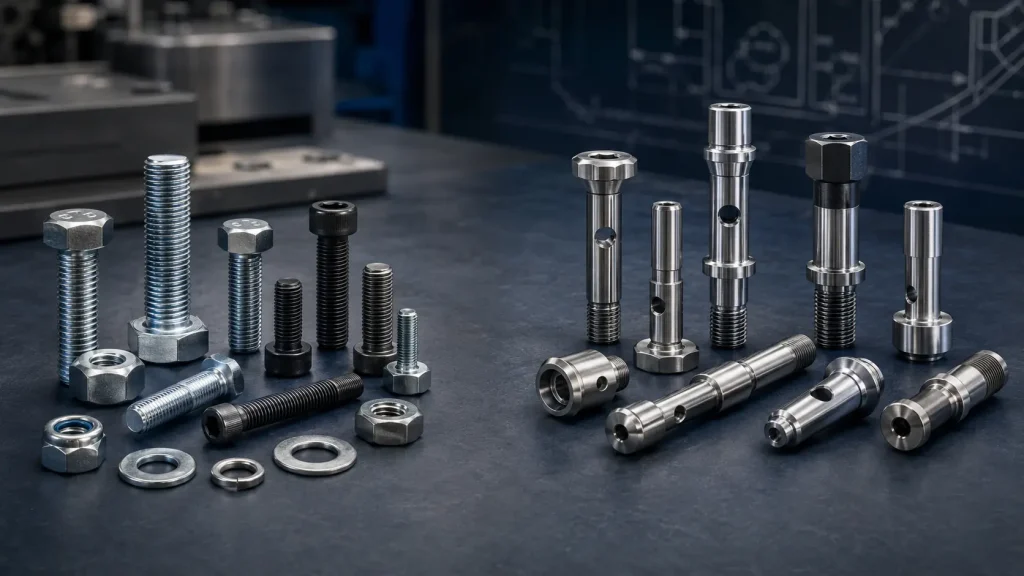
A standard fastener follows a recognised dimensional, thread, material and property-class system, and is normally selected from a supplier catalogue. Examples include common hex-head bolts, socket screws, nuts, washers and pins. Standardisation makes interchangeability, inspection and replacement easier, but it does not mean that every combination of diameter, length, grade and coating is held in stock by every distributor.
A modified-standard fastener starts with a known catalogue or standard-form part and receives a controlled change: a special length, reduced shank, cross-hole, machined shoulder, slot, captive feature or project-specific coating. This can be an efficient middle ground, although modification may affect strength, thread engagement, finish integrity or the validity of the original certification.
A fully custom fastener is defined by an engineering drawing because its geometry, material condition, tolerance, drive feature, coating, identification or performance requirement is not adequately covered by an available standard item. Custom does not automatically mean stronger or better; it means that the customer must define and verify the characteristics that make the part fit for purpose.
| Decision factor | Standard | Modified-standard | Fully custom |
| Initial unit cost | Usually lowest for stocked sizes | Base part plus secondary operation | Higher at low volume; may fall with scale |
| Development cost | Minimal selection work | Drawing and process review | Engineering, setup/tooling and validation |
| Lead time | Shortest only when genuinely in stock | Stock availability plus processing | Material, tooling, production and inspection route |
| Performance fit | Good when standard features meet the duty | Targeted improvement with limited redesign | Application-specific, subject to verification |
| Replacement | Broadest sourcing options | Controlled supplier or conversion route | Drawing-controlled and supply-plan dependent |
Cost: Compare the Complete Economic Picture
For a stocked standard fastener, the purchase price reflects established tooling, large production volumes and a shared market. That usually makes it the economical choice for prototypes, maintenance parts and assemblies that can accept common dimensions. However, low catalogue price can be offset by extra washers, spacers, brackets, manual orientation, difficult tool access, repeated tightening or inventory carried across several part numbers.
Custom fastener quotations may include non-recurring engineering, programming, special tooling, gauges, first article inspection, heat treatment, coating, testing and material minimums. These costs are concentrated at the beginning of the programme and can make a small batch look expensive. At stable volumes, a well-designed fastener may reduce assembly operations, consolidate components, prevent incorrect installation or eliminate rework. The relevant measure is then cost per completed assembly—not simply cost per fastener.
Buyers should separate recurring unit price from one-time charges and ask how each changes at prototype, pilot and production quantities. Tooling ownership, expected tool life, material yield, scrap allowance, inspection frequency, packaging and price breaks should be visible. A custom design is commercially strongest when it solves a measurable problem: fewer parts, shorter cycle time, lower warranty risk, better ergonomics or a longer service interval.
Lead Time: Availability Is More Than a Catalogue Listing
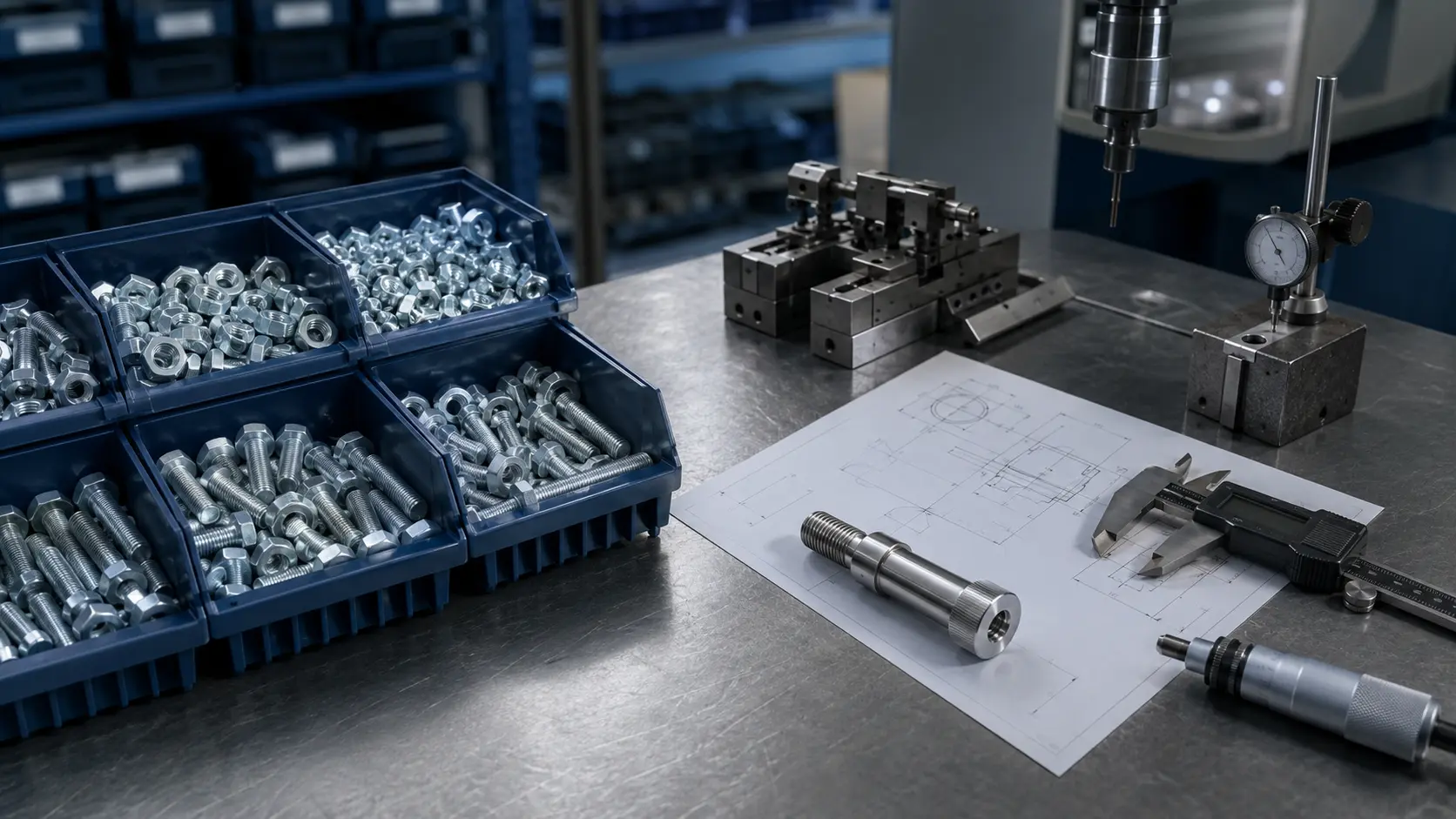
A standard fastener is fastest when the exact size, property class, material and finish are physically available. A catalogue line that is made to order can still carry a substantial production lead time. Procurement should confirm stock location, available quantity, lot consistency, documentation and replenishment time instead of relying on a nominal listing.
Custom lead time depends on the manufacturing route. A small batch of turned parts may require material procurement, programming, workholding, machining and inspection. A cold-headed or forged production part may require dedicated tooling and sample approval before volume manufacture, but can become faster and more economical per piece once the process is established. Heat treatment, coating, passivation, third-party testing or customer witness points add further stages.
Schedule risk is reduced when the drawing is complete, specifications are current and the approval route is agreed before purchase. Buyers should also plan beyond the first delivery: define safety stock, tooling maintenance, second-source strategy, raw-material commitments and the process for design revisions. A custom part with a stable forecast can be easier to manage than an unusual “standard” part that repeatedly disappears from distribution.
Performance: Design the Joint, Not Just the Fastener
Mechanical strength is only one element of fastener performance. The joint must develop and retain the required clamp load without yielding, loosening, fatigue damage, thread stripping or unacceptable deformation of the clamped parts. Head geometry, shank diameter, thread run-out, engagement length, under-head bearing area and installation torque all influence the load path. A custom feature can improve packaging or assembly, but a reduced head or unusual transition can also introduce a weaker section that requires calculation and validation.
Material and property class must be specified independently of shape. Carbon and alloy steel fasteners may be selected by defined mechanical property classes, while corrosion-resistant stainless fasteners use their own grade and property class systems. Temperature, fatigue, shear, corrosion and torque–clamp behaviour are not automatically covered by a generic material callout. The application should therefore define the governing standard, service temperature and any additional proof-load, hardness, tensile or fatigue evidence.
Environment also changes the decision. Stainless grade, plating or other coating must suit moisture, chlorides, chemicals, outdoor exposure and the mating materials. Coating thickness can affect thread fit, and lubricated finishes change the relationship between installation torque and preload. High-strength electroplated steel needs explicit control of hydrogen-embrittlement risk. Galvanic compatibility, galling, paint systems and future maintenance should be reviewed as part of the complete joint.
When Standard Fasteners Are the Better Choice
- the required diameter, length, head style, drive, thread, material and property class are readily available;
- the joint can meet its load and environmental requirements without special geometry;
- field replacement, multi-supplier availability and low inventory complexity are important;
- prototype or low-volume demand does not justify dedicated setup, tooling or validation;
- a recognised specification provides the documentation and inspection basis required by the customer;
When a Custom Fastener Can Earn Its Cost
- the available space requires a special head, shoulder, shank, drive or anti-rotation feature;
- a captive or multi-function design can eliminate parts and shorten assembly time;
- the load path, sealing interface, alignment or controlled breakaway behaviour cannot be achieved with catalogue parts;
- service temperature, corrosion exposure, tamper resistance or identification requires a controlled material and finish combination;
- high recurring volume, costly installation or severe failure consequences justify application-specific optimisation;
Choose the Manufacturing Route Early
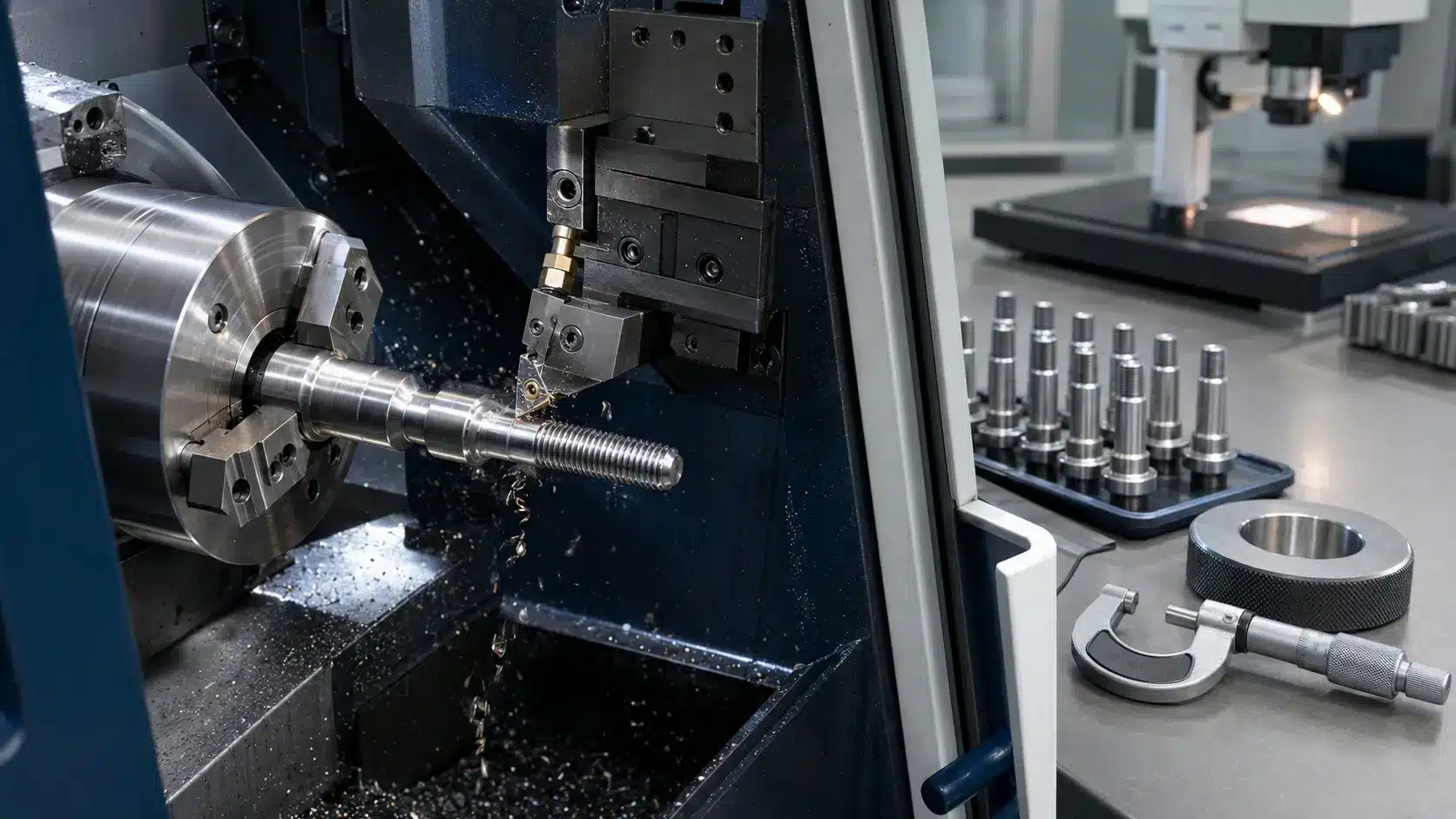
The most economical process follows geometry and volume. Axisymmetric studs, shoulder screws, pins and special shanks are natural candidates for CNC turning, which can combine diameters, grooves, drilling and threading in a controlled setup. Flats, slots, pockets, drive features or non-axisymmetric details may add CNC milling. Nova’s broader machining services can be reviewed when a part needs several complementary operations.
Machining is flexible for prototypes and low-to-medium quantities, but it can remove material slowly compared with forming. Cold heading or forging can deliver high material utilisation and production speed at scale, although tooling cost and geometry rules become more significant. Secondary thread rolling, cutting, heat treatment, grinding, coating or marking may still be required. The supplier should confirm the proposed route, process capability and subcontracted stages before design release.
The Modified-Standard Middle Ground
Before commissioning a completely new fastener, test whether a standard base part can be converted safely. Shortening a bolt, adding a cross-hole or machining a shoulder may preserve some sourcing and tooling advantages. The drawing must still control the finished part, and engineering should assess whether the change cuts through a coating, reduces effective thread engagement, alters hardness, damages rolled-thread run-out or invalidates the original manufacturer’s certificate. Traceability should distinguish the modified lot from unmodified stock.
Inspection and Documentation Expectations
Standard fasteners are not inspection-free. The purchase order should identify the exact standard and revision, dimensions, property class, finish, marking and required certificates. For custom parts, the approved drawing becomes the primary acceptance document. It should define datums, critical dimensions, thread tolerance class, material condition, mechanical requirements, coating and any special characteristics.
Depending on risk and contract scope, evidence may include material certificates, heat or lot traceability, a dimensional or first article report, thread plug or ring gauge results, hardness, tensile or proof-load testing, coating thickness and process certificates. Salt-spray, fatigue or torque–tension testing should be requested only when the specification and acceptance criteria make the result meaningful. Nova outlines project-specific inspection and documentation controls on its quality approach page.
Custom Fastener RFQ Checklist
A complete request for quotation helps suppliers choose the correct process and quote comparable scope. Include:
- latest 2D drawing and, where useful, a 3D model with revision status and units;
- joint function, design loads, duty cycle, service temperature and failure consequences;
- thread form, size, pitch, hand, tolerance class, engagement length and mating-part information;
- head, drive, shoulder, shank, under-head radius, datums, critical tolerances and surface-finish requirements;
- material grade, condition, mechanical property class, hardness and heat-treatment requirements;
- coating, passivation, lubrication, colour, thickness and corrosion or chemical exposure requirements;
- inspection plan, first article, test methods, sampling, certificates, lot traceability and marking;
- prototype quantity, annual demand, release quantities, target delivery, packaging and substitution policy;
Frequently Asked Questions
Are custom fasteners always more expensive?
They usually carry more development and setup cost, especially at low volume. They can nevertheless reduce total assembly cost or failure risk, and dedicated forming can lower unit cost at sufficient volume. Compare lifecycle economics, not only the first purchase order.
Can a standard fastener be modified?
Yes, provided the finished part is drawing-controlled and the change is reviewed. Machining, drilling or refinishing may affect strength, coating, threads and the applicability of the original certificate, so the modified part should not be treated as unchanged catalogue stock.
What quantity makes a custom fastener economical?
There is no universal threshold. Geometry, material, tooling, inspection and assembly savings matter as much as annual quantity. Machining may suit tens or hundreds of parts, while dedicated forming normally needs a larger and more stable programme to amortise tooling.
Does custom mean higher performance?
No. Custom geometry creates the opportunity to match a specific joint, but its performance must still be calculated, manufactured and verified. A standard fastener with a well-understood property class is often the safer choice when it already meets the duty.
Make the Choice at Assembly Level
The best fastener is the least complex option that meets the complete requirement. Standard parts support rapid sourcing and interchangeability; modified-standard parts solve focused packaging or assembly problems; fully custom parts are justified when geometry, environment, performance or lifecycle cost demands a controlled design.
Nova Fabrication can review fastener geometry, material, tolerances, manufacturing route and documentation through its engineering services and coordinated metal manufacturing capabilities. To evaluate a project, request a quote with the drawing, application requirements, forecast quantities and applicable standards.