


A warehouse rack is not safe because its shelf plate looks thick or because a supplier quotes one impressive capacity figure. Load capacity belongs to a defined system: shelf decks, beams, uprights, bracing, connectors, base plates, anchors and the supporting floor all work together. Change the span, beam elevations, load position or installation conditions and the permissible load may change as well.
That makes specification more important than guesswork. A buyer should state what will be stored, how it will be placed, the maximum weight at each level and the environment in which the rack will operate. Nova Fabrication’s warehouse and shelf solutions can then be discussed around the actual application rather than a generic kilogram rating.
Key takeaway: the safe capacity is the lowest permissible value in the complete load path. A shelf, beam or upright rating must never be used as a substitute for an engineered system rating tied to a specific configuration.
What Does “Load Capacity” Actually Mean?
The first step is to define the capacity being discussed. A quotation that says “1,000 kg capacity” is incomplete unless it identifies the component, load distribution, configuration and units. The following terms should be separated in drawings, calculations and load notices.
Term | What it describes | Specification implication |
Shelf or level load | Permissible load on one shelf deck or one beam level. | State whether the rating assumes a UDL, pallets or defined support points. |
Bay load | Combined permissible load carried by all levels between two upright frames. | Do not multiply a level rating without checking the frame and configuration. |
Frame capacity | Capacity of uprights and bracing for a stated height and beam-level spacing. | Changing the first beam height or level positions can change the rating. |
UDL | Uniformly distributed load spread approximately across the supporting area. | Useful only when actual goods genuinely distribute load in that way. |
Point load | Concentrated reaction from a foot, wheel, bin, machine part or pallet runner. | Give magnitude, footprint, number and exact position of each reaction. |
Floor/anchor capacity | Ability of the slab and anchorage to transfer base reactions safely. | Confirm slab data, anchor design and installation requirements separately. |
Why Two Similar Shelves Can Carry Different Loads
Sheet thickness matters, but it is only one variable. Steel grade, clear span, shelf depth, folds, return flanges, ribs, stiffeners and the number of supports can change both strength and deflection. Connections also matter: a bolted bracket, hook-in beam, welded joint and formed tab transfer load differently. Manufacturing tolerances and local cut-outs can further affect the result.
The upright frame is equally configuration-dependent. Its capacity is influenced by unbraced length, frame depth, bracing pattern, connector stiffness and the vertical spacing of beam levels. Raising the lowest beam or removing a level can make an upright less stable even when the stored product does not change. Capacity tables are therefore valid only for the manufacturer, component series and arrangement for which they were developed.
Uniformly Distributed Loads vs Concentrated Loads
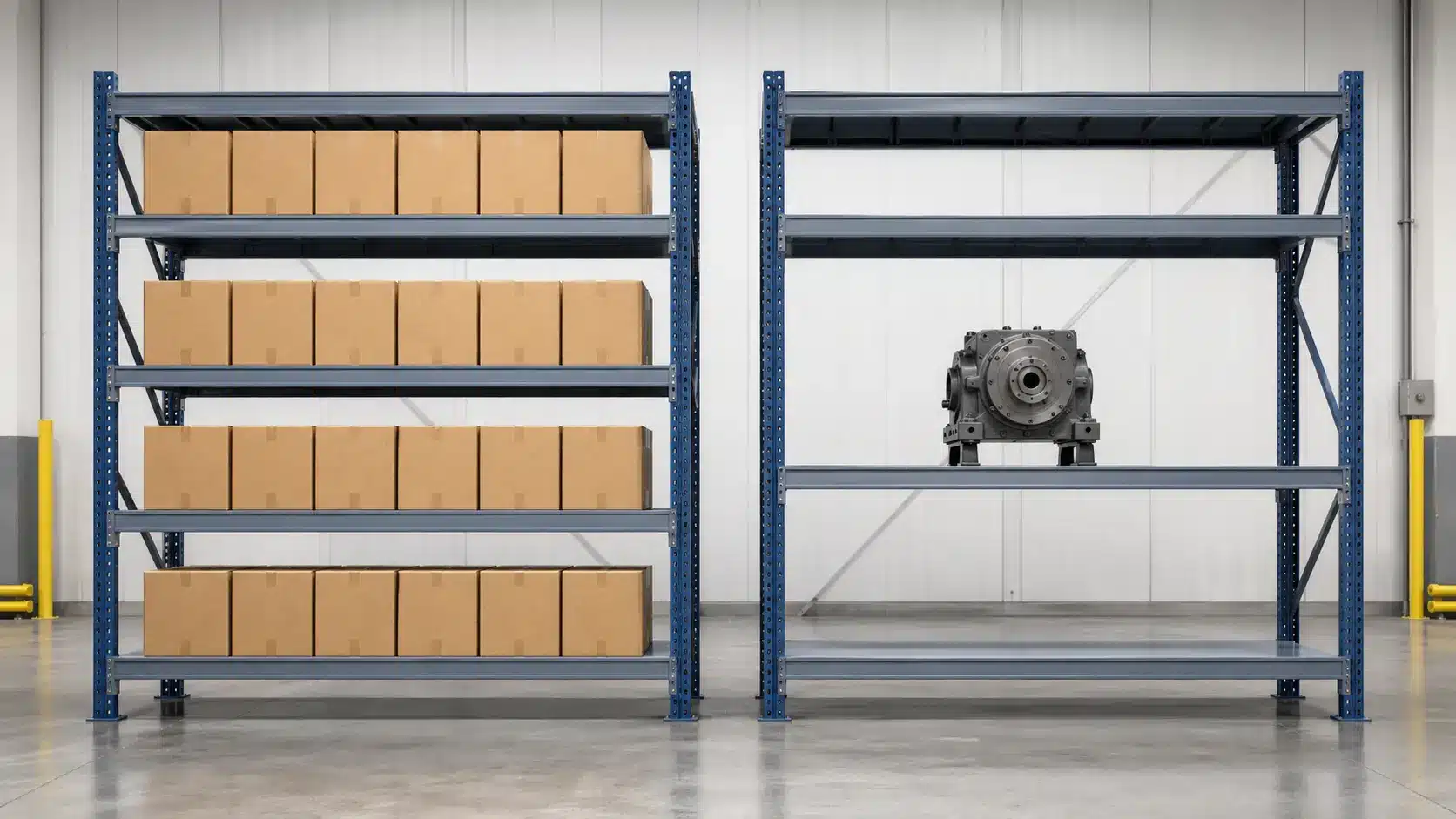
A UDL spreads weight over the supporting surface. Small cartons covering most of a shelf may approximate this condition. A gearbox resting on four feet, a coil on two timbers or a tote supported only along its edges creates concentrated reactions. The total weight could be identical, yet local bending and deflection can be much higher under the concentrated load.
For that reason, buyers should not convert a UDL rating into a point-load rating. Provide the load footprint and location, including any off-centre placement. If operators may store several product types, design for the most demanding credible case and control the permitted arrangement with dividers, supports or clear load instructions.
Follow the Complete Load Path
The load path normally runs from the goods into a shelf deck or pallet, through beams or rails, into upright frames and bracing, then through base plates and anchors into the floor slab. Every interface must remain stable and serviceable. A strong shelf on undersized beams is unsafe; strong frames on an unsuitable slab are also unsafe. Deflection, sway, connector behaviour and accidental eccentricity can govern before a component reaches its nominal material strength.
This is why project-specific engineering review should establish the governing standard, load combinations, serviceability limits and responsibilities. Physical load testing may support product development or verification, but it does not replace structural design unless an applicable standard provides a controlled test-based route.
Information to Define Before Design Starts
A usable warehouse shelf specification should describe the real operating conditions. At minimum, provide:
- rack type, overall height, bay width, depth, number of levels and required adjustability;
- maximum item, pallet or container weight, dimensions, support points and centre of gravity;
- maximum shelf/level load and maximum bay load, clearly distinguishing UDL from concentrated loads;
- manual, trolley, forklift, stacker-crane or automated loading method, including likely impact exposure;
- aisle, access, egress, sprinkler, lighting and material-handling clearances required by the facility;
- slab thickness, concrete strength, reinforcement, joints, levelness and any limits on drilling or anchors;
- indoor, outdoor, humid, refrigerated, hygienic, chemical or corrosive environmental conditions;
- site wind or seismic requirements, local building rules and the authority having jurisdiction;
- future expansion, relocation or beam-level changes that should be accommodated without unsafe improvisation;
Load Cases, Safety Factors and Serviceability
Design loads may include the self-weight of the rack and stored goods, non-uniform loading, placement tolerances, horizontal forces, handling impact and environmental actions where applicable. Seismic design needs its own site and system inputs. There is no universal safety factor that a buyer should add to a catalogue number; the selected design standard defines the appropriate limit states, factors and combinations.
Strength alone is not enough. Excessive shelf or beam deflection can make containers unstable, reduce clearances and impair handling. Excessive sway or out-of-plumb installation can change how load is shared. The acceptance criteria should therefore cover both ultimate resistance and serviceability for the intended operation.
Floor, Anchors and Installation Are Part of Capacity
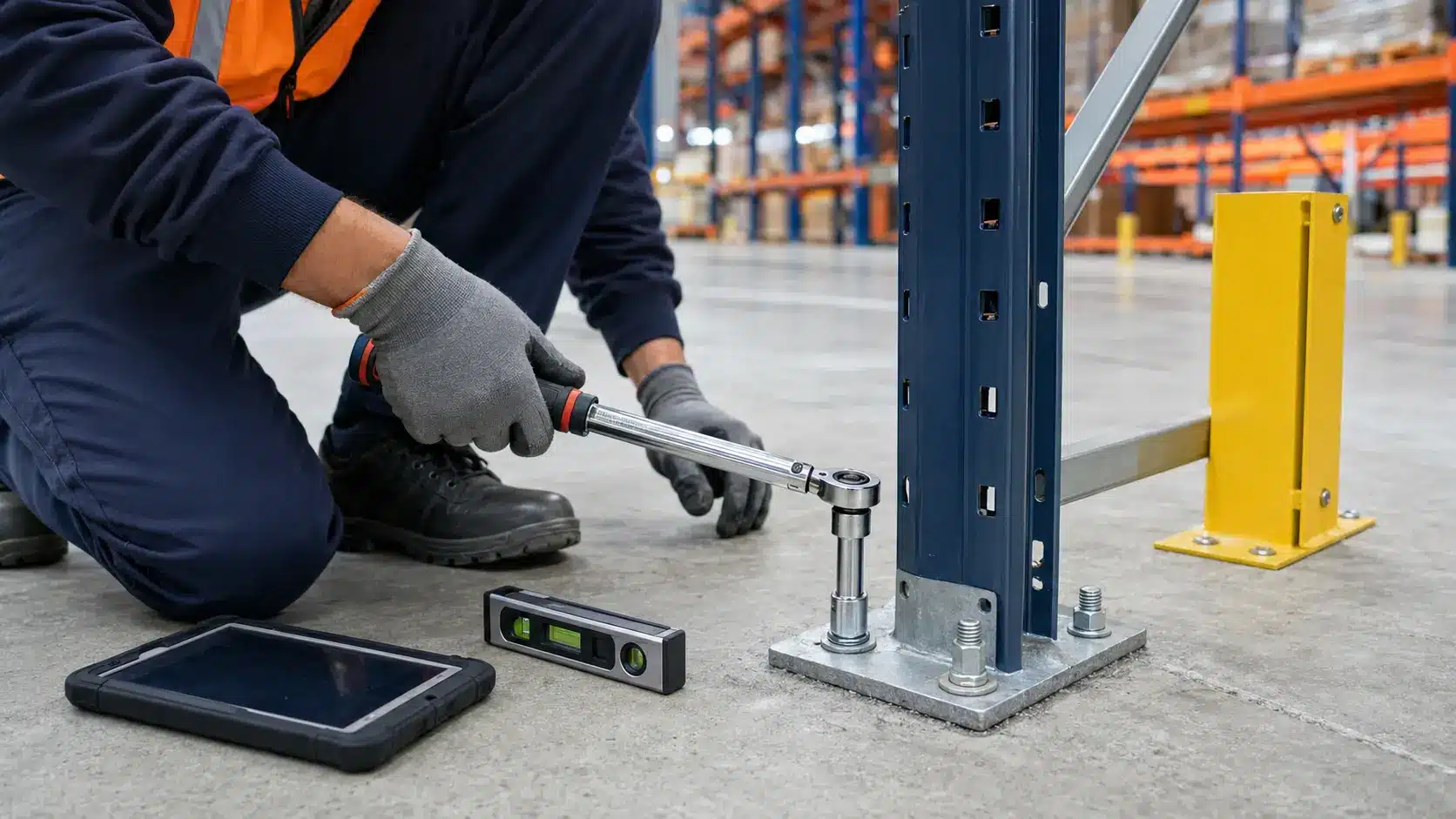
Rack reactions are delivered to a relatively small footprint. The slab assessment should address concrete properties, reinforcement, joints, edges, embedded services and local bearing. Anchor type, diameter, embedment, edge distance and installation torque must follow the engineered design and the approved anchor instructions. Shims or grout should not create unstable bearing conditions.
Installation quality should be recorded: rack location and orientation, frame plumbness, beam elevations, connector locks, bracing, base plates, anchors and protective devices. A correct drawing manufactured accurately can still lose capacity through poor erection or unauthorized field modification.
Manufacturing Quality Supports the Design Rating
Repeatable dimensions help the assembled system behave like the design model. Processes such as sheet metal laser cutting and metal bending influence hole position, profile geometry, fit-up and interchangeability. Where the design uses permanent joints, controlled welding services are important for connection integrity and distortion control.
Inspection may include material certificates, dimensional checks, connector or component tests, weld inspection and first-article verification. The finish should match the environment without hiding defects or interfering with assembly. Nova’s coating services include options that can be evaluated for appearance and corrosion protection, but the specification should define preparation, coating system, colour, thickness and acceptance criteria.
Load Notices and Configuration Control
A visible load notice should match the approved rack configuration. Depending on the system and applicable standard, it may identify the rack model or location, maximum unit or UDL per level, maximum bay load, number and elevation of levels, loading assumptions, drawing or calculation reference, supplier and revision date. Units must be unambiguous.
Operators should not move beams, remove braces, mix components, add levels, alter anchors or repair damage without approval. If a configuration changes, the design and load notice should be reviewed and updated before the rack returns to service. For broader application context, Nova’s article on metal shelf production for warehouses and industrial facilities explains how dimensions, material, load and finish choices affect a custom system.
Inspection and Maintenance After Handover
Handover should include approved drawings, load notices, installation records and inspection or test documents required by the contract. During use, personnel should report impact, bent uprights, damaged bracing, displaced beams, missing locks, loose anchors, corrosion, overloading or unstable goods. Affected bays should be unloaded or isolated when the responsible competent person considers continued use unsafe.
Routine visual checks and periodic expert inspections should follow the applicable standard, local rules, risk level and manufacturer guidance. A damaged member should not be straightened, welded or reinforced on site merely because it looks repairable. Repair or replacement requires an approved method that restores the documented system capacity.
Warehouse Racking RFQ Checklist
- layout drawing with rack locations, bay dimensions, levels, aisles and clearances;
- unit-load schedule showing maximum and typical weights, dimensions, support points and handling method;
- required shelf/level load, bay load and UDL or point-load assumptions;
- site, slab, anchorage, seismic, wind, fire-protection and environmental information;
- material grade, finish, colour, corrosion category and any hygiene or cleaning requirements;
- governing standard and jurisdiction, calculation responsibility and required design sign-off;
- inspection, first article, testing, certificates, traceability and handover-document requirements;
- installation scope, barriers, load notices, spare parts, training, inspection plan and change-control process;

Frequently Asked Questions
Can shelf capacity be calculated from sheet thickness alone?
No. Thickness is only one input. Grade, span, folds, stiffeners, supports, holes, connections, deflection limits and load position all affect capacity. The complete system and configuration must be evaluated.
Is shelf capacity the same as bay capacity?
No. Shelf or level capacity applies to one supporting level; bay capacity limits the combined load between upright frames. Uprights, bracing, base plates, anchors or the floor may govern before all individual levels reach their separate ratings.
Can beam levels be moved after installation?
Only after the revised arrangement has been checked. Beam spacing affects upright stability and frame capacity. The approved drawing and load notice should be updated when a change alters the design assumptions.
Does a load test replace structural calculations?
Not automatically. Testing can validate defined components or configurations, but a safe design must follow the applicable standard and a competent engineering route. A one-off test also cannot represent every load position, damage state, installation condition or future configuration.
Specify the System, Not Just a Capacity Number
A safe warehouse rack specification connects the goods, load distribution, shelf geometry, frame configuration, anchors, floor, environment and operating method. It also defines how the rating will be documented, displayed, inspected and controlled when the warehouse changes.
Nova Fabrication’s custom metal shelf production can be evaluated against project-specific dimensions, materials and finishes. To start a technical and commercial review, request a quote with the layout, load schedule, site information, required standards and handover documents.