
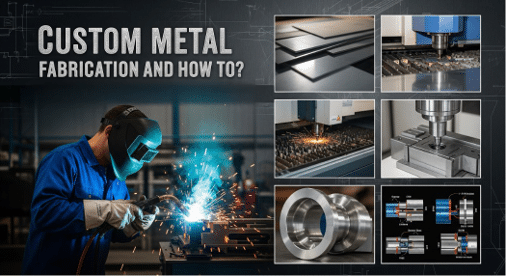
In the modern industrial world, off-the-shelf solutions rarely fit the complex demands of today’s engineering challenges. Whether it is a structural component for a skyscraper, a delicate chassis for medical electronics, or robust agricultural machinery, the answer almost always lies in Custom Metal Fabrication.
But what exactly goes into this process? How does a flat sheet of steel become a high-performance product?
At Nova Fabrication, we believe that understanding the “How-to” of metal fabrication is just as important as the final product itself. This guide will walk you through the intricacies of custom metal manufacturing, detailing the journey from a digital concept to a tangible reality, and explain why choosing the right partner is the most critical step in the supply chain.
Understanding the Core: What is Custom Metal Fabrication?
Custom metal fabrication is not a single action; it is a comprehensive value-added process that involves constructing structures and machines from various raw materials. Unlike mass production where millions of identical parts are stamped out, custom fabrication focuses on tailored solutions designed to meet specific dimensions, tolerances, and functions.
Typically, this process involves working with a variety of metals, including:
- Carbon Steel: Known for its strength and structural integrity.
- Stainless Steel: Valued for its hygiene and corrosion resistance.
- Aluminum: Prized for its lightweight properties and heat dissipation.
- Copper and Brass: Used for conductivity and aesthetics.
The “How-to” of this industry is a blend of traditional craftsmanship and cutting-edge technology. It requires a facility that can seamlessly switch between heavy-duty welding and microscopic laser cutting precision—a versatility that defines the operational capability of Nova Fabrication.
Phase One: Design, Engineering, and Prototyping
Every successful fabrication project begins long before the metal touches the machine. It starts in the engineering department. The “How-to” here revolves around Design for Manufacturability (DFM).
In this phase, engineers use CAD (Computer-Aided Design) software like SolidWorks or AutoCAD to create 3D models of the part. This isn’t just about drawing lines; it is about simulating the physical properties of the metal.
- Stress Analysis: Will the part hold up under load?
- Bend Allowances: When we bend metal, it stretches. Engineers must calculate the “K-factor” to ensure the final dimensions are accurate after bending.
- Nesting: To minimize waste, parts are digitally arranged on a virtual sheet of metal to get the maximum yield.
At Nova Fabrication, our engineering team works closely with clients during this stage to suggest design tweaks that can reduce production costs without compromising quality.

The Cutting Process: Precision at the Speed of Light
Once the design is finalized, the physical work begins with cutting. In the past, this was done with shears and saws. Today, the standard for high-quality custom metal fabrication is Laser Cutting.
How does it work? A high-powered beam of light (often a Fiber Laser) is focused onto the material surface. The energy density is so high that the metal melts and vaporizes instantly. A jet of gas (Oxygen or Nitrogen) blows away the molten material to leave a pristine edge.
This method offers several advantages:
- Extreme Precision: Tolerances can be held within +/- 0.1mm.
- Clean Edges: Often eliminating the need for secondary deburring processes.
- Complex Geometries: Lasers can cut intricate shapes and holes that mechanical punches simply cannot achieve.
For thicker plates or materials that reflect light (like copper), other methods like Waterjet or Plasma cutting might be used, but for the majority of precision sheet metal work, the laser is king.
Forming and Bending: The Art of Shaping Metal
After cutting, the flat part (the blank) usually needs to be formed into a 3D shape. This is where CNC Press Brakes come into play. This is one of the most skill-intensive parts of the “Custom Metal Fabrication” process.
The Process: The operator (or a robotic arm) places the flat metal between a punch and a die. The press brake exerts tons of force to bend the metal at a precise angle.
- Air Bending: The most common method, where the punch pushes the metal into the die but doesn’t bottom out. It allows for various angles using the same tooling.
- Bottoming: The punch presses the sheet completely into the die for high precision.
Consistency is key here. Variations in material thickness or grain direction can affect the bend angle. Advanced fabrication shops, like Nova Fabrication, use CNC brakes with automatic angle measurement systems to correct these variations in real-time, ensuring that the 1000th part is identical to the 1st.

Finishing: The Final Touch for Durability
A raw metal part is rarely the finished product. It needs protection against the elements and a visual finish that matches the brand identity. The “How-to” of finishing usually involves Powder Coating.
Unlike wet paint, powder coating applies a dry thermoplastic powder electrostatically. The part is then cured in an oven, causing the powder to melt and form a hard “skin.”
- Durability: It is far more resistant to chipping and scratching than paint.
- Eco-Friendly: It emits near-zero VOCs (Volatile Organic Compounds).
- Variety: Available in thousands of colors and textures (matte, glossy, sand-textured).
Other finishing options include Anodizing (for aluminum) to increase corrosion resistance and surface hardness, or Plating (zinc, chrome) for conductivity and rust prevention.
Joining and Assembly: Welding and Fastening
Now that the components are cut and bent, they must be assembled. This is the stage where separate pieces become a unified structure.
Welding: This is the heart of fabrication. Depending on the material and requirement, different techniques are used:
- MIG (GMAW): Fast and versatile, great for structural steel.
- TIG (GTAW): Slower but produces high-quality, aesthetically pleasing welds, essential for stainless steel and aluminum.
- Spot Welding: Used for joining overlapping sheets without adding filler material.
Mechanical Assembly: Not everything is welded. Many custom enclosures or chassis require hardware insertion. This includes pressing in PEM nuts, studs, or standoffs that allow electronic components to be mounted later. This step requires strict attention to detail to ensure threads remain clean and usable.

How to Choose the Right Custom Fabrication Partner?
Understanding the process is one thing; executing it is another. When you are looking for a partner to handle your “Custom Metal Fabrication” needs, you are not just buying machine time; you are buying expertise.
Here is how to evaluate a potential partner:
- Capacity and Scalability: Can they handle a prototype run of 5 units and scale up to 5,000 units?
- Quality Control: Do they have ISO certifications? Do they use CMM (Coordinate Measuring Machines) to verify dimensions?
- End-to-End Service: Can they handle the entire lifecycle—from laser cutting to assembly and logistics?
This is where Nova Fabrication stands out. We integrate advanced machinery with a skilled workforce to offer a seamless fabrication experience. We don’t just follow drawings; we optimize them.
Engineering Your Success
Custom Metal Fabrication is a complex orchestration of technology, material science, and human skill. It is the process that builds the world around us, from the servers that host our data to the machinery that harvests our food.
Knowing “how to” navigate this process gives you a competitive edge. It allows you to design better products and choose partners who can deliver on quality and timeline.
Whether you have a rough sketch or a fully detailed CAD model, the journey from concept to metal reality requires a partner you can trust. At Nova Fabrication, we are ready to bring your vision to life with precision and passion.