
Introduction: The Critical Comparison of Sheet Metal Processing Methods
Modern industrial manufacturing is built upon precision, speed, and cost optimization. Sheet metal fabrication, in particular, forms the foundation of countless products, from electronic enclosures to automotive components. The success of any project depends heavily on selecting the correct sheet metal processing method.
The two most common and debated techniques in the market are CNC Laser Cutting and CNC Punching (Turret Punching). Although both technologies ostensibly serve the same purpose—to create the desired geometry from sheet metal—they differ fundamentally in their operating principles, cost structures, processing speeds, and final product quality.
This detailed guide provides a roadmap for engineers, procurement specialists, and manufacturers, helping you navigate the complex decision-making process to choose the most suitable cutting method for your project. We will examine, step by step, which technology best serves your project’s budget, timeline, and technical requirements.
Section 1: A Deep Dive into CNC Laser Cutting Technology
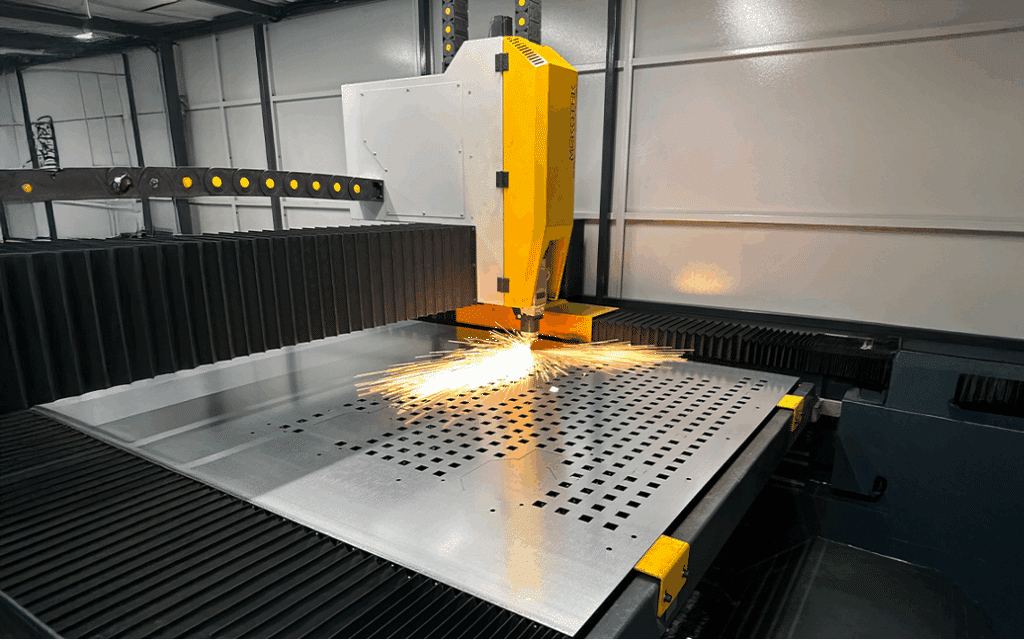
CNC Laser Cutting is a non-contact thermal process that cuts material by melting, burning, or vaporizing it using a focused beam of light (typically a Fiber Laser). The non-contact nature eliminates the risk of mechanical deformation, such as bending or wear.
The Working Principle of Laser Cutting: Shaping with Light
The process involves a series of precise steps to achieve the cut:
- Beam Generation: The high-efficiency Fiber Laser source, which is most common today, generates the light.
- Direction and Focusing: The generated light is directed and focused onto an extremely small point on the material via fiber optic cables and an optical lens system.
- Thermal Cutting: The focused laser beam instantly melts or vaporizes the material upon impact.
- Gas Assistance: A high-pressure gas (often Nitrogen, Oxygen, or Air) blasts the molten metal away from the cutting line (kerf), leaving a clean and smooth cutting edge.
Advantages of Laser Cutting: Why is it Preferred?
Laser cutting is favored for its inherent precision and flexibility. It delivers excellent edge quality and accuracy, resulting in smooth, burr-free edges that typically do not require secondary processing like grinding or deburring. Due to the flexibility and non-contact nature of the laser beam, it can effortlessly cut highly complex contours, sharp corners, and small internal features, making it incredibly versatile. Since the process is entirely software-driven using CAD, it requires no tooling cost for new or custom designs, a significant cost advantage for prototyping and low-volume production. Furthermore, the setup time is minimal, as the operator only needs to load the program and position the material. The narrow kerf also allows for tighter nesting, maximizing material utilization and reducing waste.
Disadvantages of Laser Cutting: Limiting Factors
Despite its strengths, laser cutting has drawbacks. The cutting speed decreases proportionally in thicker materials as the thermal effect has to penetrate deeper; past a certain thickness, punching can become faster. Fiber lasers are more efficient than older CO2 systems, but high power requirements still contribute to ongoing energy consumption. Historically, highly reflective materials like copper and brass were challenging due to the risk of the laser beam reflecting and damaging the optics, although modern Fiber Laser technologies have largely overcome this issue. Lastly, for operations requiring numerous repetitive holes, the laser cuts each hole sequentially, which can lead to significant time loss compared to punching.

Section 2: CNC Punching Technology (Turret Punching)
CNC Punching (or Turret Punching) is a mechanical process that cuts or forms sheet metal by applying force between a die (matrix) and a punch set. Essentially, it is the automated, industrial version of a paper hole puncher.
The Working Principle of Punching: Mechanical Force
The process utilizes mechanical force and pre-made tools:
- Tool Set: The machine houses a rotating turret containing numerous sets of punches and dies (matrix) in various shapes and sizes.
- Positioning: The sheet metal is rapidly moved and positioned to the desired cutting point on a CNC-controlled table (X-Y axes).
- Punching Action: The selected punch is driven through the sheet metal by hydraulic or mechanical force, completing the cut.
- Repetition: The machine can repeat this process incredibly fast to produce a series of holes and cuts.
Advantages of Punching: Speed in Mass Production
Punching is the undeniable speed leader for serial punching operations, such as cutting repetitive standard shapes (circles, squares, ovals, etc.) or hundreds of small holes on a sheet. The machine completes the entire hole-cutting process in a fraction of a second with a single stroke. A key advantage is its forming capability—punch presses can perform secondary operations such as threading, countersinking, small bending, and shaping (forming) within the same machine, eliminating the time and cost of external operations. As a mechanical process, its energy consumption is generally lower compared to laser cutting. Finally, it offers consistency in thicker materials; as long as the correct die is used, it provides the same cut quality regardless of thickness.
Disadvantages of Punching: Limitations and Costs
A major drawback is the tooling (die) cost, as purchasing a new punch and die set is required for every new or special shape. This significantly increases the initial investment for prototyping or low-volume production. Furthermore, its geometric flexibility is limited to the shapes available in the machine’s turret. Cutting round contours or complex shapes requires sequential hits (a process called “nibbling”), which is time-consuming and compromises edge quality. Since it relies on mechanical tearing and cutting, the edges are not as smooth as laser cuts; they typically include a burr and a fracture zone, often necessitating a secondary deburring or sanding process. Lastly, because the sheet moves on rollers, there is a higher risk of surface scratching on the material compared to the non-contact laser process.
Section 3: Head-to-Head Comparison of Laser and Punch Cutting – The Decisive Criteria
After reviewing the fundamental details, the focus shifts to a direct comparison of the tangible benefits each method offers for your project. Success in manufacturing relies on balancing variables such as tonnage, speed, tool life, and material costs. This section provides a detailed analysis across four key comparison points to aid your sheet metal processing decision.
3.1. Cost Dynamics: Initial Investment vs. Mass Production
Cost is arguably the most crucial factor in any production decision, and the cost dynamics of Laser and Punch cutting are fundamentally different. Laser cutting’s most significant cost advantage is zero tooling cost. Since the laser is a software-driven process, you do not need to invest in any additional hardware for a new part geometry. This dramatically increases flexibility and reduces the initial cost for low-volume production and prototyping.
Conversely, Punch Cutting necessitates a high initial investment in the tool set. You must purchase a set of punches and dies for every different shape and size. However, after this high initial investment, the energy and operational cost per piece for the punch machine tends to be lower than the laser. The power requirement of the laser source, especially when cutting thick materials, can increase operational expenses. In summary, Punching is advantageous long-term for high-volume, standard parts after the initial investment is amortized, while Laser cutting takes the cost lead for low-volume, frequently changing designs by eliminating the tooling cost.

Cost Factors | CNC Laser Cutting | CNC Punching |
Tooling Cost | None (Zero) | Very High (Required for every shape) |
Initial Investment | Machine cost is high. | Machine cost is medium-to-high. |
Operational Energy | High (Especially for thick material) | Low (Primarily based on mechanical force) |
Cost Per Piece (High Volume) | Medium/High | Low (Once tooling is amortized) |
Prototyping Cost | Very Low (Only programming) | Very High (Requires tool purchase) |
3.2. Relationship Between Speed, Volume, and Material Thickness
Speed is perhaps the most critical performance indicator, and making a general statement about “the fastest” can be misleading, as speed largely depends on the type of work being performed.
Punch Cutting is the absolute speed leader in serial punching operations, such as punching hundreds of identical holes on a sheet. The machine cuts a hole with a single stroke in milliseconds. The laser, however, must trace the contour of each hole sequentially. Therefore, for structures with dense hole patterns, such as ventilation grilles or electronic control panels, Punch cutting can achieve up to 60% time savings.
However, in complex contour cutting or parts with interlocking different shapes, Laser Cutting gains the speed advantage. The punch machine must perform sequential hits (nibbling) to create a complex contour, which is slow and inefficient. The laser traces the contour quickly with a single continuous beam movement.
When considering material thickness, the situation changes again. Laser Cutting typically dominates in thin sheets (below 4 mm). However, in thicknesses of 6 mm and above, the thermal process takes longer, and Punch Cutting can maintain its speed advantage, particularly for simple punching operations.
Speed and Capacity Comparison | Ideal CNC Laser Cutting | Ideal CNC Punching |
Serial Punching Speed | Slow (Cuts holes individually) | Very Fast (Punches in a single stroke) |
Complex Contour Speed | Very Fast (Continuous beam movement) | Slow (Sequential hitting) |
Thin Sheets (<4mm) | Leader | Fast |
Thick Sheets (>6mm) | Speed decreases | Maintains speed with high tonnage (for punching) |
3.3. Difference in Part Complexity and Edge Quality
Another critical distinction that directly affects the aesthetics and assembly quality of the project is the resulting edge quality. Laser cutting and Punch cutting offer fundamentally different results:
Laser Cutting: As a non-contact thermal process, the cutting edge is extremely smooth and typically burr-free. This superior edge quality means the part can proceed directly to the welding or bending stage, often completely eliminating the need for secondary processing (deburring/sanding). Laser’s greatest flexibility is its ability to produce the sharpest internal corners and the most intricate internal details flawlessly, without the constraints of a physical die.
Punch Cutting: Since it relies on a mechanical shearing and tearing force, the formation of a fracture zone and light burring on the underside of the sheet is inevitable, especially in thick material. This usually requires an additional deburring operation before assembly, adding extra cost and time. Moreover, when the punch machine cuts a complex internal contour, the sequential, overlapping hits of the punch create a “scalloped edge” effect. This can be aesthetically unacceptable and can reduce assembly precision.
3.4. Material Variety and Thickness Limitations
The type of material to be processed is one of the most significant technical factors limiting the capabilities of the two technologies.
CNC Laser Cutting has traditionally faced difficulties with highly reflective materials like copper and brass because the thermal process carries a risk of the beam reflecting and damaging the optics. Although high-power Fiber Lasers have largely overcome this barrier, the risk persists. However, it is highly capable of cutting materials like aluminum, stainless steel, carbon steel, and even some plastics with high quality. Its thickness limit is generally around 25 mm for steel and 15 mm for stainless steel; beyond this, efficiency rapidly declines.
CNC Punching does not have a thermal limitation. In theory, it can cut any material as long as the machine has enough power (tonnage). However, the material type directly affects tool life. Very hard and abrasive materials cause the dies to wear out quickly, leading to a need for more frequent sharpening or replacement. In terms of thickness limits, 6 mm steel is generally ideal; in thicknesses of 8 mm and above, the bending and tearing effect becomes too great, making punching technically more difficult and resulting in lower quality.

Section 4: Advanced Capabilities and Their Impact on Production Strategy
The choice between Laser and Punch cutting is not limited to just cutting speed; it is also closely related to the value-added operations the machine can perform on the sheet metal beyond simple cutting and how it integrates into the overall manufacturing workflow. This analysis is critical for companies looking to minimize secondary processing costs.
4.1. Forming and Secondary Process Integration: The Unique Power of Punching
CNC Laser Cutting is, by its nature, a cutting operation. It can only create two-dimensional planar cuts on the material and lacks any three-dimensional forming capability. CNC Punch Presses, on the other hand, possess incredible forming power thanks to specialized die sets that can be integrated into the machine’s turret. This capability makes punching unrivaled in certain niche applications:
- Countersinking: A countersink form can be applied around a hole to allow bolt heads to sit flush with the sheet surface.
- Tapping: Immediately after a hole is punched, a special tool on the punch can create the screw threads, eliminating the need to use weld nuts or perform a separate external operation.
- Louvers and Embossing: Three-dimensional forms like louvers (for ventilation) and aesthetic embossing can be created by shaping the sheet metal with a single stroke.
This secondary process integration makes Punch Cutting incredibly cost- and time-efficient for the high-volume production of assembly-ready parts. With a single machine and a single setup, the part is both cut and endowed with all the necessary details for assembly (threads, ventilation channels, etc.). In laser cutting, each of these operations would require the part to be removed from the machine and processed at a separate station (e.g., a manual tapping machine or a press).
4.2. Material Utilization and Nesting Efficiency
Minimizing material waste is one of the biggest competitive advantages in sheet metal processing costs. Both Laser and Punch cutting use Nesting software to efficiently place parts onto the sheet metal. However, each has its own limitations:
- Laser Cutting: The narrowness of the laser beam (leaving a narrow kerf) allows parts to be placed very close together, even sharing a common cut line. This high flexibility allows for the use of nearly the entire sheet, minimizing material waste (scrap rate). Laser Cutting is superior in nesting efficiency, particularly for free-form parts.
- Punch Cutting (Turret Punching): Due to the physical dimensions of the punch tool, a certain safety distance must be maintained between each punching operation. This means parts cannot be placed as closely together as with a laser, resulting in more empty space (scrap) on the sheet. This factor can increase the material cost of Punch cutting, especially when using expensive materials like stainless steel or aluminum.
4.3. Software and Automation Integration
Although both technologies are CNC-controlled, their programming complexity differs. In Laser Cutting, the CAD drawing is translated directly into machine code; the software’s main focus is optimizing the cutting path and ensuring the best nesting.
In Punch Cutting, the role of the CAD/CAM software is more complex. The software must not only arrange the parts but also decide which hole to punch with which tool, optimize the tool change sequence, and create a tool path that avoids hitting the sheet holders (clamps) that secure the metal to the table. This complex process requires a higher level of expertise from both the operator and the software.
Section 5: Decision Matrix and Optimal Selection
Having thoroughly examined all the technical, cost, and operational factors of Laser and Punch cutting, we can now establish a final matrix to make a definitive decision for your project. It must be remembered that there is no single “best” technology; there is only the solution most suitable for the project’s requirements.
5.1. The Decision Tree for Your Project: Choosing the Right Path
The following questions will help you clearly define your project and guide you toward the correct method:
- How Complex is the Part Geometry?
- Very complex contours, sharp corners, small internal details? → Laser Cutting.
- Consists primarily of standard shapes like circles or squares? → Punch Cutting.
- What is the Volume of the Part?
- Low-volume runs (1–100 pieces) or prototypes? → Laser Cutting (Avoids tooling costs).
- Very high-volume mass production (10,000+ pieces)? → Punch Cutting (Cheapest cost per piece once the initial investment is amortized).
- Is Secondary Processing Required?
- Does the part require forming operations like threading, louvers, or countersinks? → Punch Cutting (Integrated solution in one machine).
- Is only a clean cut needed with no forming? → Laser Cutting (Smooth edge, no need for secondary deburring).
- What is the Material Thickness?
- Mainly thin sheets (below 4 mm)? → Laser Cutting (Faster and higher quality).
- Mainly thick materials (6 mm and above)? → Laser Cutting (Still preferred for quality, but Punching is an alternative for punching).

5.2. The Final Decision Matrix
Project Criterion | Laser Cutting is Ideal | Punch Cutting is Ideal |
Geometry Type | Complex, sharp-cornered, variable contours. | Standard shapes, rectangular panels, densely hole-filled grids. |
Production Volume | Prototype, Low, and Medium-Volume Runs. | High-Volume, Repetitive Mass Production. |
Edge Quality Need | Smooth, burr-free (Aesthetic products). | Cleaning/Deburring process acceptable (Functional products). |
Forming Need | No (Requires a separate press machine). | Yes (Operations like threading, louvers, countersinks in one machine). |
Material Efficiency | High (Excellent nesting capability). | Medium (Scrap increases due to safety distances). |
The Balance of Technology and Engineering
CNC Laser Cutting and CNC Punch Cutting are the two pillars of sheet metal fabrication. Laser Cutting is an indispensable solution, especially for engineering and prototyping projects, with its superior flexibility, precise edge quality, and zero tooling cost. Conversely, Punch Cutting maintains its cost leadership in high-volume production of assembly-ready parts due to its unparalleled speed in repetitive punching and its single-machine forming capability.
Making the optimal choice requires understanding not only the advantages of these technologies but also their operational and cost constraints. A successful manufacturing firm should house both technologies in its machine park to offer the most suitable, efficient, and cost-effective solution for every project. Determining which of these two powerful technologies will create the highest value for your specific project is a critical step that requires professional engineering expertise.