
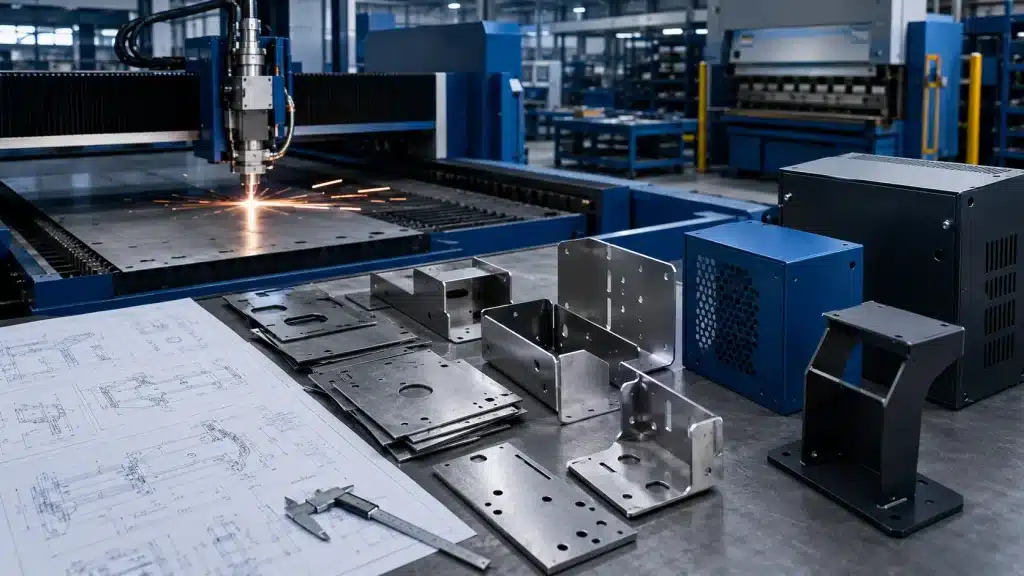
A successful metal fabrication project does not begin with cutting, bending, or welding. It begins with a clear technical drawing and a well-planned production process. Every detail, from material selection to surface coating, affects the final quality, durability, and performance of the product.
In custom metal fabrication, each project has its own requirements. Dimensions, tolerances, material type, joining methods, surface finish, and application conditions must be evaluated before production begins. When these steps are managed correctly, the result is a reliable, functional, and long-lasting metal product.
At Nova Fabrication, we support custom metal manufacturing projects from technical drawing review to final delivery. Our production capabilities include laser cutting, bending, machining, welding, assembly, coating, and quality control.
What Is the Metal Fabrication Process?
The metal fabrication process includes all stages required to transform raw metal materials into finished products or components. This process may involve cutting, forming, machining, joining, coating, inspection, and packaging.
A typical metal fabrication process includes:
- Technical drawing review
- Material selection
- Production planning
- Laser cutting
- Bending and forming
- CNC machining
- Welding and assembly
- Surface coating
- Quality control
- Packaging and delivery
Each stage plays an important role in the final result. Even a small mistake in the early planning phase can affect production time, cost, and product quality.

Technical Drawing Review
The first step in the metal fabrication process is reviewing the technical drawing. A technical drawing shows the dimensions, tolerances, material specifications, hole positions, bending angles, welding points, and finishing requirements of the part.
A clear and accurate drawing helps reduce production errors and ensures that both the customer and manufacturer work with the same expectations.
During this stage, the following details are checked:
- Part dimensions
- Material type and thickness
- Tolerances
- Cutting details
- Bending lines and angles
- Hole diameters and positions
- Welding areas
- Surface coating requirements
- Assembly details
If any information is missing or unclear, it should be clarified before production starts. This helps prevent delays, revisions, and unnecessary costs later in the process.
Material Selection
After the technical drawing is reviewed, the most suitable material is selected for the project. Material selection directly affects strength, weight, corrosion resistance, machinability, appearance, and cost.
Common materials used in metal fabrication include:
- Steel
- Stainless steel
- Aluminum
- Galvanized sheet metal
- Mild steel sheet
- Copper
- Brass
- Special alloys
For example, stainless steel may be preferred for projects that require corrosion resistance and a clean appearance. Aluminum is a good option when lightweight parts are needed. Steel is widely used for strong and durable industrial components.
Choosing the right material from the beginning improves product performance and helps create a more efficient manufacturing process.
Production Planning
Once the material and technical details are confirmed, the production process is planned. This stage determines which machines and operations will be used to manufacture the part.
Production planning usually answers questions such as:
- Will the part be produced with laser cutting?
- Is profile or pipe laser cutting required?
- Does the part need bending?
- Is CNC machining necessary?
- Will welding or assembly be required?
- Which surface coating method will be used?
- What is the required production quantity?
- What is the expected delivery time?
Good production planning helps reduce waste, control costs, and improve delivery performance. It is especially important for repeat production, complex parts, and export-oriented projects.

Laser Cutting
Laser cutting is one of the key stages of modern metal fabrication. It allows sheet metal, profiles, and pipes to be cut with high precision and repeatability.
Laser cutting is commonly used for:
- Sheet metal parts
- Custom brackets
- Machine components
- Metal panels
- Profiles and pipes
- Industrial parts with complex shapes
The main advantages of laser cutting include high accuracy, clean edges, fast production, repeatability, and the ability to cut complex geometries. It is an efficient solution for both prototype production and larger production quantities.
Bending and Forming
After cutting, some parts need to be bent or formed into the required shape. Bending is commonly used in sheet metal fabrication to create panels, cabinets, brackets, frames, covers, and machine bodies.
Important factors in bending include:
- Material thickness
- Bending angle
- Bending radius
- Part geometry
- Hole positions
- Tolerance requirements
A correctly planned bending process ensures that the part fits properly during assembly and performs as expected in its final application.

CNC Machining
Some metal parts require additional precision after cutting and bending. CNC machining is used when tight tolerances, precise holes, threads, grooves, or special surfaces are needed.
CNC machining can include milling, turning, drilling, tapping, and surface finishing operations. It is especially important for machine parts, automotive components, connection elements, and technical parts that require high dimensional accuracy.
This stage helps improve the functional performance of the final product.
Welding and Assembly
Welding is used to join metal parts together securely and permanently. The correct welding method depends on the material, thickness, product design, strength requirement, and visual expectations.
Common welding methods include:
- MIG/MAG welding
- TIG welding
- Spot welding
- Robotic welding
- Manual welding
After welding, some products may also require assembly. This can include adding fasteners, hinges, brackets, inserts, or other components. During assembly, part alignment, connection points, and overall functionality are checked.
Proper welding and assembly ensure that the final product is strong, stable, and ready for use.
Surface Coating
Surface coating improves both the durability and appearance of metal products. Depending on the application, coating can protect the surface against corrosion, scratches, moisture, chemicals, and outdoor conditions.
Common surface coating options include:
- Electrostatic powder coating
- Wet painting
- Galvanizing
- Anodizing
- PVD coating
- Polishing
- Brushing
- Sandblasting
For outdoor products, corrosion resistance is usually the main priority. For architectural or decorative products, visual appearance may be equally important. The right coating method should be selected according to the product’s material, environment, and performance expectations.

Quality Control
Quality control is one of the most important stages of the metal fabrication process. Before delivery, the manufactured parts must be checked to ensure that they match the technical drawing and project requirements.
Quality control may include:
- Dimensional inspection
- Hole and connection point checks
- Bending angle control
- Welding quality inspection
- Surface coating inspection
- Visual quality control
- Assembly compatibility checks
A strong quality control process helps detect possible issues before the product reaches the customer. This improves reliability, reduces rework, and supports long-term customer satisfaction.
Packaging and Delivery
The final stage is packaging and delivery. Metal products must be protected against scratches, impact, moisture, and deformation during transportation.
This is especially important for coated, polished, or export-ready products. Correct packaging ensures that the finished product reaches the customer in the same quality as it left the production facility.
Conclusion
The journey from technical drawing to finished product requires careful planning, precise production, and strict quality control. Each step, from material selection to coating and delivery, affects the final performance of the metal product.
A successful metal fabrication process is not only about manufacturing a part. It is about understanding the project requirements, choosing the right production methods, and delivering a reliable product that meets the customer’s expectations.
At Nova Fabrication, we provide custom metal fabrication solutions for industrial, commercial, and technical projects. From technical drawings to finished products, we help customers turn their ideas into high-quality metal components.
For your next custom metal fabrication project, you can contact Nova Fabrication or request a quote to discuss the most suitable production process for your needs.