
How to Specify Industrial Wet Paint: Primer, Topcoat, Color and Dry Film Thickness
Industrial wet paint specifications should define more than a color. A complete coating system must describe the substrate, surface preparation, primer, intermediate coat if required, topcoat, color, gloss level, dry film thickness and inspection criteria.
When these requirements are missing, different suppliers may quote completely different coating systems for the same component. One supplier may assume a single economical coat, while another includes blasting, epoxy primer and a polyurethane topcoat. The prices cannot be compared fairly because the technical scope is not the same.
This guide explains how engineers and purchasing teams can specify an industrial wet paint system that delivers the required appearance, corrosion protection and service life.
Why Industrial Wet Paint Is Specified as a System
Paint performance depends on the entire coating system rather than one product. The main elements are:
- Base material
- Condition of the incoming surface
- Surface cleaning and preparation
- Primer type
- Intermediate coat, when necessary
- Topcoat chemistry
- Total dry film thickness
- Application and curing conditions
- Inspection and acceptance criteria
A premium topcoat applied over oil, welding residue, rust or an incompatible primer can fail prematurely. Conversely, an economical coating system may perform well when the exposure is mild and the surface has been prepared correctly.
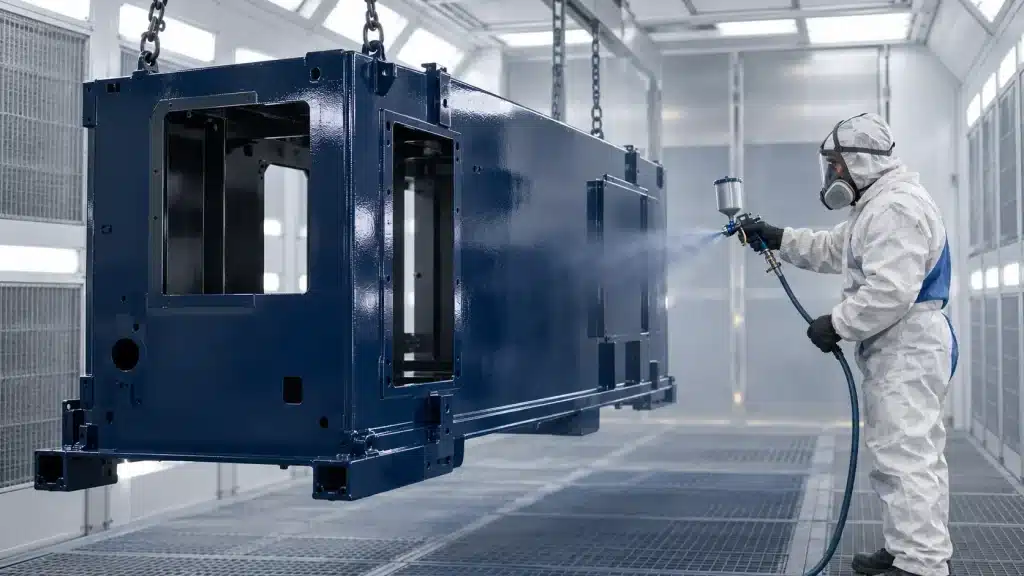
Nova Fabrication’s wet painting service can be incorporated into a complete manufacturing route that includes fabrication, surface preparation, coating and final inspection.
1. Define the Substrate and Service Environment
The coating specification should begin with the material being painted. Carbon steel, galvanized steel, aluminum and stainless steel require different preparation and primer strategies.
The supplier should know:
- Base material and grade
- Material thickness
- Indoor or outdoor use
- Expected humidity and condensation
- Chemical exposure
- UV exposure
- Operating temperature
- Coastal or industrial atmosphere
- Abrasion and impact risk
- Required design life
- Decorative expectations
For example, a steel machine enclosure used inside a dry factory does not normally require the same system as an outdoor frame exposed to rain, sunlight and industrial pollution.
If several coating processes are being considered, Nova Fabrication’s guide to surface coatings for metal products provides a broader comparison of protective finishing options.
2. Specify Surface Preparation
Surface preparation is one of the most important determinants of paint life. The surface must provide both cleanliness and sufficient adhesion for the selected primer.
Depending on the substrate and performance requirement, preparation may include:
- Removal of oil and grease
- Alkaline or solvent cleaning
- Removal of weld spatter
- Grinding of sharp edges
- Rust and scale removal
- Abrasive blasting
- Mechanical abrasion
- Chemical pretreatment
- Dust removal
- Controlled drying before painting
The required preparation should be written into the specification instead of using phrases such as “clean before painting.”
For fabricated steel parts, the drawing or purchase order should also clarify whether welds must be continuous, whether corners require rounding and whether visible grinding marks are acceptable. Coating tends to become thinner on sharp edges, so edge preparation can materially affect corrosion resistance.
A good specification might state:
Carbon steel surfaces shall be degreased and abrasive blasted to the project-defined cleanliness and surface-profile requirements. Dust, moisture, oil, scale and loose corrosion products shall be removed before primer application.
The precise cleanliness grade and profile should be selected according to the coating manufacturer’s technical data and the project’s governing standard.

3. Select the Correct Primer
The primer creates adhesion to the substrate and provides the first layer of corrosion protection. It should be compatible with both the base metal and the subsequent coats.
Epoxy Primer
Epoxy primers are widely used on industrial steel structures, machinery, enclosures and fabricated components. They generally offer:
- Strong adhesion
- Good chemical resistance
- Effective corrosion protection
- Compatibility with many industrial topcoats
However, epoxies can chalk or discolor under prolonged UV exposure. They are therefore commonly protected with a UV-resistant topcoat when used outdoors.
Zinc-Rich Primer
Zinc-rich primers can provide enhanced protection for properly prepared carbon steel. They are frequently considered for demanding industrial or exterior environments.
Their performance depends heavily on surface preparation, correct film thickness and compatibility with subsequent coats. A zinc-rich primer should not be substituted automatically for a standard primer without considering the complete coating system.
Epoxy Zinc Phosphate Primer
Zinc phosphate epoxy primers are commonly specified for general industrial corrosion protection. They can provide a practical balance among adhesion, application flexibility, protection and cost.
Etch or Specialty Primer
Aluminum, galvanized steel and other difficult substrates may require a specially selected primer or pretreatment. The coating supplier should confirm compatibility with the exact substrate and surface condition.
If a drawing simply states “one coat primer,” the supplier still has to make several assumptions. The specification should preferably identify:
- Primer chemistry
- Approved product or equivalent
- Color, when relevant
- Target DFT
- Compatible topcoat
- Required preparation
- Application restrictions
4. Choose the Topcoat According to Exposure
The topcoat provides the final color, gloss, weather resistance and much of the system’s resistance to handling and cleaning.
Polyurethane Topcoat
Two-component polyurethane topcoats are often selected for industrial products requiring:
- Good color retention
- UV resistance
- Smooth decorative appearance
- Chemical and abrasion resistance
- Outdoor durability
They are commonly combined with an epoxy primer for exterior industrial equipment.
Epoxy Topcoat
Epoxy topcoats offer good chemical and mechanical performance in many indoor environments. Their limitations under sunlight should be evaluated before outdoor use.
Alkyd Enamel
Alkyd systems can be economical and practical for mild indoor environments. They may be suitable where exposure is limited and very high chemical or weather resistance is unnecessary.
Acrylic and Other Specialty Coatings
Acrylics and other specialized coatings may be selected for fast drying, appearance, weather resistance or particular application requirements.
Nova Fabrication’s article on different types of wet paints explains the practical differences among common paint chemistries.

5. Specify Color Correctly
A phrase such as “paint blue” is not an adequate industrial color specification.
The purchase order or drawing should identify a recognized color reference, such as:
- RAL color number
- Pantone reference when technically suitable
- Customer-approved physical sample
- Paint manufacturer’s product and color code
RAL references are widely used for fabricated metal products, but the color code alone may not guarantee an identical visual result in every situation. Perceived color can be affected by:
- Gloss level
- Surface texture
- Primer color
- Film thickness
- Application method
- Lighting
- Viewing angle
- Production batch
- Substrate condition
For appearance-critical components, request a painted approval sample or first article before releasing the full production quantity.
The specification should also state whether color matching will be evaluated visually or instrumentally and whether an agreed color-difference tolerance applies.
6. Define the Gloss Level
Two components painted in the same RAL color can look different if their gloss levels are not the same.
Typical descriptions include:
- Matt
- Satin
- Semi-gloss
- Gloss
- High gloss
These words can be interpreted differently between paint manufacturers. For critical projects, define an agreed gloss range and the measurement geometry rather than relying only on a descriptive term.
Gloss can also influence practicality. Very glossy finishes may reveal dents, grinding marks and surface waviness more clearly, while heavily matt surfaces can be harder to clean in some environments.
7. Specify Dry Film Thickness
Dry film thickness, or DFT, is the thickness of a paint layer after its solvents have evaporated and the coating has cured.
DFT is usually expressed in micrometres, written as µm.
The specification should distinguish between:
- Primer DFT
- Intermediate-coat DFT
- Topcoat DFT
- Total system DFT
Illustrative Coating Build-Ups
Application | Example coating concept | Illustrative total DFT |
Mild indoor exposure | Primer plus industrial topcoat | 80–120 µm |
General industrial use | Epoxy primer plus durable topcoat | 120–180 µm |
Exterior exposure | Epoxy primer plus polyurethane topcoat | 140–220 µm |
Demanding environment | Multi-coat protective system | Project-specific |
These ranges are examples, not universal specifications. The correct thickness must be established using the service environment, required life, paint manufacturer’s data and applicable project standards.
More paint is not automatically better. Excessive thickness may cause:
- Solvent entrapment
- Slow curing
- Cracking
- Sagging
- Pinholes
- Poor intercoat adhesion
- Premature coating failure
Insufficient thickness can reduce coverage and expose the substrate to moisture and corrosive agents.
8. Clarify Whether the Requirement Is Per Coat or Total
A note stating “paint thickness: 120 µm” is ambiguous. It may refer to the complete coating system or only the topcoat.
A clearer specification would state:
- Epoxy primer: 60–80 µm DFT
- Polyurethane topcoat: 50–70 µm DFT
- Total system: 110–150 µm DFT
The project should also define whether the stated values are nominal targets, minimum values or acceptable ranges. Local readings, average readings and maximum thickness limits may require separate treatment.
9. Consider Part Geometry During Design
Complex geometry can make wet-paint application and inspection difficult. Common problem areas include:
- Deep recesses
- Closed cavities
- Narrow gaps
- Overlapping plates
- Sharp internal corners
- Threaded holes
- Bearing surfaces
- Electrical grounding points
- Sealing surfaces
- Identification plates
The drawing should identify areas that must remain unpainted and specify the required masking. Threads, machined fits and electrical contact surfaces often need protection during painting.
Drain and vent provisions may also be necessary where liquid, blasting media or cleaning chemicals could become trapped. Early design review through design for manufacturability can reduce coating defects and unnecessary manual work.
10. Define Curing and Handling Requirements
A coating can appear dry on the surface while remaining insufficiently cured for assembly, packaging or service.
The process plan should consider:
- Flash-off time between coats
- Minimum and maximum recoat intervals
- Ambient temperature
- Substrate temperature
- Relative humidity
- Ventilation
- Full-cure time
- Packaging and handling delay
Parts packed too early may suffer from blocking, marking or adhesion to protective materials. Heavy components should also have suitable lifting and hanging locations so coated surfaces are not damaged during handling.
11. Establish Inspection and Acceptance Criteria
A paint specification should explain how the finished product will be accepted.
Common inspection points include:
- Surface preparation condition
- Environmental conditions during application
- Wet film thickness during painting
- Dry film thickness after curing
- Color
- Gloss
- Coverage
- Adhesion when required
- Cure condition
- Visual defects
- Masking accuracy
- Repair quality
Visual acceptance criteria should address defects such as:
- Runs and sags
- Pinholes
- Blisters
- Craters
- Dry spray
- Dirt inclusions
- Orange peel
- Exposed substrate
- Uneven color
- Overspray on protected areas
Not every cosmetic variation affects coating performance. The acceptance level should reflect whether the component is a hidden structural bracket, a machine frame or a highly visible enclosure panel.

12. Plan Touch-Up and Repair
Welded assemblies and large structures may require coating repairs after transport, installation or final assembly.
The specification should define:
- Approved repair material
- Surface preparation for damaged areas
- Minimum and maximum repair size
- Required overlap onto intact coating
- Final thickness
- Color and gloss expectations
- Whether repaired areas must be visually invisible
Touch-up paint should be chemically compatible with the original system. An unapproved repair material may create adhesion problems or a noticeable color difference.
Wet Paint vs Powder Coating
Wet painting is particularly useful for:
- Large components that do not fit into a curing oven
- Heat-sensitive assemblies
- On-site repair
- Complex multi-layer corrosion systems
- Broad color and chemistry options
- Components requiring thin or highly controlled decorative finishes
Powder coating may offer advantages for high-volume parts, robust finishes and efficient factory application. The correct process depends on geometry, exposure, production quantity and finish requirements.
For a more detailed comparison, see Wet Painting vs Powder Coating. Nova Fabrication also provides a broader range of metal coating services for projects requiring alternative finishing methods.
Industrial Wet Paint Specification Checklist
Include the following information in the drawing, coating schedule or RFQ:
- Substrate material and grade
- Component dimensions and weight
- Indoor or outdoor service
- Corrosive, chemical and UV exposure
- Expected operating temperature
- Required surface preparation
- Primer type and DFT
- Intermediate coat and DFT, if applicable
- Topcoat type and DFT
- Total system DFT
- Color standard and code
- Gloss or texture
- Areas requiring masking
- Cosmetic acceptance level
- Required coating inspections
- Adhesion or corrosion testing requirements
- Repair procedure
- Packaging and handling requirements
- Approved paint manufacturer or equivalent-substitution rules
- Required inspection and coating records
Example Specification
A practical specification for a fabricated carbon-steel industrial enclosure might read:
Degrease and abrasive blast all carbon-steel surfaces to the coating manufacturer’s specified cleanliness and profile. Apply a compatible two-component epoxy primer at 60–80 µm DFT, followed by a UV-resistant polyurethane topcoat at 50–70 µm DFT. Total system thickness shall be 110–150 µm DFT. Final color shall be RAL 5010, semi-gloss. Mask all threads, grounding points, identification surfaces and specified mating faces. Finished surfaces shall be continuous and free from runs, exposed substrate, blistering and other visually unacceptable defects. Submit DFT inspection records with the shipment.
This example must still be adapted to the real environment, paint product and contractual standard.
Conclusion
A reliable industrial wet-paint specification must connect the service environment to the complete coating system. Defining only a paint color leaves critical decisions about surface preparation, primer chemistry, topcoat performance and film thickness open to interpretation.
The most effective specifications clearly state:
- What substrate will be painted
- How the surface will be prepared
- Which primer and topcoat system will be used
- What color and gloss are required
- How much dry film thickness is acceptable
- How the finished coating will be inspected
For a comparable technical and commercial quotation, send the component drawings, material information, exposure conditions, color requirements and coating acceptance criteria through Nova Fabrication’s request a quote page.