

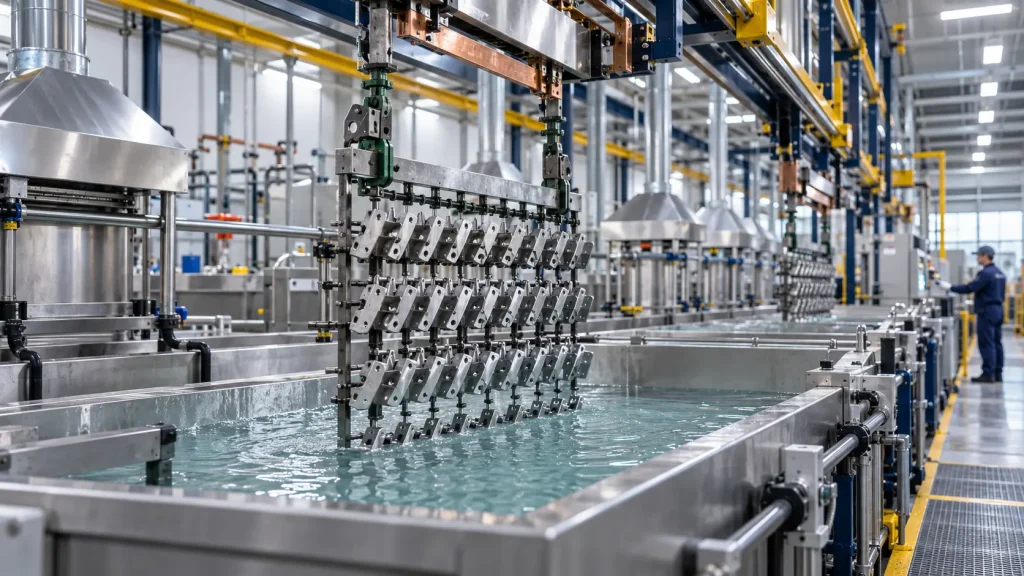
Electroplating Thickness Explained: Corrosion Resistance, Appearance and Cost
Electroplating applies a controlled metallic layer to a component using an electric current and an electrolyte solution. Depending on the selected metal, the coating can improve corrosion resistance, wear behavior, electrical performance and appearance.
However, specifying only “zinc plated,” “nickel plated” or “chrome plated” is not enough. The coating material, thickness, passivation, surface preparation and inspection requirements must be defined together.
A thicker coating can improve protection, but it may also increase cost, affect dimensional tolerances and create problems on threads or precision fits. The correct thickness is therefore the one that satisfies the functional requirement without creating unnecessary manufacturing risk.
What Is Electroplating Thickness?
Electroplating thickness is the distance between the outer surface of the deposited metal and the underlying component. It is normally measured in micrometres, written as µm.
During the electroplating process, the component is placed in an electrolyte and connected to an electrical circuit. Metal ions are deposited onto the surface, gradually forming a metallic coating.
The final thickness depends on:
- Plating time
- Current density
- Bath chemistry
- Component material
- Surface preparation
- Part geometry
- Rack position
- Agitation and solution flow
- Distance from the anode
- Required post-treatment
Thickness is not always perfectly uniform across the entire component. Corners, edges and areas exposed to higher current density may receive more coating, while deep recesses and internal surfaces may receive less.
How Thickness Affects Corrosion Resistance
For protective coatings such as zinc or zinc-nickel, increasing the coating thickness generally provides more material that can be consumed before corrosion reaches the base metal.
However, corrosion resistance is not controlled by thickness alone. It also depends on:
- Coating chemistry
- Porosity
- Surface cleanliness
- Passivation type
- Sealer or topcoat
- Environmental exposure
- Handling damage
- Test method
- Storage and packaging conditions
A thin, uniform and correctly passivated coating may perform better than a thicker coating containing pores, bare areas or poor adhesion.
This is why corrosion requirements should not be written only as a thickness value. When relevant, the specification should also identify the required corrosion test, test duration, acceptance criteria and permitted type of corrosion.
For a broader comparison of finishing options, see Nova Fabrication’s guide to surface coatings for metal products.
Thickness and Appearance
Electroplating is frequently selected because it can produce an attractive metallic appearance. Nickel and decorative chrome systems can create smooth, bright surfaces, while zinc coatings may be combined with different passivation colors and sealers.
Coating thickness can influence appearance, but it cannot hide every manufacturing defect.
The final finish is also affected by:
- Base-metal roughness
- Machining marks
- Scratches and dents
- Grinding direction
- Porosity
- Weld quality
- Cleaning and activation
- Undercoat selection
- Brighteners and bath condition
Decorative plating follows the existing surface more closely than a thick paint or powder coating. If the component requires a premium reflective finish, polishing or surface refinement may be necessary before plating.
A thicker decorative coating does not automatically create a smoother component. If the base surface is poor, the coating may make defects more visible rather than conceal them.

Typical Electroplated Coating Choices
Coating | Common purpose | Thickness consideration |
Zinc | Sacrificial corrosion protection for steel | Selected according to environment and passivation |
Zinc-nickel | Higher corrosion resistance in demanding applications | Requires controlled alloy composition and post-treatment |
Nickel | Appearance, wear resistance and undercoating | Thickness affects barrier protection and finish |
Decorative chrome | Bright appearance over suitable underlayers | Usually part of a multilayer system |
Hard chrome | Wear resistance and dimensional restoration | May require grinding after plating |
Copper | Undercoat, conductivity or surface build-up | Often used as one layer in a multilayer system |
The appropriate process depends on the substrate, geometry and service conditions. Nova Fabrication’s wider coating services include alternatives for projects where electroplating is not the most suitable finishing method.
Why More Thickness Is Not Always Better
Increasing electroplating thickness normally requires additional processing time and deposited metal. It may also increase the risk of dimensional and surface-related problems.
Excessive coating thickness can affect:
- Thread engagement
- Hole diameter
- Bearing fits
- Sliding surfaces
- Electrical contact points
- Sealing interfaces
- Assembly clearances
- Edge build-up
- Surface roughness
- Production cost
For precision components, the engineering drawing should clarify whether the stated dimension applies before or after plating.
For example, a shaft manufactured to its final nominal size and then plated may no longer fit its mating component. Conversely, a bore may become smaller after coating.
This is particularly important for custom fasteners, where excessive coating can interfere with threads, recesses and controlled bearing surfaces.
Part Geometry Causes Thickness Variation
Electrical current does not distribute equally across every area of a complex component.
Plating tends to build more heavily on:
- Sharp edges
- Corners
- External projections
- Areas close to the anode
It may build less effectively in:
- Deep holes
- Recesses
- Internal corners
- Shielded surfaces
- Long tubes
- Closely spaced features
This effect is sometimes described as throwing power: the ability of a plating process to deposit metal into areas with less favorable electrical conditions.
If a component has difficult geometry, the supplier may need special racks, auxiliary anodes, shields or process adjustments. A single nominal thickness value may therefore be insufficient. The drawing should identify the significant surfaces where the requirement must be achieved.
How Thickness Affects Cost
Electroplating cost is influenced by much more than the amount of deposited metal.
The main cost drivers include:
- Plating material
- Required coating thickness
- Processing time
- Component surface area
- Part geometry
- Racking or barrel processing
- Cleaning and activation
- Masking
- Passivation and sealing
- Heat treatment
- Inspection and testing
- Wastewater treatment
- Production quantity
A thicker coating generally increases bath time and material consumption. But complicated masking or inspection requirements may have a greater cost impact than a small increase in thickness.
Very low-volume components can also be expensive because process setup, bath control and testing costs are divided across fewer parts.
Thickness Measurement and Inspection
Electroplating thickness can be evaluated using several methods, depending on the coating and substrate.
Common methods include:
- X-ray fluorescence measurement
- Magnetic or electromagnetic gauges
- Coulometric testing
- Microscopic cross-section analysis
- Mass-based calculations
Not every method is suitable for every coating system. Multilayer nickel-chrome systems, thin decorative coatings and complex alloy deposits may require more specialized measurement.
The inspection plan should define:
- Minimum or target thickness
- Measurement method
- Significant surfaces
- Number of readings
- Sampling quantity
- Permitted variation
- Required inspection records
Without this information, the supplier may measure only an easily accessible flat surface that does not represent the critical functional area.

Special Consideration for High-Strength Steel
Some high-strength steel components can be susceptible to hydrogen embrittlement during cleaning and electroplating.
Depending on the material strength, manufacturing route and governing specification, the process may require:
- Controlled cleaning procedures
- Restrictions on acid exposure
- Post-plating hydrogen-relief baking
- Defined time between plating and baking
- Process documentation
- Mechanical testing
This requirement should be identified before quotation. It should not be added after production has started because it can affect the entire plating route, price and delivery time.
Electroplating vs Hot-Dip Galvanizing
Electroplated zinc coatings are generally thinner and smoother than hot-dip galvanized coatings. This can make electroplating suitable for smaller components, fasteners, brackets and parts with tighter dimensional requirements.
Hot-dip galvanizing normally creates a much heavier zinc coating and is often selected for structural steel and outdoor fabrications. More information is available in Nova Fabrication’s guide to hot-dip galvanizing and corrosion protection.
The two processes should not be selected based only on appearance or initial cost. Component size, exposure, dimensional tolerance and required service life must all be evaluated.
Electroplating RFQ Checklist
Include the following information when requesting a quotation:
- Base material and grade
- Component drawing and revision
- Dimensions before or after plating
- Required plating metal
- Minimum or target thickness
- Significant surfaces
- Passivation and sealer requirements
- Color and appearance
- Corrosion-test requirement
- Areas requiring masking
- Thread and fit requirements
- Hydrogen-relief requirements
- Inspection method
- Sampling plan
- Required certificates and reports
- Production quantity
- Packaging requirements
Conclusion
Electroplating thickness affects corrosion resistance, appearance, dimensions and cost, but it should never be specified in isolation.
A complete specification should connect:
- The coating material
- The required thickness
- The service environment
- The component geometry
- Post-treatment and passivation
- Inspection and acceptance criteria
The best coating is not necessarily the thickest one. It is the coating system that provides the required performance while preserving tolerances, assembly function and commercial efficiency.
For a project-specific coating and manufacturing review, submit your drawings, material requirements and expected environment through Nova Fabrication’s request a quote page.