
Powder Coating Pretreatment: Why Cleaning and Phosphating Determine Coating Life
A powder-coated part may look perfect when it leaves the production line but begin to blister, peel or rust after a short period in service. In many cases, the powder itself is not the main cause of failure. The problem began before the powder was applied.
Oil, welding residue, dust, rust, fingerprints and poorly rinsed chemicals can prevent the coating from bonding correctly to the metal. Even high-quality powder and accurate oven curing cannot compensate for an improperly prepared surface.
Effective pretreatment creates a clean, chemically stable surface that allows the coating to adhere and resist under-film corrosion. For many steel components, this process includes cleaning, rinsing and phosphating before Nova Fabrication’s electrostatic powder coating service is applied.
Why Powder Coating Needs Pretreatment
Powder coating is applied electrostatically and then cured into a continuous polymer film. The coating may provide colour, impact resistance, weather protection and corrosion resistance.
However, the coating still depends on the surface beneath it.
Pretreatment has three main purposes:
- Remove contamination from the metal
- Create a surface that supports coating adhesion
- Improve corrosion resistance if the coating is scratched or damaged
Without proper pretreatment, the powder may adhere to oil, dirt or loose oxide rather than directly to the substrate. When the contamination moves or breaks down, the coating can separate from the metal.
Common symptoms of poor pretreatment include:
- Peeling around edges and holes
- Blistering
- Rust spreading beneath the coating
- Poor adhesion after impact
- Craters or fisheyes
- Uneven colour or gloss
- Premature failure near welds
- Corrosion beginning at scratches
What Must Be Removed Before Powder Coating?
Fabricated metal parts can carry several types of contamination.
Typical examples include:
- Cutting and machining oil
- Drawing compounds
- Grease
- Dust and metal particles
- Fingerprints
- Mill scale
- Laser oxide
- Rust
- Welding spatter
- Grinding residue
- Marker ink
- Silicone-containing products
- Previous coatings
Different contaminants require different removal methods. An alkaline cleaner may remove oil effectively but will not necessarily remove heavy rust or mill scale. Mechanical blasting may remove oxide but can leave oil trapped on the surface if degreasing is not performed correctly.
The pretreatment process should therefore be selected according to the material, contamination level, part geometry and required service life.

Typical Powder Coating Pretreatment Stages
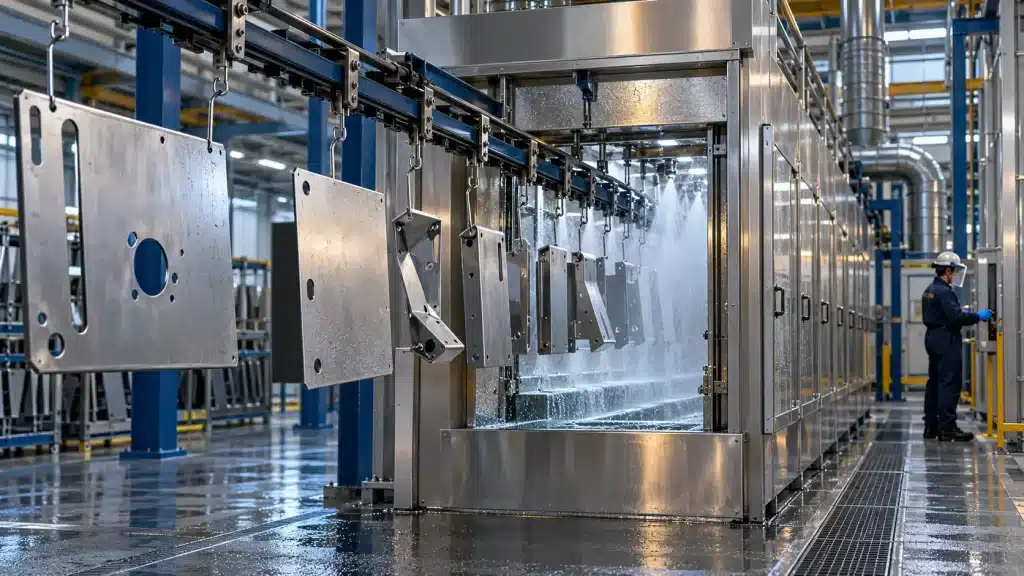
A pretreatment line may use spray cleaning, immersion tanks, manual preparation or a combination of methods.
Stage | Main Purpose |
Initial inspection | Identify oil, rust, weld residue and surface defects |
Degreasing | Remove oil, grease and organic contamination |
Rinsing | Remove loosened contamination and cleaning chemicals |
Descaling or etching | Remove rust, oxide or unstable surface layers |
Conversion treatment | Create a phosphate or alternative conversion layer |
Final rinsing | Remove residual chemicals and stabilize the surface |
Drying | Eliminate moisture before powder application |
Powder application and curing | Create and polymerize the final coating film |
The exact sequence can change depending on the substrate and performance requirements.
Why Cleaning Is More Than Washing the Part
Cleaning must remove contamination without leaving another contaminant behind.
If the cleaner is too weak, oil may remain on the surface. If it is too strong or poorly controlled, it may attack the substrate or create difficult-to-rinse residues.
Important process variables include:
- Cleaner concentration
- Bath temperature
- Contact time
- Spray pressure
- Water quality
- Contamination loading
- Part positioning
- Rinse efficiency
- Bath maintenance
Complex fabricated components require particular attention. Box sections, folded channels, overlapping joints and drainage holes may trap chemicals or rinse water.
Parts designed for coating should therefore include suitable drainage and hanging points. Nova’s DFM guide for sheet metal parts explains how manufacturing and finishing requirements can be considered during the design stage.
What Is Phosphating?
Phosphating is a chemical conversion process that reacts with the metal surface and forms a fine crystalline phosphate layer.
Unlike powder coating, the phosphate layer is not a thick decorative film. It acts as an intermediate layer between the substrate and the final coating.
For steel components, commonly used systems include iron phosphate and zinc phosphate.
Iron Phosphate
Iron phosphate is frequently used for indoor components and moderate corrosion-protection requirements.
Its advantages may include:
- Relatively simple processing
- Good powder coating adhesion
- Lower process complexity
- Suitability for many general industrial products
- Economical treatment of fabricated steel parts
Zinc Phosphate
Zinc phosphate can provide stronger corrosion performance for more demanding environments when correctly applied and controlled.
It may be selected for:
- Outdoor components
- Automotive parts
- Agricultural equipment
- Industrial machinery
- Products exposed to moisture
- Applications requiring improved under-film corrosion resistance
Zinc phosphate processes are generally more complex and require close control of bath chemistry, sludge, rinsing and operating conditions.
The correct choice depends on the substrate, exposure category, coating system and required performance—not simply on which process sounds more advanced.

Does Every Metal Need Phosphating?
No. Pretreatment must be compatible with the base material.
Phosphating is widely associated with steel, but other substrates may require different preparation methods.
Examples include:
- Carbon steel: degreasing, rust removal and iron or zinc phosphate may be appropriate.
- Galvanized steel: cleaning and a compatible conversion treatment must account for the zinc surface.
- Aluminium: cleaning, etching and an aluminium-compatible conversion coating are generally used instead of applying a standard steel phosphate process.
- Stainless steel: cleaning, abrasion or blasting may be required to create sufficient adhesion, depending on the coating specification.
Modern zirconium or silane-based conversion treatments may also be considered for certain substrates and performance targets.
Nova Fabrication’s wider coating services allow the finish and preparation route to be evaluated according to the actual material and application.
How Pretreatment Improves Coating Life
Better Adhesion
A clean and converted surface provides a more stable base for the cured powder film. This helps the coating resist peeling, impact and mechanical damage.
Improved Corrosion Resistance
If moisture reaches bare metal through a scratch or damaged edge, a conversion coating can slow corrosion from spreading beneath the powder film.
More Consistent Appearance
Removing oil and residue helps reduce craters, fisheyes and local gloss variation.
Better Edge and Weld Performance
Edges, welds and heat-affected areas are common starting points for coating failure. Correct cleaning and pretreatment reduce—but do not completely eliminate—these risks.
Longer Maintenance Intervals
A well-prepared coating system can reduce premature repainting, replacement and field repair costs.
The overall corrosion performance still depends on coating chemistry, film thickness, curing, part design and service environment. Pretreatment is essential, but it is not the only variable.
Why Rinsing and Drying Matter
A good cleaning or phosphate bath can still produce poor results if rinsing and drying are neglected.
Residual chemicals may cause:
- Poor adhesion
- Blistering
- Staining
- Craters
- Reduced corrosion resistance
- Contamination of later process stages
Water quality is especially important during final rinsing. Dissolved salts left on the surface can attract moisture and contribute to under-film corrosion.
After rinsing, the component must be fully dried. Moisture trapped inside folds, cavities or welded sections may escape during curing and create coating defects.
Common Pretreatment Failures
1. Coating Over Oil
The powder may initially cover the contaminated area but later peel or crater.
2. Incomplete Rust Removal
Loose rust and scale create an unstable base beneath the coating.
3. Poor Rinsing
Cleaner or phosphate residue remains on the surface and interferes with adhesion.
4. Flash Rust Before Coating
Clean steel can begin to oxidize if it remains wet or is stored too long before coating.
5. Incorrect Chemistry for the Substrate
A treatment designed for carbon steel may not provide suitable performance on aluminium or galvanized steel.
6. Touching Clean Parts
Bare-hand contact can transfer oil and salts back onto the prepared surface.
7. Trapped Chemicals
Closed corners, seams and poorly positioned drainage holes may retain treatment chemicals.
8. Coating Without Pretreatment Control
The process may appear visually acceptable while bath concentration, pH, temperature or rinse quality has moved outside the intended operating window.
Pretreatment vs Powder Selection
A premium exterior powder does not automatically create an exterior-grade coating system.
Coating life depends on the complete system:
- Substrate
- Surface condition
- Pretreatment
- Conversion layer
- Powder chemistry
- Film thickness
- Oven temperature
- Metal temperature
- Curing time
- Part geometry
- Environmental exposure
Polyester powder may be selected for UV exposure, while epoxy systems can offer strong chemical and corrosion resistance in suitable environments. However, neither performs as intended if applied over contamination.
If the decision is between liquid and powder coatings, Nova’s guide to wet painting vs powder coating explains the differences in finish, durability and production requirements.

How Should Pretreatment Quality Be Verified?
Quality control should be matched to the project risk and specification.
Possible controls include:
- Visual cleanliness inspection
- Water-break testing
- Bath concentration monitoring
- pH and temperature recording
- Conversion coating checks
- Dry-film thickness measurement
- Cross-cut adhesion testing
- Impact testing
- Bend testing
- Cure verification
- Salt-spray or cyclic corrosion testing
- Production coupons or sample panels
A salt-spray result should not be treated as a universal prediction of real outdoor life. It is a comparative laboratory test that must be interpreted together with the coating specification and exposure conditions.
Nova’s broader guide to surface coatings for metal products provides additional guidance on matching coatings to corrosion and appearance requirements.
Powder Coating RFQ Checklist
A complete coating request should include:
- Base material and grade
- Part dimensions and weight
- Indoor or outdoor use
- Environmental exposure
- Required colour and gloss
- Texture requirements
- Powder chemistry where specified
- Pretreatment requirement
- Corrosion-performance target
- Required film-thickness range
- Areas to be masked
- Threads and electrical contact points
- Cosmetic inspection standard
- Adhesion-testing requirement
- Corrosion-testing requirement
- Packaging and handling expectations
- Annual production quantity
For fabricated products, it is also useful to identify welds, enclosed cavities, drainage points and surfaces that will be visible after assembly.
Nova’s custom metal manufacturing services can coordinate cutting, bending, welding, surface preparation and coating within the complete production route.
Conclusion
Powder coating durability begins long before powder reaches the spray gun.
Cleaning removes oils, dust, oxide and fabrication residue. Rinsing prevents chemical contamination from moving into later stages. Phosphating or another suitable conversion treatment improves adhesion and helps limit under-film corrosion. Correct drying then prepares the component for powder application and curing.
The best pretreatment system depends on the substrate, environment and expected coating life. Carbon steel, galvanized steel, aluminium and stainless steel should not automatically receive the same chemical treatment.
To review the most appropriate preparation and coating route for a fabricated metal product, submit the material, drawings, exposure conditions and performance requirements through Nova Fabrication’s request a quote page.