
How Zinc Coating Thickness Affects the Service Life of Galvanized Steel
Hot-dip galvanizing protects steel by covering it with a metallurgically bonded zinc coating. This zinc layer acts as both a physical barrier and sacrificial protection. If the surface is scratched, the surrounding zinc can continue protecting the exposed steel within a limited area.
However, not every galvanized component provides the same service life. One of the most important variables is zinc coating thickness.
In general, a thicker zinc coating contains more material that can be gradually consumed before the underlying steel becomes vulnerable. But coating thickness alone does not determine durability. Environmental exposure, steel chemistry, part geometry, drainage and manufacturing quality must also be considered.
What Is Zinc Coating Thickness?
Zinc coating thickness is the distance between the outer surface of the coating and the underlying steel. It is normally measured in micrometres, written as µm.
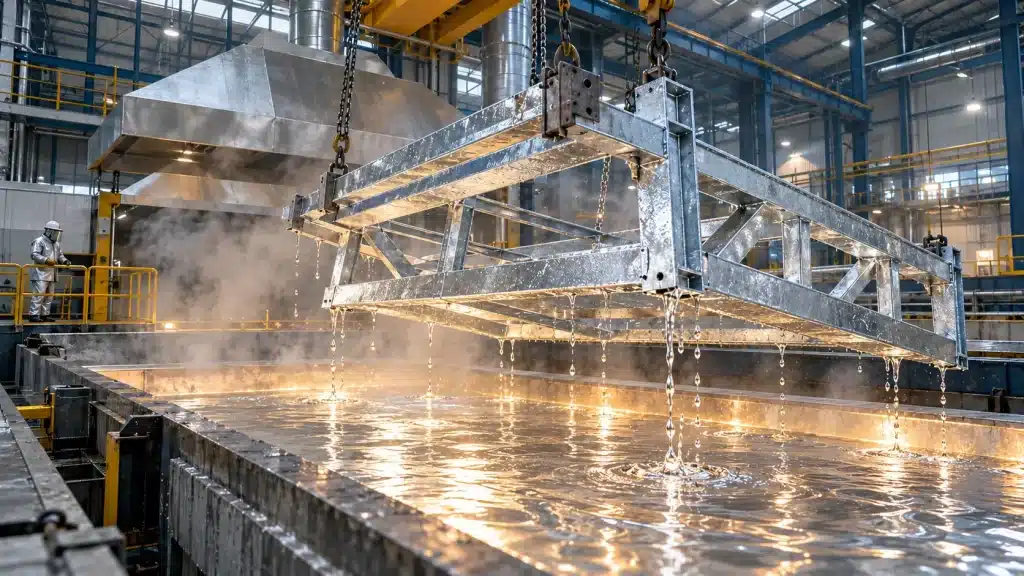
During hot-dip galvanizing, fabricated steel components are cleaned, prepared and immersed in molten zinc. A series of zinc–iron alloy layers forms on the steel, followed by an outer zinc-rich layer.
The resulting thickness depends on several factors:
- Steel composition and silicon content
- Base-metal thickness
- Surface roughness
- Pickling and preparation conditions
- Immersion time
- Zinc bath temperature
- Withdrawal speed
- Part geometry
- Galvanizing process control
This means the fabricator cannot always select an exact thickness in the same way a liquid-paint applicator selects a target dry film thickness. The steel and galvanizing process influence how the coating develops.
Why a Thicker Zinc Coating Usually Lasts Longer
Zinc gradually reacts with the surrounding atmosphere. Over time, a portion of the coating is consumed while protecting the steel.
Within the same environment, service life is therefore broadly related to the amount of zinc available. If one coating is significantly thicker than another and both are exposed to identical conditions, the thicker coating will generally protect the steel for longer.
A simplified way to understand the relationship is:
Estimated service life ≈ zinc coating thickness ÷ local zinc corrosion rate
This is only an engineering concept—not a guaranteed life calculation. Real corrosion rates vary with humidity, salt, pollution, temperature, sheltering and maintenance conditions.
A 100 µm coating should not automatically be described as lasting twice as long as a 50 µm coating without first defining the exposure environment.
Environment Can Matter More Than Thickness
The same galvanized component may perform very differently in two locations.
Exposure environment | Typical corrosion pressure | Important considerations |
Dry indoor facility | Low | Condensation and chemical contact |
Rural outdoor environment | Low to moderate | Rainfall, humidity and drying cycles |
Urban or industrial area | Moderate to high | Airborne pollutants and surface deposits |
Coastal environment | High | Chlorides, salt spray and persistent moisture |
Chemical-processing area | Project-specific | Chemical concentration, splash and fumes |
Buried or submerged service | Highly variable | Soil chemistry, water composition and oxygen |
A moderately thick coating in a dry indoor facility may remain functional for decades. The same coating close to the sea or in an aggressive industrial atmosphere may be consumed considerably faster.
For this reason, buyers should specify the operating environment instead of requesting only “galvanized steel.” Nova Fabrication’s overview of surface coatings for metal products explains how exposure conditions influence coating selection.

Steel Thickness and Galvanized Coating Requirements
Galvanizing standards generally establish coating requirements according to factors such as steel type and section thickness. Heavier structural sections often develop thicker coatings than thin sheet components.
The project specification should identify:
- Applicable galvanizing standard
- Steel product type
- Material thickness
- Minimum coating thickness or coating mass
- Inspection method
- Number and location of readings
- Repair acceptance criteria
It is important not to copy one thickness requirement across every part in an assembly without checking whether it is suitable for thin sheet, plate, tube, fasteners and cast components.
The selection of the base material also affects the complete fabrication route. For structural projects, the comparison between S235 and S355 structural steel can help engineers evaluate strength, weldability and finishing requirements together.
Average Thickness vs Local Thickness
A galvanizing report may include both local and average measurements.
- Local coating thickness refers to measurements taken within a defined reference area.
- Average coating thickness represents the average of the required readings across the component or inspection area.
This distinction matters because corrosion protection can be limited by areas where the coating is unusually thin. A high average result does not always compensate for poorly coated edges, tight gaps or damaged areas.
The inspection plan should therefore define:
- How many components will be tested
- Where measurements will be taken
- How many readings are required
- Minimum local thickness
- Minimum average thickness
- Instrument calibration requirements
- Treatment of unusual or inaccessible surfaces
Why Excessive Thickness Is Not Always Better
A thicker coating can improve corrosion life, but uncontrolled excessive thickness may create other problems.
Very thick or brittle coatings may be more vulnerable to:
- Flaking during handling
- Edge damage
- Cracking under severe impact
- Fit-up problems
- Reduced thread functionality
- Dimensional interference
- Rough or uneven appearance
The objective should be a sound, continuous and standard-compliant coating—not simply the highest possible reading.
Threads, mating surfaces, holes and tight-tolerance interfaces require particular attention. Allowances may need to be included during custom metal manufacturing so that the galvanized components still assemble correctly.
Part Design Influences Coating Quality
Good galvanizing performance begins during product design. Zinc must be able to reach all surfaces, while air, cleaning fluids and molten zinc must enter and drain safely.
Important design considerations include:
- Vent holes in hollow sections
- Drainage openings at low points
- Avoidance of sealed cavities
- Access to internal surfaces
- Suitable weld design
- Removal of welding slag and paint
- Control of overlapping surfaces
- Distortion risk in thin or asymmetrical fabrications
- Adequate clearance for fasteners and moving parts
Poor drainage can create thick runs, trapped zinc or uncoated areas. Sealed sections can also create serious processing hazards.
Designing only for structural performance and considering galvanizing at the end of the project often results in avoidable modifications and inconsistent coating quality.
Measuring Galvanized Coating Thickness
Coating thickness is commonly checked with a calibrated magnetic gauge. The instrument measures the non-magnetic zinc layer over the magnetic steel substrate without damaging the coating.
Reliable inspection requires:
- A calibrated instrument suitable for zinc on steel
- Clean measurement surfaces
- Multiple readings rather than one isolated value
- Measurements away from obvious spikes or zinc droplets
- An agreed sampling plan
- Comparison with the applicable standard and purchase specification
Visual inspection should accompany thickness measurement. A coating may meet the thickness requirement but still contain drainage defects, sharp zinc projections, bare areas or transport damage.
Where documentation is required, the RFQ should request a coating inspection report rather than assuming one will automatically be supplied.

Can Galvanized Steel Be Painted?
Yes. A paint system can be applied over galvanized steel to create a duplex coating system.
This approach may be selected when the project requires:
- Additional corrosion protection
- A specific color
- Improved architectural appearance
- Identification or safety marking
- Longer maintenance intervals
However, fresh galvanized surfaces require correct preparation and a compatible primer. Applying ordinary paint directly onto an unsuitable surface may cause adhesion failure.
Nova Fabrication’s coating services include different protective and decorative options that can be assessed according to the material, exposure and required appearance.
What to Include in a Galvanizing RFQ
To obtain technically comparable quotations, provide:
- Steel grade and product form
- Material thickness
- Part dimensions and weight
- Drawings and 3D models
- Required galvanizing standard
- Minimum local and average coating requirements
- Exposure environment
- Venting and drainage details
- Masked or uncoated areas
- Thread and fit requirements
- Appearance expectations
- Inspection and reporting requirements
- Repair method and acceptance criteria
- Packaging and transport requirements
A quotation based only on part weight and the instruction “hot-dip galvanized” may not include the same preparation, inspection or documentation scope from every supplier.
Conclusion
Zinc coating thickness has a direct influence on the potential service life of galvanized steel because it determines how much protective zinc is available to resist corrosion.
However, thickness should never be evaluated alone. A durable galvanized component also depends on:
- Environmental corrosivity
- Steel chemistry
- Surface preparation
- Part geometry
- Venting and drainage
- Coating continuity
- Handling and installation
- Inspection quality
The most reliable specification combines a suitable coating thickness with the correct galvanizing standard, galvanizing-friendly component design and clearly defined acceptance criteria.
For a project-specific review, drawings and exposure information can be submitted through Nova Fabrication’s request a quote page.